


 Francais
 Deutsch
 Italiano
Refine Your Search
Sattahip Thailand 1969 stock footage and images
- Showing 19 to 24 of 1159 results more
more Hide
Hide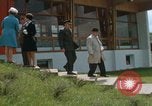
Former war correspondents visit Normandy American cemetery and Memorial in Normandy, France and present a time capsule
Former U.S. war correspondents in Normandy, France to mark the 25th anniversary of Allied invasion of France during World War II. Correspondents outside a cafe near Normandy as they prepare to leave a luncheon. Retired General J. Lawton Collins is escorted by a uniformed U.S. Army officer to a waiting car. View of the Normandy coastline from a moving car. American flag on the bonnet of a car as it drives along the road. Graves at the Normandy American Cemetery and Memorial. Wife of a correspondent walks amidst graves at the cemetery. Grave of Wesley J. Rubenstein with a Star of David Jewish headstone. An F-4E Phantom aircraft in flight overhead. American and French flags hoisted at the cemetery. Correspondents tour the cemetery. View of a plaque ad time capsule unveiled by the correspondents and presented that day. It says, "In memory of General Dwight D. Eisenhower and the forces under his command, this sealed capsule containing news reports of the June 6, 1944 Normandy Landings is placed here - by the newsmen who were there. June 6, 1969." A man with a baby tied to his back. Correspondents speak during the ceremony. A photographer clicks pictures.
U.S. Army helicopters and defensive positions of the 54th Field Artillery Group during the Vietnam War
A helicopter is seen in flight, high overhead. Scene shifts to an OH-6 helicopter of the U.S. Army 54th Field Artillery Group, parked on the ground at a Base Camp, during the Vietnam War. Camera focuses on a 155mm M109 howitzer in a dugout position. U.S. troops standing atop the M109 and others look over their location, where mounds of earth are piled up from excavated defensive positions. Closeup of soldiers taking measurements for the defenses. another view of two persons strapping in an OH-6 helicopter. Soldiers working on the defense preparations, nearby. The helicopter takes of raising lots of dust. Camera follows it as it climbs and passes over the U.S. base, showing various buildings and other features of the base. (Note: Reportedly, the 54th Artillery Group was deactivated in November 1969 and all aircraft were given to other units.)
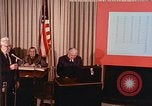
The Selective Service System (SSS) holds a draft lottery to induct men into the Vietnam War.
The December 1, 1969 Draft Lottery for the year 1970 is held at the United States Selective Service headquarters in Washington, D.C. The draft lottery is led by General Lewis B. Hershey, Selective Service Director. The ceremony begins with a benediction, and then an official pours slips of paper containing birth dates into a glass bowl. Congressman Alexander Pirnie of New York draws the first birth date. He declares the date, September 14, and another man pastes the birth date next to a number on a board. Members of the Selective Service Youth Advisory Committee draw additional birth dates and the board is filled out with the draft sequence.
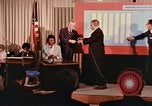
Lottery selection of potential soldiers for the Vietnam War by the Selective Service System (SSS) in United States.
The Selective Service System (SSS) holds a draft lottery in 1969. The Lottery selection system chooses soldiers for induction into the Vietnam War. Members of the Selective Service Youth Advisory Committee participate in the draft, choosing birth dates from a glass bowl. The dates are read aloud and posted on the draft board. One young man protests the Vietnam War by flashing a Peace sign with his fingers every time he chooses a draft number.
UN 18-Nation Committee on Disarmament meets in Geneva; Hundreds of thousands in Washington DC protest Vietnam war
Meeting of the Eighteen-Nation Committee on Disarmament (United Nations) on January 27, 1966, at the Palace of Nations, Geneva, Switzerland. Seen among others are: William C. Foster, U.S. representative,and Director of the Arms Control and Disarmament Agency; Soviet chief negotiator, S.K.Tsarapkin; and British representative, Lord Chalfont (Alun Arthur Gwynne Jones, Baron Chalfont). Views of the meeting starting with Mr. Tsarapkin as the Chair. Camera pans interior of the Palace of Nations. View of the outside of the building. Press briefing with closeup of Mr. Tsarapkin as he voices the USSR support for discussion of draft treaties to stop the spread of nuclear weapons. Closeups of U.S. delegate William Forster standing by a lake as narrator speaks of the hope for progress. Next scene is three years later: shows Joan Baez singing her song "Last night I had the strangest dream," at a Moratorium to End the War in Vietnam rally near the Washington Monument, in Washington, DC, on November 15, 1969. This gathering of hundreds of thousands of antiwar citizens, in peaceful protest, was organized by the National Mobilization Committee to End the War in Vietnam. View of peaceful crowd of demonstrators gathered on the Washington Monument Grounds, listening to Baez sing. Next scenes show views of various boy and girls all over the world. Children of many races and nationalities are seen including Indian, Middle eastern, African, Asian, European, and American children. Some of the children are smiling or playing. Some are standing near a radar or radio control tower. One boy is standing behind barbed wire. Clip ends with scene inside a United States nuclear missile silo (possibly Minuteman), with a team of two Air Force personnel on duty, always at the ready to launch missiles if required. Closeup view of a 24 hour clock is seen ticking, and one of the personnel in the silo watches it closely. A key hangs from the clock. Another airman is seated at a desk in the missile silo.

Explosion of nuclear device, resulting red colored clouds, fire ball, fading to darkness in night sky
Explosion of an unknown/unidentified atomic bomb or nuclear bomb device during a nuclear weapon test. Bright flash illuminates clouds with orange and red. Ball of fire erupting upward in night sky. Entire sky is illuminated. Explosion fading and sky growing darker around orange and red area at center of explosion. Part of a 1969 U.S. Air Force film reel, but the year and location of the test is unknown.