


 Francais
 Deutsch
 Italiano
Refine Your Search
Seoul Korea 1960 stock footage and images
- Showing 67 to 72 of 2020 results more
more Hide
Hide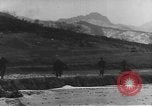
U.S. 8th Army forces battle their way to Seoul during the Korean War. Lieutenant General Ridgeway takes command.
Operations of United States troops in Korea during the Korean War. U.S. soldiers advance towards a battlefield. Smoke from firing and bombardment on the battlefield. Wrecked equipment and rubble on the ground. Prisoners of war are questioned by a soldier. Tanks advance on the battlefield and soldiers fire rifles. Mountains in the foreground. American forces enter the capital city of Seoul and set up a 155mm howitzer next to Government-General of Chōsen Building (also called the Japanese General Government Building or the Seoul Building, built by the Japanese in 1926). View of the sandbagged howitzer firing at North Korean targets. An aerial view of the battlefield. U.S. Army Lieutenant General General B. Matthew Ridgway, newly appointed Commanding General of the U.S. Eighth Army, arrives on a U.S. C-54 transport plane, to assume command in Seoul. As he steps from the plane, he is greeted by Major General William M. Hogen and another officer.
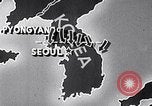
Attack by North Korea and U.S. attempt in United Nations' Security Council meeting to protect South Korea.
Start of Korean War. South Korea is attacked by Communist North Korea. Map shows division of Korea and capital of North and South Korea as Pyongyang and Seoul. Animated arrows shows attack of North Korea to South Korea. Troops of Korean Republican Army in the South mobilizing in citiies and heading to the front. South Korean soldiers fire rifles and artillery from trenches and hills. Smoke is seen among mountain ranges during battle. Soldier looks through binoculars. Next scene is in the United States, in Lake Success, New York, where guards at the United Nations simultaneously raise flags of many nations at the United Nations. South Korean ambassador Chang Myon is seen at an Emergency meeting of the Security Council of the UN. Secretary of UN, Trygve Lie states the situation is a as threat to world peace and calls for acceptance of the U.S. demand to reestablish peace. All 9 members present raise their hands in acceptance. Next scene is back in South Korea. Scenes of displaced civilian refugees including women and children. Many are gathered together. Man helps old woman to walk. Two Korean refugee boys stand side by side as one child eats bread. Next scene is again at the United Nations. Empty seat of representative of the Soviet Union is shown. U.S. Ambassador to the UN, Warren Austin, speaks and asks that the UN members vote to to assist South Korea, repel the armed attack by North Korea, and bring peace. Camera shows Security Council delegates voting, as 7 out of 8 representatives raise their hands in acceptance.
UN troops withdraw to north of Seoul after the Chinese Spring offensive during the Korean War.
United Nation troops face the Spring offensive during the Korean War. UN forces move north of Seoul, Korea in a defensive position after the Chinese launch a Spring offensive. Convoy of truck and jeeps move. Engineers plant land mines in a field along the Lincoln Line. Barbed wire fences being put up in the mine field. Men at a 75 mm recoilless rifle on hillside as it covers the valley. Soldiers look through binoculars and artillery being fired. Armored Patrol returns to Lincoln Line. Artillery being fired outside Capitol building in Seoul. American soldiers dig out emplacements. Sandbags being piled up. UN soldiers clean their rifles in sandbagged positions.
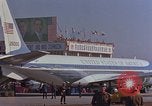
U.S. President Lyndon B Johnson visits Korea and returns back to United States.
United States President Lyndon B. Johnson visits Korea after attending the Manila Summit Conference. View of the United States Air Force One presidential plane after landing in Seoul. South Korean Air Force performs aerobatics to welcome President Johnson. Korean crowd welcomes President Lyndon B Johnson. Koreans hold American flags in hand. School girls, wearing traditional chima jeogori, sing to welcome the President. President Johnson reviews Korean troops. Sign says “Welcome President and Mrs. Johnson”. President Johnson holds both American and Korean flags in front of crowds. President Johnson leaves in his aircraft after his visit in Korea. Koreans sing the traditional “Arirang” song upon President Johnson’s departure from Korea. The President talks about his visit to different nations and the local people he met.
Korean hardships under Japanese occupation and official Japanese annexation of Korea in 1910
Korean propaganda film depicting Japanese involvement in Korea, from end of Russo-Japanese war through post annexation in 1910. Landscape scenes of Korea. A 4-stacker Japanese troop ship, in a Korean harbor, flying the rising sun flag. Japanese troops disembarking, and marching off the pier. Japanese atrocities committed against the Korean people. Still pictures of Japanese officers. Slate highlights August 10, 1910, the date that Japan officially annexed Korea. Images show Korean flag being replaced by that of Japan. Panning views over rooftops of residential neighborhood and buildings in Nam San Dong, Seoul. Scene shifts to poorer rural area village with straw-roofed huts. Men till rice fields and irrigate fields by manpower alone. Views of various farm crops in the fields. Women are seen harvesting crops. In village, peasants thresh grains by hand. Officials arrive to weigh and take rice from village.Narrator states that the Japanese were everywhere and treated the Korean people very badly.Burlap bags of grain piled on cart. Korean workers load farm products for shipment to Japan. Various cargoes of Korean products being moved by rail to ports for shipment to Japan. Korean women and some children at work in fabric mills. Korean men at work in smelting plant. Many Korean men laboring on rock piles, and carrying heavy logs. One man collapses. Another collapses while working in surface mining. Supervisor chases others who try to assist him. (Note:This film, which contains some very old historic footage, is attributed to the War Department Military Intelligence Division, and was probably produced circa 1940. It is listed as 1910 because Japanese annexation and related events are included herein.)
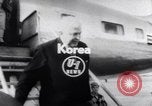
United States Secretary of Defense Mr. Charles E Wilson arrives with his wife in Seoul
United States Secretary of Defense Charles E. Wilson accompanied by Mrs. Jessie Curtis Wilson arrives in Seoul, South Korea. They get down from an airplane. He is greeted by United States Commander of the Far East Forces General Maxwell Taylor, and Ambassador Ellis O. Briggs. They meet other people at the airport who had come to welcome them. People welcome them with bouquets of flowers. Mr. Wilson talks with other people.