


 Francais
 Deutsch
 Italiano
Refine Your Search
Seoul Korea 1960 stock footage and images
- Showing 757 to 762 of 2020 results more
more Hide
Hide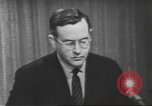
Vice President Nixon and Senator Kennedy debate over Quemoy and Matsu issue prior to presidential elections in the U.S.
The fourth presidential election debate held between Democratic nominee Senator John F. Kennedy and Republican nominee U.S. Vice President Richard Nixon in New York, United States on 21st October 1960. ABC News correspondent Quincy Howe speaks during the debate and allows NBC correspondent John Chancellor to pose a question to Richard Nixon a . Correspondent Chancellor asks a question about Quemoy and Matsu issue. Vice President Nixon points out inconsistency of Senator Kennedy. He further explains it by saying that Senator Kennedy signed a resolution in 1955 which gave the president the power to use United States forces to defend Formosa (Taiwan) and offshore islands. But he also voted for an amendment which was lost, an amendment which would have drawn a line and left out those islands. Vice President Nixon supports President Eisenhower's position. Correspondent Howe asks Senator Kennedy to comment on the topic. He speaks about President Eisenhower sending a mission to persuade Chiang Kai-shek in the spring of 1955 to withdraw from Quemoy and Matsu because they were exposed. The President was unsuccessful. He refers to the fact that in 1958, as a member of the Senate Foreign Relations Committee, he was very familiar with the position that the United States took in negotiating with Communist China (PRC) on these two islands. He further that the U.S. was unable to persuade China's Chiang Kai-Shek to withdraw and thus it was decided by the U.S. to defend the islands.
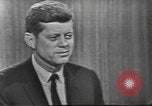
Senator Kennedy gives his closing statement during the fourth presidential election debate held in New York, United States.
The fourth presidential election debate held between Democratic nominee Senator John F. Kennedy and Republican nominee U.S. Vice President Richard Nixon in New York, United States on 21st October 1960. ABC news correspondent Quincy Howe asks Senator Kennedy to give his closing statement. Senator Kennedy says if he loses the election he would continue in the Senate to try and build a stronger country. He says that the year is of importance for the United States. He speaks about the present situation of the U.S. in regard to education, science, and diplomatic relations. He says that the Republican party has stood still really for twenty-five years and opposed all of the programs of President Roosevelt and others. He further says that the U.S. should get a party which believes in going ahead so that the country can reestablish its position in the world with strong defense, economic development, justice for people and should particularly to try to reestablish the atmosphere which existed in Latin America at the time of Franklin Roosevelt.
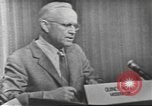
Vice President Nixon gives his closing statement during the fourth presidential election debate held in New York, U.S.
The fourth presidential election debate held between Democratic nominee Senator John F. Kennedy and Republican nominee U.S. Vice President Richard Nixon in New York, United States on 21st October 1960. ABC news correspondent Quincy Howe speaks during the debate and asks Vice President Richard Nixon to give his closing statement. Vice President Nixon opposes Senator Kennedy's statement that American is standing still. He says more houses and classrooms have been built, there has been a progress in civil rights and progress in field of slum clearance in Eisenhower's Administration which is more than in the previous administration. He says the United States should extend freedom to the world. He says that there were eleven dictators in Latin America in 1953 and now there are only 3 left. Nixon also talks about free government in Africa. He says that America will move ahead with the kind of leadership that we can provide in these years ahead. Correspondent Quincy speaks. He says that the opening statements by both candidates ran eight minutes each. The closing statements ran four minutes, thirty seconds. The order of speaking was reversed from their first joint appearance, when they followed the same procedure. A panel of newsmen questioned each candidate alternately. The first discussion dealt only with domestic policy. This one dealt only with foreign policy. As members of a new political generation, Vice President Nixon and Senator Kennedy have used new means of communication to pioneer a new type of political debate.
Night views of the closing ceremonies for Summer Olympics of Rome, Italy.
Closing ceremonies for Summer Olympics of 1960 in Rome, Italy. Night views show a parade in stadium. Many torches burn in a stand. Lighted sign on scoreboard reads 'Tokyo next Olympics'.
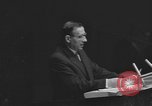
U.N. delegates applaud as Premier of Cuba Fidel Castro walks to the lectern and begins a record duration speech in New York.
Premier of Cuba Fidel Alejandro Castro Ruz addressing the officials and dignitaries of the United Nations in New York, United States. Clip shows the first few minutes of the speech, which was the longest single speech ever to be delivered to the United Nations, at 269 minutes. Delegates applaud as Castro walks to the lectern to address the 872nd plenary meeting of the General Assembly on 26 September 1960. Castro addresses the officials. He begins his record speech, by saying, ironically, (translated), "Although it has been said that we speak at great length, don't worry, you may rest assured that we shall endeavor to be brief and to put before you what we consider it our duty to say."
Contractors development inspection and technical compliance inspection of a USAF B-52 Startofortress in the U.S.
A film titled '1960 B-52 Annual Report' on a progress report covering development and production of United States Air Force B-52 Stratofortress aircraft. A B-52 Stratofortress aircraft in flight overhead. Aerial view looking down on top of a B-52 aircraft in flight. The aircraft leaves smoke trails. Interior of Wichita plant. A crowd gathered in a building. Models of aircraft. People look at the models. The crowd observes seat ejection and bomb navigation systems. A man working on instruments. Configuration of H-model. A truck carrying parts of aircraft enters a building. Parts of aircraft. Joining of wings and major sections of the aircraft. Completion of the first H model of the aircraft. Contractors development inspection and technical compliance inspection.