


 Francais
 Deutsch
 Italiano
Refine Your Search
Seoul Korea 1960 stock footage and images
- Showing 895 to 900 of 2020 results more
more Hide
Hide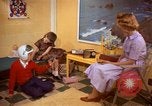
A woman with a boy and a girl in a family fallout shelter and a boy and a girl play in United States.
1960's Cold War fallout shelter for nuclear bomb or atomic bomb attack: A woman sits with a boy and a girl in a living room of a family fallout shelter in United States. Boy plays with the model of B-66 airplane. He wears a plastic helmet. Woman reads a book. The girl plays with toys. They listen to the radio. A dart board on the wall. The girl plays with a doll. A purse on the floor. They get up and leave.
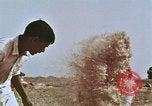
Farmers work in a farm and harvest crop in India.
Highlights the problem of increasing population and food scarcity in India in the 1960s. Farmers work in the farms. They harvest crop of wheat. Farmers beat wheat from chaff against a screen. Houses in the background. Farmers are unaware of the hybrid seeds. A man examines seeds closeup. Low food production. Woman gives food to a cow. A woman spreads cow dung to dry in the sun to form cakes. A cart filled with cow dung cakes being transported to market to be sold for cooking fuel.
Recap of slavery, the Civil War, and job integration in the United States, in the context of the civil rights movement.
African American and white children swim and play in an integrated swimming pool in the United States in the 1960's. A black man beside a white man working on an integrated engine car assembly line. A black shoe shine man. A black street sweeper. Narrator indicates that African American workers are in increasingly skilled jobs and supervisory positions. A black draftsman in an officer environment. A black bank manager gives an application to a black woman. Huey Newton leads the Black Panthers in a protest. Stills portray trade and transport of African American slaves. Stills show the Civil War in the United States, and aftermath of war showing blacks voting and as politicians during reconstruction. Footage of African American people working on farms in cotton fields picking cotton, including boy and girl child laborers picking cotton. Footage of a Rust Cotton Picker machine in operation as African American workers watch. American troops, including African American soldiers of the U.S. Army 369th Infantry "Harlem Hellfighters", marching in victory parade in the United States after returning from World War 1. View of segregated African American soldiers in the parade in New York City cheered by parade attendees. Brief scene with Henry Johnson on the side of the parade route being congratulated by civilians. (Johnson and Needham Roberts received the Croix de Guerre for exceptional heroism). Black and white workers entering or exiting a factory during World War 2. Black American troops and Tuskegee Airmen pilots in segregated units during World War 2. The Tuskegee pilots in uniform gathered together during a briefing on an airfield. View of U.S. military forces comprised of white and black personnel, integrated beginning in 1947. A white officer gives binoculars to a black soldiers.
Donald G. Williams speaks about private industry diversification programs and the activities of the people in Richland, Washington.
Activities of the Atomic Energy Commission on the Hanford Project in Richland, Washington. An animation depicts : a plant set up for radioactive material recovery from storage by Isochem Inc. An electronic assembly plant by International Telephone and Telegraph Corporation. A plant for the use of nuclear power in the space by Douglas United Nuclear . The Battelle Memorial Institute scientists work in a laboratory. Computer Sciences Corporation employees work on machines in a Univac computer room, processing data transferred through telephone lines. Workers of the U.S. Casting Company work on machines. Meters and other equipment. Donald G William, the manager of the AEC Richland, speaks about various other organizations involved in the segmentation and diversification program. Various scientists and workers at work in the plant. A barge in a river. The center for graduate study. Visitors at the science center in the Richland administration building. A child stands. Houses and trees in the foreground. Building of the dental center. People on a street in Richland Washington, and view of 1950s and 1960s cars and various automobiles. Homes along streets in suburban neighborhoods of the Richland Washington area. People passing time at a local lake swimming area, with boy and girl children and families enjoying the water. A boat in water. Men water skiing. A U-37 Tri-Cities speed boat leaving dock area and speedboats in a race. An aerial view of the city. Vehicles on a road.
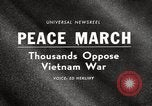
The anti war protests against the United States involvement in the Vietnam War.
Anti-war protests in the United States during the Vietnam War. Protesters march and demonstrate against the United States involvement in the Vietnam War from Central Park to the UN headquarters in New York City. Demonstrators in crowd holding protest signs. A number of African American marchers hold signs that read, "Black men should fight white racism, not Vietnamese freedom fighters." Another sign reads, "They are our brothers whom we kill." Masses of people including doctors, teachers, and businessmen on streets. People dressed in different costumes and 1960s hippie fashion as they protest. Young men participate in burning their draft cards while a crowd gathers around to watch the draft card burning. Pro-war counter protestors (sometimes called "Hawks") also demonstrating and arguing with anti-war activists. Pro-war banner reads, "End Hanoi Sanctuary. Let's bomb Hanoi to win the war and destroy the Communist conspiracy." Another Hawk sign reads, "Anarchy Cannot be Permitted in the USA. Fight Communism and Red Termites." African American civil rights activist Martin Luther King Jr. walks toward the United Nations building with other officials advocating peace. Policemen drag a protester. Scene changes to San Francisco: 50000 people carry banners as they protest the war in Vietnam and march to the Kezar Stadium (670 Kezar Dr, San Francisco, CA 94118, United States) for a mass assembly. People push each other during the protest as pro-war demonstrators clash with anti-war demonstrators and pacifists. A huge crowd gathered at a stadium.
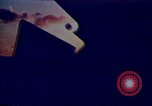
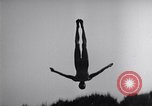
Early Bell Laboratory technology in computer art and computer animation for communication, advertising, motion pictures.
Computer screen showing animation of a silhouette of a man running. Narrator states that the first such image was generated at Bell Telephone Laboratories in New Jersey in the early 1960s. More views of the so called "Olympic Runner" graphic design generated by the Bell Laboratories newest digital computer. Colors like pink, blue and red are used in the early, historic computer art and animation technology. Men seated in a control room, interacting with the digital computer and other animation and recording hardware. Views of computer monitor screens and discussion by narrator about various visual forms created by computers. Various computer generated images are shown on the screen. Engineer stands in front of video tape machine where the images are being recorded. More computer and animation hardware is shown including an Animation Aid. Narrator describes process of photographing analog computer art work onto motion picture film and then enhancing it with color choices. Engineer is seen operating camera, and then a close up view of motion picture film running on machines and on reels. Animation and color consultant in discussion as they stand over some frames of the film that they have isolated. Sample work of early computer artists is shown, with moving animated art seen on screen, combining color and motion in new ways that were not possible before the digital computer. Another view of the video tape machine operating. Narrator discusses use of the computer also in development of computer generated music that accompanies the visual images. Animated clock is seen. Different kinds of animations are seen.