


 Francais
 Deutsch
 Italiano
Refine Your Search
Seoul Korea 1960 stock footage and images
- Showing 913 to 918 of 2020 results more
more Hide
Hide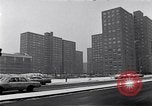
Buildings in Harlem; baseball player Willie Mays on an advertisement board of Alaga syrup in Harlem, New York City.
Housing project high rise apartment buildings of Harlem, New York City. Cars move on streets of Harlem in light snow. Slush on roads and sidewalks. 1960's automobiles and buses passing on streets. An advertisement board on a building for a hair product with message "You will love what ultra sheen does for your hair!" Image of Giants' baseball player Willie Mays on an advertisement board for Alaga Syrup, with message, "Willie Mays says: Say, hey! Love that real ribbon cane flavor." Three advertisement boards at a wall. Bus and cars at street. Sign reads "485 Lenox Avenue" (New York, New York 10030). The door of the apartment building opens. A truck passes. Multi story apartment buildings in the area. Availbility sign for Lennox Terrace apartment buildings at 470 Lenox Ave New York, New York 10030.
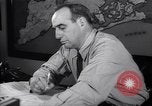
New York Urban Planner, Robert Moses, at his desk in New York City
Robert Moses,controversial visionary urban planner of bridges, highways, and worlds fairs, inter alia, for New York City, from the 1920s through about the 1960s. He is seen at a desk in his office, wearing shirt and tie, but no jacket. A large map of Greater New York, including New Jersey and Long Island, is on the wall behind him. He makes and receives telephone calls. Scene shifts to another office, where he appears wearing a jacket. He reviews papers containing planning ideas including sketches. Mr. Moses annotates some of the documents.
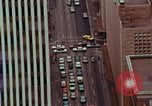
Pilot study on Freeway Control System to prevent traffic congestion on Gulf Freeway, Texas United States.
Pilot study on Freeway Control System for controlling the pressure of increasing automobile traffic on busy roads and highways. Elevated near aerial view of a busy city cross road intersection in downtown Houston, Texas, with private cars, taxi cabs and trucks and view of city as seen from a skyscraper. Camera view widens showing more of the downtown Houston skyline, the sign for the Texaco company is seen atop a skyscraper building, and the rotating Gulf oil company sign is seen atop another skyscraper. The Gulf Freeway six lane road busy with 1960s and 1950s models of trucks and cars such as sedans, station wagons, and pickup trucks. Increasing lanes and controlling entry of cars to control traffic situations. Cars enter main highway from sideways one after the other. Police officers on a signal control entry of cars and allow calculated number of cars to enter the highway. A driver of car with an equipment. Close circuit cameras mounted on highways. Monitors at Freeway Surveillance System head office. Scientists at work, observe camera videos and take readings from meter panel. Capacity Demand and Gap Acceptance methods to control merging traffic congestion.
Death sentence by court to convict Hauptmann for kidnap and murder of son of aviator Charles Lindbergh, Flemington New Jersey.
The kidnapping and murder case of the infant son of aviator Charles Lindbergh, in Flemington New Jersey. Coverage of court ruling in 1935. A huge crowd outside the court during the trial of Bruno Richard Hauptmann for kidnapping and murder termed as 'the crime of the century'. Lindbergh and his wife confront Hauptmann from witness stand. The letters of ransom written by Hauptmann. Lindbergh testifies in the court of trial. Hauptmann cross examined by Attorney General Wilnetz. On February 13, 1935 Judge declares that Hauptmann will receive the death penalty, by electric chair. From a January 1960 newsreel recounting events 25 years earlier.
Highway, houses, bridges, waterfront, skyscrapers and cars on roads of Chicago, Illinois United States.
Film opens with hazy aerial views of Chicago Illinois. Scene shifts to views from vehicle driving on Chicago highway. A road sign reads "Des Plaines River Rd exits 1/2 mile ahead." A Boeing 727 commercial airliner is seen overhead with wheels down as it descends to land. Some 1960s cars drive past. 1961 Ford C-Series truck driving. View back, of the airliner descending above the highway, and of truck and cars passing the camera vehicle. Overhead highway road sign reads "Chicago Downtown 15 Miles." View of the Chicago skyline of buildings on Lake Michigan waterfront. View from slow moving aircraft of the Wrigley Building; the Michigan Avenue Bridge across the Chicago River; and the Tribune Tower. Camera continues to pan to East and then at the Kemper Building with "United Insurance" written near its top. Camera then swirls downward to river and bridges directly below and then back up from street and down again, ending on avenue near building displaying two American flags.
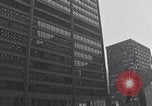
Skyscrapers and an underpass, offices, sculpture, people working in offices in Chicago, Illinois United States.
Skyscrapers and an underpass of Chicago, Illinois United States. Modernistic offices and people working in them in the 1960s. Views of Daley Plaza (50 W Washington St, Chicago, IL 60602, United States) and the untitled sculpture (“Chicago Picasso”) by Pablo Picasso on display in the plaza. A boy with a camera takes photograph of the skyscrapers or sculpture. Busy streets and roads with buses and cars behind him can be seen.