


 Francais
 Deutsch
 Italiano
Refine Your Search
Seoul Korea 1960 stock footage and images
- Showing 943 to 948 of 2020 results more
more Hide
Hide
Life story of George Herbert Walker Bush, Vice-President and later President of the United States.
George Herbert Walker Bush speaks to the 1984 Republican National Convention as the nominee for Vice President. Supporters cheer holding banners. Childhood pictures of George W. Bush with his family. He is shown as a fighter in a squadron in the U.S. Navy in World War II. Footage of his rescue by submarine after he is shot down. Footage of Yale University and a photo of Bush wearing a Yale sweatshirt. George H W Bush starting in the oil business in Texas. Shots of oil workers drilling for oil and an offshore platform. A reporter interviews Bush in the 1960's in front of the U.S. Capitol building in the background. Footage of Bush speaking before the United Nations in his role as U.N. Ambassador. Vice President Bush meets Chinese officials. George H. W. Bush with Barbara Bush and their five children, including George W. Bush, as he announces his candidacy for President in 1979. Bush during his campaign, before abandoning it to join the Republican ticket as Vice President with Ronald Reagan for President. The Vice President circa 1983 with U.S. President Ronald Reagan at Reagan's ranch, in a meeting with Tip O'Neill, and on the steps of United States Capitol building, as George Bush was on the campaign trail with President Reagan running on the Reagan/Bush ticket for 1984.
Decline in industry and jobs, and Stock Market crash and start of Great Depression in the United States.
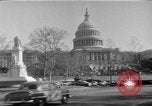
The film 'The Unfinished Revolution' opens by showing people recovering after the Great Depression in the United States. Most scenes circa 1929 - 1931 (but film produced in 1960s). Landmarks in Washington DC: the United States Capitol building with 1940s and 1950s cars and taxi cabs on roads in foreground. View of exterior of Supreme Court building. Closer view of U.S. Capitol and then of the White House in Washington DC. Also the Washington Monument. Scene changes to the American West and a herd of sheep and of cattle grazes on pastures or ranch. Cowboys on horseback herd cattle on a giant field with snow covered mountains in the background. Farmers work in a field picking cotton. Scene changes to New York City with view of Manhattan skyline including Empire State Building, with new skyscrapers in construction in the foreground. View of market area and tenements; push cart vendors lined up on a street in a lower east side New York City neighborhood, and a Ford sedan on the street. Busy New York City streets filled with cars and pedestrians at end of 1920s. Children standing on fire escape in poor downtown area look down over suspended laundry lines between tenement buildings. An officer looks out from small window of a raised booth traffic light as the lights on the booth change color. A Ford automobile assembly line. Engineers work in a factory with minimum wages. A farmer plows a field of potatoes using four horses. A wheat thresher working a field. Trains at a crossing, on a bridge, and coal cars lined up at a coal yard. Busy New York Stock Exchange (NYSE) floor filled with people around time of 1929 stock market crash and start of Great Depression. Frenzied stock market scenes. Board outside a factory reads 'No Men Wanted'. Scenes of silent railroad yards and dormant factories. A man plays an accordian and collects coin donations. Jobless people wait in relief lines, soup kitchen lines, unemployment lines or queues and bread lines. Unemployed and homeless men asleep in public areas.
President Ronald Reagan gives a speech on the Defense Budget at the White House in Washington DC.
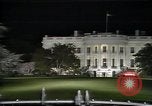
U.S. President Ronald Reagan at the White House in Washington DC. President Ronald Reagan gives a speech on the Defense Budget and on the need for increased defense spending. He speaks about the Defense Program America needs. President Reagan states that the American security should be prepared for all situations. He presents various comparison charts depicting weapons of the Soviet Union versus the United States. An animation shows 'Intercontinental Missiles'. Intermediate Range Weapons from 1978-1982. An animation shows the difference in production of submarines, artillery and weapons between the United States and the Soviet Union. Labeled reconnaissance photograph shows the Soviet Communications Intelligence Facility in Lourdes, Cuba. Aerial reconnaissance photos of the Soviet Weaponry Sandino Airfield in Nicaragua. An airfield under construction in Grenada. President Reagan in his speech states that the American military force should be ready to respond to any emergency situation. An animated graph shows the percent of budget from 1960-1980 dedicated to defense versus social services, with defense spending falling proportionally as spending on social programs increased. At the end of the speech President Ronald Reagan asks for America's prayers and support.
President Ronald Reagan's political career leading to election as California Governor, in the election of 1966
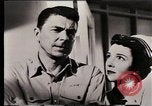
Film opens showing a still photograph of Ronald Reagan and Nancy Davis when they appeared together in the 1957 film, "Hellcats of the Navy." Although they were married since 1952, She was billed as Nancy Davis in the film. View of the newly wed Reagans cutting their wedding cake in 1952. Best Man, William Holden and his wife, Ardis Ankerson (stage name Brenda Marshall) share the moment with them. Closeup of Reagan and his new wife. Still photograph of Ronald Reagan appearing in the television series, "Death Valley Days." Next he is seen in a chair on the set of the TV series,"General Electric Theater," which he hosted from 1953 until 1962. He also toured General Electric plants to talk about the benefits of the free enterprise system. He is seen seated sharing a meal and posing with women employees of General Electric. Film shifts in time to the year 1932, when Reagan was first eligible to vote. Camera focuses on men's feet and they shuffle on a line at a soup kitchen. Views of men receiving food and drink. President Franklin D. Roosevelt is seen, seated in an open car chatting with people surrounding it. Roosevelt sits in the midst of men playing guitars and banjos. On inauguration day, March 4, 1933, he and his Vice President Henry Wallace are seen in the back of an open car. First Lady, Eleanor Roosevelt, sits just ahead of them. President Harry Truman being sworn in by Chief Justice of the United States Fred Vinson, January 20, 1949, for a second term as President. Views of the Republican National Convention in 1952 when the party chose Dwight D. Eisenhower as its candidate for President. He and his wife Mamie, at the podium together. Ronald Reagan addressing a large group. Supporters walking with Republican Presidential candidate, Richard Nixon, whom Reagan favored over Democrat John F. Kennedy in the 1960 national election. In 1962 Reagan officially became a Republican Party member, supported Barry Goldwater and their candidate for President at the Republican National Convention of 1964. Views of Goldwater at the convention and stepping from an airplane during his campaign. Still photo of Goldwater next to Reagan, and then of Reagan defending Goldwater in a nation-wide address. View of Reagan and wife Nancy, and son, Ronald, walking together across field at their ranch in California. They are surrounded by Republican Party leaders who ask him to run for Governor. He and Nancy laughing about it. Billboard advertising Reagan for Governor, and views of him on the campaign trail. Views of Governor Edmond Brown surrounded by his supporters during the campaign. Reagan speaking during the campaign, and then seen with Nancy when he won the gubernatorial election.
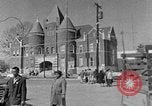
Mayor Carl Burton Stokes elected as Mayor of Cleveland in 1967; citizens of Cleveland and its City Council; Stokes meeting with President Nixon
Mayor Carl Burton Stokes, African American political leader in Cleveland, at the time of his election as Mayor of Cleveland on November 7, 1967. Views of his campaign headquarters and posters in it that read 'Stokes For Progress'. Men and women wearing Stokes hats. The crowd cheers at his mayoral victory. Newly elected Mayor Stokes addresses the crowd from microphone and receives constant applause and cheering. Audio of new Mayor Stokes speaking to supporters in his victory speech while scenes are shown of African American and white men and women citizens of Cleveland walking on streets of the city in typical late 1960's and early 1970's fashions. Scene includes pedestrians young and old walking and boarding a city bus. Mayor Stokes seen exiting a building and walking in Cleveland. Meeting in progress in Cleveland City Council chamber. Views of various City Council members including a number of African American council members. Mayor Stokes seated with U.S. President Richard Nixon and other big city mayors discussing the urban crisis.
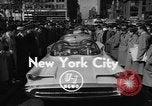
The Lincoln Futura concept car, precursor to the Batmobile, makes its first appearance in New York City.
The Lincoln Futura concept car's first appearance in New York. Futura car is driven through the New York City streets. The Lincoln Futura drives past the United Nations building. Various features of Futura are displayed: a double, clear-plastic canopy top, exaggerated hooded headlight pods and very large, outward-canted tail fins at both ends of the vehicle. People standing beside the car look at it as the driver shows the engine and demonstrates the lowering of the pod windows. Built at a cost of $250,000, this car would later by purchased by George Barris and converted into the Batmobile for the 1960's television show.