


 Francais
 Deutsch
 Italiano
Refine Your Search
Seoul Korea 1960 stock footage and images
- Showing 1021 to 1026 of 2020 results more
more Hide
Hide
Director Streibert speaks on the purposes of the USIA and Soviet influence; scenes from a Soviet anti-American propaganda film
Theodore Cuyler Streibert , Director of the U.S. Information Agency, speaks on the purposes of the Agency (USIS). The Director seated at a table. He states that there is much misunderstanding about the United States, throughout the world, and Communist entities wish to take advantage of this to spread misinformation about the U.S. As the leading world power for peace, he says the U.S. must tell the world the truth about America. This is the mission of the USIA. A map portrays Soviet dominated areas within the so-called "iron curtain,"encompassing 800 million people. Another map illustrates targets of Communist propaganda employed to facilitate North Korea's aggression against South Korea. A graph illustrates propaganda spending by the Soviet Union and Communist China, primarily to spread misinformation about America. Segments of a Soviet propaganda film about the U.S. are shown. It begins with a map of the U.S. and then shows the Statue of Liberty. Camera pans over Manhattan, showing skyscrapers. A narrator disparages American commercialism, materialism and sensationalism. A lion is seen sitting in a convertible car, looking over a young woman's head. Next are scenes of an American beauty contest, and of women performing precision water skiing. Then an airplane is seen crashing on landing and a car is seen burning. View from trolley car moving along Broadway, from Times Square, in Manhattan, New York City, at night. A follies-style Broadway show. Show girls in bathing suits, walking past the camera. Show girls performing on stage. Another nighttime view of Times Square. Dogs being manicured by groomers. Outdoor soup kitchen scene from the Great Depression in the 1930s with unemployed men receiving food. Hobos or homeless men at a railroad siding. Milk and grain being spilled from containers during a labor and pricing dispute. Scenes of slum area tenement houses with wash drying on lines strung between the buildings. Men playing bocce ball in the yard of an apartment house. Camera pans up the Empire State Building from street level view. African American drummer with other band musicians performing in a civilian band, and scenes of African American musicians in a U.S. Army band. Poor African Americans in the South, at home and doing wash outdoors. Mounted police maintaining order in scenes of a fire and public protest or labor strife (circa 1935) interposed with views of the Statue of Liberty. A Soviet propaganda poster about the Korean War, shows an American soldier walking away from a dead Korean woman whose small child clings to her. Fires burn and a burning airplane falls from the sky in the background. A propaganda cartoon shows "warmongers of the west" being counterbalanced by a Soviet fist on a pair of scales.
World tensions after World War II. The Baruch Plan. The Berlin Airlift. The Korean War. The Cold War. The Atomic age. Ballistic Missiles
Speaking before United Nations Atomic Energy Commission (UNAEC) in its first meeting in June 1946, Bernard Baruch proposes international control of all atomic energy -- the so-called Baruch Plan. Low level aerial view of ruined post World War 2 European city. Goods including heavy equipment, locomotives, being loaded aboard ships to aid in the postwar recovery of Europe (The Marshall Plan). Workers in Western Europe making use of Marshall Plan materials to rebuild their national infrastructures. West European farmers restoring agriculture. View from overflying light airplane of parts of postwar Berlin in 1948. Blocked roads and empty railroad tracks leading from East Germany to West Germany, blocked by the Soviet Union. Barge traffic at standstill due to Soviet actions. U.S. C-54 transport aircraft flying supplies into West Berlin (The Berlin Airlift) during the Soviet blockade of that city. West Berlin citizens watching U.S. transport aircraft bringing fuel, food and other essentials into the isolated city. A C-54 flying low over empty railroad lines, as it prepares to land in West Berlin. Supplies offloaded from a DC-3 ( AKA C-47 or British Dakota) equipped with unusual set of rear cargo doors. Supplies being moved on Tegel Airport with many C-54 aircraft in the background. Numerous C-47 aircraft operating at Tempelhof airport. An East German official opening a barricade as Soviet blockade of West Berlin ends on May 12, 1949, and supply trucks begin to move over roads again. Flags of Western nations flying on high flagpoles. Glimpse of Allied warships underway during the Cold War. Formation of P-38 Lightning aircraft in flight overhead. NATO troops marching and NATO armor on parade. Flashes of heavy artillery firing at night. Korean refugees moving South in 1950 with the outbreak of the Korean War. View of UN Security Council meeting in the absence of Soviet representative. U.S. tanks firing guns and American infantrymen in conflict with North Korea in Korean War. American wounded on stretchers.Delegates of both North and South Korea signing the Korean Armistice Agreement in P'anmunjŏm, on July 27, 1953. A rocket is launched. Images of earth from inside a space craft in orbit. Narrator mentions the first satellite to circle the earth, the soviet Sputnik 1 in 1957. View of Soviet pilots in low pressure altitude chamber. A test subject in an aircraft making a maneuver that allows him to experience "weightlessness." Objects in his cockpit float about. A military rocket launch monitored by arrays of radar. An object being retrieved from space by means of a parachute. A nuclear powered submarine. Rockets on display during a military parade in Red Square, Moscow, the Soviet Union. A U.S. Air Force B-52 bomber taxiing. More views of rockets seen during a Soviet military parade in Red Square, Moscow.
Yakov Malik walks out of a meeting of the Security Council in New York, United States.
The United Nations Security Council meeting in New York, United States. Delegates discuss the issue of invasion of South Korea by North Korea (Korean War period). Soviet representative Yakov Malik boycotts the presence of Nationalist Chinese representative and walks out of the meeting.
Wounded Chinese soldiers treated and presented with gifts in Taipei, Taiwan after defecting.
Aircraft in flight over sea. Convoy of ships underway on their way to Taipei, Republic of China (Taiwan) from Incheon, Korea. Liberated Chinese prisoners (originally from People's Republic of China) are preparing to start new lives in Taiwan (Republic of China) having decided to defect from mainland China, becoming "anti-Communist Heroes." The soldiers sing and play music aboard ship. Freed Chinese prisoners repatriated to Taiwan after their release from Korean prison camps in the Korean War. A Chinese prisoner playing an erhu fiddle. United States Navy warships escort the ship of Chinese Prisoners. Crowd and officials lined up at Taipei Songshan Airport (No. 340-9, DunHua N Rd, Songshan District, Taipei City, Taiwan 10548) awaiting the arrival of wounded soldiers from war. Large crowds hold bouquets, signs, and banners. Plane lands on the runway and taxis. Crowd waves flags. Man directs plane. Large crowd cheers. A crowd surrounds ambulance moving ahead. Wounded Chinese soldiers are carried on stretchers to ambulance. They receive bouquets from the crowd. Soldiers disembark from the plane. Nurses serve drinks and food to soldiers. Members of Chinese Civil and Government organizations enter hospital in outskirts of Taipei. Wounded soldiers on bed. Members of Overseas Chinese National Salvation Association and Overseas Chinese students present gifts and greetings to wounded soldiers. Another group of soldiers in a nearby hospital receive gifts. A soldier speaks at mike and makes a symbolic representation of blood-stained flag. Men with signs and flags in hospital. Aircraft in flight over Keelung, northeast of Taipei. Chinese prisoners return on ship from Incheon, South Korea. Troops disembark from ships. The crowd lined up with flags and signs at the dock. Band plays music. Ship enters Keelung harbor. Chinese prisoners aboard ship. Large crowd cheers.
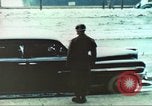
U.S. Naval Commanders direct their forces to support U.S. forces in Korean War
U.S. military officers make plans following encirclement of U.S. forces in Korea near Chosin Reservoir in November 1950. General Douglas Macarthur gets out of a car and is greeted by an officer. He walks inside a building in Tokyo, Japan. Scene changes to Pearl Harbor, Hawaii. A board reads 'Commander in Chief Pacific and United States Pacific Fleet'. The Commander in Chief of the United States Pacific Command, Admiral Arthur William Radford, sits at a desk in his office and signs a document with orders. Scene changes to Tokyo again, with exterior sign and awning that says "Commander Naval Forces, Far East." Vice Admiral Charles Turner Joy directs support for the imperiled forces in Korea. He places orders for commander of 7th Fleet, Commander Carrier Division 15, Commander of Fleet Marine Air Wing to move forward with maximum support. A board reads 'Far East Navy Forces'. Different boards read '315th Air Division Combat Cargo', '5th Bomber Command' and '5th Air Force'. U.S. Navy Rear Admiral Edward C. Ewen observes rough sea from a ship during a winter storm. A naval officer looks through binoculars. An officer transfers between ships via breeches buoy. Water splashes over the deck of U.S. Navy ship during heavy storm.
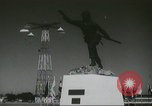
Sketches of U.S. Army Infantrymen fighting in every conflict from the Revolution to the Korean War.
Sketches of U.S. Army Infantry in the United States. 'Follow Me' statue at the U.S. Army Infantry School at Fort Benning, Georgia. The sketches depict infantrymen in various conflicts in American history, from Washington in the Revolution to combat in Korea. An infantryman holds the American flag. U.S. Army Infantry during the invasion of Africa. They fight in the Korea War.