


 Francais
 Deutsch
 Italiano
Refine Your Search
Seoul Korea 1960 stock footage and images
- Showing 1123 to 1128 of 2020 results more
more Hide
Hide
UNICEF Executive Committee meet at the UN headquarters for a medical and welfare campaign.
The Executive Committee of the United Nations International Children's Emergency Fund (UNICEF) meet at the United Nations headquarters. The agenda of the meeting is a medical and welfare campaign against diseases and malnutrition world over. Delegates from Pakistan, Israel and United States seen. A nurse trains ladies with the aid of a skeleton. India: A doctor checks a boy's ears as other children wait their turn. Korea: A doctor checks a boy as other children watch. A girl is given a pill and food in a backward area. Men carry supplies of antibiotics, serums, and powdered milk on their backs.
Development of F-86 Sabre at Wright Air Development Center and first flight test of F-86 at Muroc Dry Lake
Development and flight of various U.S. aircraft. A page of Wright Air Development Center (WADS) book reads 'A Sense of Urgency'. A technician works on drawing board. Aerial view of formation of five Convair B-36 aircraft in flight. A centrifuge test in progress at WADC of Wright-Patterson Air Force Base. Evening journal headlines reads 'Reds Invade South Korea'. Explosion during actual battle of Korean War. Smoke due to explosion. Aerial formation of C-119 Flying Boxcar. Parachutes descend. Formation of eight C-119 during jump. Lined up five F-86 Sabre aircraft. Crew members and gasoline trucks in front of F-86. Insignia of United States on F-86. Last minute check is made prior to mission. Refueling of an F-86 by a man. F-59A aircraft in flight leaves a smoky trail. A book in hands of a man. Four technicians seated at desk and are reviewing future proposals of jet aircraft. An outline drawing of an aircraft F-84 Thunderjet. Various instruments and gauges during testing of mechanical systems of aircraft. The door to cold weather chamber opened. An engineer wearing heavy clothing takes instruments through door. F-80 Shooting Star lands and taxis. Narrator discusses problems of load on landing gear. A man cleans the wheels of F-80 after landing. Two technicians seated at a desk discuss about the project. Project engineer hold the model of F-86 aircraft in hand pointing to various sections of F-86 Sabre. Test conducted on a dynamometer machine. Tire test conducted. Gauges which record wheel speed, brake recorder. F-86 Sabre stationary. Initial flight test of an F-86 conducted at Muroc Dry Lake in California. F-86 taxis and takes off. F-86 in flight. A pilot in a cockpit. Landing of F-86.
President Harry Truman speaks at a celebration of the 175th Anniversary of the Declaration of Independence.
President Harry Truman speaks at a celebration of the 175th Anniversary of the Declaration of Independence, held on the Washington Monument grounds in Washington DC. President Truman, at the podium, states that peace in Korea does not lessen world tensions as long as Soviet rulers remain an armed camp. He states that vigilance is the price of peace. (Korean War period.)
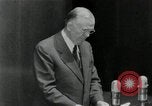
U.S. Secretary of State, George Marshall addresses the General Assembly of the United Nations
In a speech to the General Assembly of the United Nations, U.S. Secretary of State, George Marshall, refers to repeated vetoes by a permanent member of the Security Council. He discusses the post-war state of the world and the many matters yet to be resolved, including the independence of Austria, the Palestine issue, the matter of Korea, still divided along the 38th parallel, and status of nations in Eastern Europe, etc.
USIA operations like radio broadcast, press edition and Director Streibert explains mission to a committee in U.S.
United States Information Agency (USIA) radio operators operate radio studio controls and set frequencies for transmission and receiving. USIA staff work on gathering additional facts, with newsroom reporters and editors in a press room typing and working on stories, a woman editing motion pictures, typing, printing at USIA. Exterior view of headquarters building of United States Information Service or USIS. People enter and exit the building of USIS. Members of a Citizens Committee and Director Streibert enter into a room. Map of world in room. Citizens seated on sofa. Director Streibert explains U.S.I.A. mission to a citizens' committee and talks about America's history and involvement in the world. One Citizen Committee member smokes a pipe. The Director shows a chart of how "communist propaganda is spread by a vast worldwide machine." Director Streibert explains (via anti-communist propaganda, or reverse propaganda...during Cold War) its mechanism and control exerted via the presidium of the Soviet communist party. View of Soviet Union leaders watching a military parade in Red Square, Moscow, Russia. Khrushchev is among the leaders. Next scenes show Communist rallies and speakers in Korea and then in China. At the Chinese rally, a scene of unrest unfolds as a group filling a large truck enters a rally, jumps down, and inflames the crowd. Communist leader Khrushchev with other Soviet officials debarks an airplane and meets leaders in India. He waves at a welcoming crowd during a visit. View of piles of Motion picture canisters ,magazines, pamphlets and books distributed as propaganda by Soviet Union. High production quality of paper shown. Industrial equipment and industrial farming equipment is displayed in a large exhibit hall for visiting foreign governments and dignitaries to view and consider investment. The Director states that long term Communist goals are world domination, and short term goals include the encouragement of neutralism, dividing and confusing American allies, and isolation of the United States. Director Streibert explains how the USIS works together with the Department of State to communicate American information. He ends the explanation by giving the USIA campaign pamphlets "Atoms for Peace" and "Atomic Power for Peace" ( The Eisenhower plan) to citizens of committee as example of a communication.
Life of U.S. President Dwight Eisenhower after World War 2; NATO; Columbia University; U.S. President; advisor to Presidents
Dwight D. Eisenhower during presidency of the Columbia University in 1948. Eisenhower walking at a Columbia University graduation ceremony in New York City and speaking to the group assembled. Two years later, views of Eisenhower as NATO supreme commander in Europe. Eisenhower seated in NATO Conference. Citizens in United States prepare signs and urge Eisenhower to run for President. He salutes a parade in 1952 as he begins a run for the Presidency. Pamphlets and posters read 'we need Eisenhower'. An animated cartoon shows a smiling and marching Uncle Sam with an "Ike for President" jingle song playing. Cartoon shows animated citizens and an elephant supporting Eisenhower. Scenes from Republican National Convention, and Nixon and Eisenhower holding their arms up together. Citizens voting, using ballot boxes, and voting machines. A nun votes. Eisenhower casts his vote. People hold U.S. flags and cheer. Signboards and neon lighting on a building track vote tally and proclaim Eisenhower victory in 1952 presidential election. Eisenhower in Korea after the election. He meets and eats with American troops in the field and studies the war effort. South Koreans wave flags on announcement of truce (cease-fire armistice) in Korean War Eisenhower takes presidential oath of office in Washington DC. He signs document for Civil Rights Act of 1957 (voting right act). View of African American students of the "Little Rock Nine" entering a military station wagon under armed troop escort during integration of Little Rock Central High School in Little Rock Arkansas. U.S. Army troops escort the African American students into school. Exterior view of United Nations building in New York. Eisenhower delivers speech on Atoms For Peace. Winston Churchill of Britain and Nikita Khrushchev of the Soviet Union visit Eisenhower in America. Scenes of John F Kennedy inauguration in 1961. Eisenhower with Kennedy and later with President Johnson. In 1968 address to Republican Convention Eisenhower notes risk of growth of Communism.