


 Francais
 Deutsch
 Italiano
Refine Your Search
Seoul Korea 1960 stock footage and images
- Showing 1165 to 1170 of 2020 results more
more Hide
Hide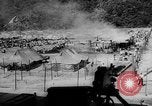
Prison riots in 1952 include North Korean POWs in Koji and U.S. prison riots in Michigan and New Jersey.
Major prison riots of the year 1952. North Korean POW soldiers of the Korean War stage a mass rebellion at POW camps in Koji islands and Pongam Island, off South Korea. U.S. and U.N. guards quell riots at the camps, resulting in death of North Korean prisoners and injuries. Medics are seen treating injured North Korean prisoners. U.N. guards escort prisoners in lines after the riots. Scene shifts to the the United States where damaged prison property in Michigan and New Jersey is seen after prison riots. Broken window glasses and furniture strewn about in a multi-story room of the New Jersey State Reformatory. Scene changes to Southern Michigan State Prison, also called Jackson State Prison, following riots there. Four prisoners including ring leader Earl Ward (second from left) are seen inside the building behind bars, during the standoff where they seized a cell block and held guards as hostages. A prison guard on watch with rifle in hand, looking from an elevated post downward onto a Jackson State Prison courtyard.
President Harry S Truman defends policies at the Civil Defense Conference in Washington DC
U.S. President Harry S Truman makes a speech at the Civil Defense Conference in Washington DC. He says that actions of Korea (during Korean War) must be confined to prevent an Atomic War between the nations of the world. Several other dignitaries seated on the dais. Press, media and photographers take coverage of the President's speech. President Truman defends administration policy actions in face of General MacArthur's criticism.

Chinese prisoners from Korean War defect to Taiwan (Republic of China).
Former communist Chinese prisoners repatriated from Korean War prison camps arrive in Taipei, Taiwan, becoming "anti-Communist Heroes" January 23, 1954. Crowd gathered outside a large building in Taipei. A large freedom bell is rung. Chairman of the gathering and Premier of the Republic of China Chen Cheng addresses the crowd. The crowd with banners demonstrates against communism and against mainland People's Republic of China. South Korean ambassador to China (Taiwan), Kim Hong-il, addresses the gathering. Men in special white uniforms lined up are the first group of liberated, defecting former prisoners. The Map of Korea shows 38th parallel on it. The United Nations and the U.S. flags. American C-119 Flying Boxcar aircraft in flight over airfield, arriving in Korean. Chinese officers march on airfield after leaving planes, before transporting to Taiwan. U.S. official instructs Chinese officers. The UN Transportation Corps loading supplies onto truck. Sign reads 'Warming Tents'. American General BS Latton with the United Nations staff inspects transportation arrangements. Processing officers arrive at the field. The Chinese Nationalist Military delegation men arrive from Taiwan. The Commanding Officer of The UN Forces, John Ho inspects the processing area with his staff. View of building area. Men prepare flags. Signs and banners along the road. General Latton with a Chinese General. Representatives of the Chinese Nationalist Government lined up to welcome prisoners after the Korean War. Band plays music. Liberated Chinese prisoners arrive with flags and banners. They are welcomed by the UN officials. Freed Chinese prisoners get into tents. (Many of the defecting Chinese were former Kuomintang soldiers taken captive by the communist forces during the Chinese Civil War.)
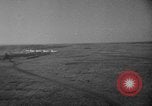
Surrender of Japanese Imperial forces aboard USS Missouri in Tokyo, Japan.
Surrender of Japanese Imperial forces leads to end of World War II. American planes approach Atsugi Air Base in Japan. Wrecked Japanese planes on airfield. Japanese labor works on airfield. C-54 aircraft lands in Atsugi. General Douglas MacArthur disembarks the plane. USS Missouri in Tokyo bay. Surrender ceremonies aboard USS Missouri. Japanese Minister of Foreign Affairs, Mamoru Shegemitsu (with cane), General Yoshijiro Umezu, Major General Yatsuji Nagai, Katsuo Okazaki, Rear Admiral Tadatoshi Tomioka, Toshikazu Kase, and Lieutenant General Suichi Miyakazi on deck of USS Missouri. Cameramen record event. General MacArthur speaks on mike. American officers surround General MacArthur. Surrender Instrument on table. Eleven men Japanese Delegation move ahead to sign the Surrender Instrument. Mamoru Shegemitsu signs Surrender Instrument. General Jonathan Wainwright and Lieutenant General Sir Arthur E Percival of British Army step forward with General MacArthur to sign Surrender Instrument. Map shows surrender locations like China, Manchuria, South West Pacific, Central Pacific, Japan, South Korea and Philippines.
United States 7th infantry soldiers advance towards the south bank of Yalu river along Manchurian border.
'UN Forces escape trap' about the United Nations forces during the Korean War. A map of Manchuria shows the position of United Nations troops along the Manchurian border. Position of the UN forces as the Chinese Red Army drived them away from the border. UN troops along the38th Parallel. United States 7th Infantry Division troops move up snow covered mountains along the Chinese and North Korean border. Supporting planes strafe the snow covered hills. A view of the frozen Yalu river along the border in North Korea.
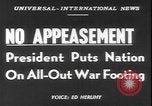
President Truman addresses the nation on the issue of Korean War and signs an emergency proclamation in Washington D.C.
United States President Harry S. Truman addresses the nation in Washington D.C., United States. President Truman in his speech blames the Soviet Union for the on going crisis in Korea. He states that United States will up hold the principles of United Nations, strengthen combined defenses, make more weapons, expand the economy. He states that war is not inevitable and America would make every possible effort to avoid general war. But it would not engage in appeasement. Later on President Truman signs an emergency proclamation.