


 Francais
 Deutsch
 Italiano
Refine Your Search
Seoul Korea 1960 stock footage and images
- Showing 1195 to 1200 of 2020 results more
more Hide
Hide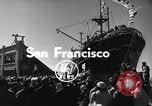
A crane loads cargo and barrels aboard a merchant vessel docked at a harbor in San Francisco, California.
Cargo loaded aboard a merchant vessel in San Francisco, California. Merchant vessel 'Korea' docked at a harbor. A large crowd of civilians gathered at the harbor. Men haul a trolley loaded with barrels and bags. A crane loads cargo aboard the vessel. A flag flutters in wind atop the vessel mast.
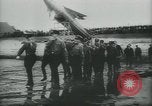
Montage of German rocketry scenes from 1930s through World War II. Nazi surrender. Atomic bomb. Japanese surrender
German rocket pioneer, Gerhard Zucker, attempting to develop postal rockets in the 1930s. Location is Wadden Sea off Cuxhaven, on April 9, 1933, where Zucker follows Nazi Sturmabteilung (also called SA or Stormtroopers) carrying the mail rocket across wet sands. The rocket is set up on a launch stand. Zucker and an assistant ignite the 8 side rockets and the mail rocket takes off. It noses up and loops over backwards, falling to the sand. German Stormtroopers lift up the damaged device. Next, is seen a later, more modern, rocket trial ending in failure. Two German engineers display a model similar to the pulse-jet-powered "buzz bomb" (V-1) employed by the Nazis in World War 2. A brief glimpse of similar American machine on sand flat, as narrator states German acknowledgement of knowledge gleaned from Dr. Robert Goddard's work. A German V-1 flying bomb (aka Doodle Bug) being launched in 1944, during World War 2. View of British houses of Parliament, London, England; an air raid shelter sign in City of Westminster. Londoners waiting out a raid in the shelter. Scenes of fire and destruction during German bombing of London, as narrator speaks about the more advanced German V-2 ballistic missiles employed later in the war. Londoners trudging through debris amongst bombed out buildings. Change of scene to U.S. infantry and armor advancing deep into Germany. Narrator refers to them overrunning rocket bases and other vital war-making facilities, near the end of the war. Glimpse of large number of German prisoners of war. Documents of military surrender being signed by Field Marshal Wilhelm Keitel, in Berlin, May 8, 1945. Closeup of Keitel. Scenes of American forces operating in Pacific theater. Aerial view of atomic bomb explosion. Japanese surrender ceremony on September 2, 1945, aboard the battleship USS Missouri. U.S. soldiers and other service personnel return home and greeting loved ones at end of war. Aerial view of Pentagon building and surrounding area in Arlington Virginia near Washington DC. U.S. troops boarding a ship in San Francisco, bound for war again, this time in Korea (1950).
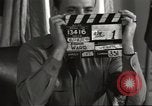
U.S. Secretary of Defense Louis Johnson makes a speech on Labor Day at the Pentagon in Virginia.
U.S. Secretary of Defense Louis Johnson makes a speech from his desk at the Pentagon in Virginia. He mentions Korea and states that, as always, Labor has offered patriotic services which has helped to keep America free through the years. As in the past, Labor and the armed forces are one, willing to work and fight together, and die, if need be, in that cause. (Korean War period.)
Vietnamese Popular People's Army men receive instructions from Tiger Division Korean soldiers in Vietnam.
ROK (Republic of Korea) Tiger Division soldiers instruct Vietnamese Popular People's Army soldiers in Vietnam during the Vietnam War. A Korean officer talks to a Montagnard family. Korean soldiers setting up field targets on a rifle range. Vietnamese Popular People's Army soldiers receive instructions from Korean soldiers at the rifle range.
Vietnamese Popular People's Army going through a fire movement course under the guidance of Korean soldiers in Vietnam.
ROK (Republic of Korea) Tiger Division soldiers instruct Vietnamese Popular People's Army soldiers in Vietnam during the Vietnam War. Vietnamese Popular People's Army soldiers going through a fire movement course under the guidance of Korean instructors.

North Korean pilot Kum Sok No meets her mother in Seattle, Washington.
People from Korea arrive in Seattle, Washington. A woman disembarking from an airplane. People gather inside a building. The woman meets her son Kum Sok No, a North Korean pilot in the building.