


 Francais
 Deutsch
 Italiano
Refine Your Search
Seoul Korea 1960 stock footage and images
- Showing 517 to 522 of 2020 results more
more Hide
Hide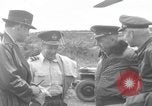
Officers discussing and touring a camp in a truck in Munsan-ni in Korea.
Allied officers in Korea during the Korean War. British Air Vice Marshal Cecil Arthur Bouchier who is the personal representative of British Chiefs of Staff, and William Atkin who is the General Manager of the London Daily Express News Service talking to officers at a base camp. United States Air Force Colonel Don Darrow is standing along with officers. The two visitors get into a truck to tour the camp. The visitors arriving with Colonel Darrow at a press train at Munsan. They get aboard. Mr Atkin, followed by others, coming off the train. Mr Atkin and the Air Vice Marshal walking in front of the train. They get into a vehicle and leave the area.

A bomb from a landing aircraft explodes on the flight deck of carrier USS Oriskany underway at sea in Korea
A bomb explodes on aircraft carrier USS Oriskany (CV/CVA-34) underway at sea off the coast of Korea. An aircraft takes off from the carrier. The F4U Corsair lands and a general-purpose bomb is released accidentally while landing. The bomb explodes and several men including the cameraman (Thomas McGrath) who was taking photographs are killed.
Democratic Party leader Adlai Ewing Stevenson talks to soldiers during his visit to the war front in Korea.
U.S. Democratic Party leader Adlai Ewing Stevenson arrives in Korea during the Korean War. A jeep parked on a field. Stevenson reviews troops. He talks to the soldiers and shakes hands with them. A tent in the background. A high altitude view of the area. Stevenson arrives at the war front in a navy airplane. He gets off the airplane and talks to an officer.
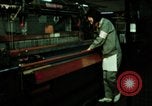
Industry in South Korea includes industrial and consumer production, manufacturing, and factories
Loom weaving machine in South Korea. Shipyard building ships. South Korean workers cutting glass. Welding metal within a frame. Control panel of Korean power plant. Glass bottles moving on assembly line in bottling plant. Television manufacturing plant with close up of "Indian" SMPTE television test pattern. Refrigerator manufacture assembly line. New cars lined up outside.
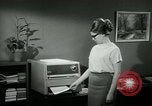
Woman engineering worker argues with boss and urges that employees make use of a new information center.
Early information retrieval practices in a corporate engineering office in the United States during the 1960s. Dramatization depicts a woman in the work force in the 1960s: Female worker with vintage 1960s beehive hair style appears to be performing work as a secretary, but, it turns out she is engineer Julie Stone. Julie takes printouts from a printer in information center. She opens a drawer and takes out document files. She leaves her office. She arrives at office of her Chief named George A Price. Chief scolds an engineer called Harry for committing mistakes in his designs. Chief asks Harry to be responsible in his work. Another engineer named Pete Newton draws designs. View of the cabins. Harry meets Newton and discuss about his conversation with Chief. Julie on telephone calls Harry. They go to a restaurant for lunch. They talk about the sources of information and Julie encourages Harry to use the information center that she runs, rather than relying on antiquated and incomplete methods of obtaining information. Julie gets up and leaves the restaurant. Harry and Pete talk in the office. Pete asks him about his meeting with Julie. Harry takes his seat and opens a drawer. He looks over the documents and publications, including a Playboy magazine, to get information about transistors. Julie meets with Chief and complains about Pete and other engineers failure to use the information center and to lookup answers to questions in a more comprehensive way. Chief attends a telephone call. Pete enters Chief's office. Depicts woman worker arguing with boss. Clip also shows examples of common work place interpretation of women worker roles in the 1960s, including opening introduction of clip that objectifies the woman worker as a sexual object (before broad awareness of sexual harassment in the workplace), and a restaurant scene that opens with the man assuming that the woman has asked him out to lunch as a love interest rather than for work purposes.

A modern field hospital to receive wounded and ill prisoners from Red captivity, raised at Panmunjom in Korea.
A modern field hospital to receive wounded and ill prisoners from Red captivity, raised at Panmunjom in Korea. Military tents, pre-fabricated buildings, trucks and jeeps at the camp. Soldiers construct roads with heavy equipment and machinery. Barb wires put up for boundaries. Military ambulances parked in the camp area. Supplies stacked in boxes. Nursing and medical personnel at the camp. A United States Medical Department ambulance train. GIs make the beds inside the train.