


 Francais
 Deutsch
 Italiano
Refine Your Search
Soc Trang Vietnam 1963 stock footage and images
- Showing 169 to 174 of 4649 results more
more Hide
Hide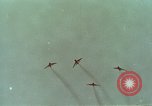
U.S. President John F Kennedy on visit to West Berlin, Germany
President Kennedy's first day started with aerobatic demonstration by planes. Airplanes are ready to take President to the visits most important stop, West Berlin. President's plane takes off from Wiesbaden Air Base. At Military Airport, West Berlin U.S. President Kennedy arrives. The welcome ceremony begins by Allied Troops as the President steps down. He came here to discuss the political problem of divided Berlin.President Kennedy addresses gathering. 26 June 1963.
President John F Kennedy leaves West Berlin.
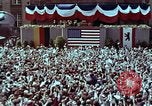
Crowd and President Kennedy on the stage during his West Berlin visit. A cannon salute to President John F Kennedy and scene of man wearing space suit. President review photos of his current visit. President Kennedy, West German Chancellor Konrad Adenauer and West Berlin Mayor Willy Brandt in front of microphone. President boards flight and the plane takes off. Aerial view of West Berlin, showing the Siegessäule (Victory Column) and the Kaiser Wilhelm Memorial Church, and the voice of John F Kennedy repeats. 26 June 1963.
U.S. President John F Kennedy arrives at Germany.
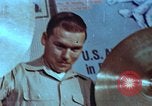
People of a band checking drum and saxophones. Scenes of printing of U.S. flag, coin depicting President Kennedy and German Chancellor Adenauer, small flags. Women folding U.S. flag and scenes of Daily mail, London, typewriter and developing photo of President Kennedy andChancellor Adenauer. People preparing for arrival of President Kennedy. President Kennedy arrives and 21 cannon salute to honor him. President reviews troops with Chancellor Konrad Adenauer, Defence Minister and Inspector General of Police. President Kennedy meets federal cabinet including Ludwig Erhard. June 1963.
President John F Kennedy addresses nation and delivers Integration speech at White House, Washington DC.
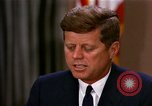
President John F Kennedy delivers 'Integration speech' at the White House, Washington DC, addressing issues of race discrimination, civil rights, and racial integration. Seated at his desk in the Oval Office, President Kennedy says he will ask Congress to pass legislation giving all Americans the right to be served in facilities that are open to the public, thus banning separate facilities for whites and blacks, also known as "Jim Crow" discrimination laws. Kennedy says this is an elementary right. He further notes that Jim Crow laws are an "arbitrary indignity that no American in 1963 should have to endure." Exterior view of White House. United States flag flying on the White House. View inside the Oval Office before the event. Cameramen, press, and journalists with motion picture and still cameras. President Kennedy arrives and sits at the desk in the Oval Office.
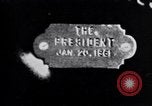
President John F Kennedy in a meeting with military advisors; also scenes from March on Washington
A plate on chair reads 'The President, Jan. 20 1961'. President John F Kennedy in a meeting with cabinet and military advisors during the Cuban missile crisis of October 1962. Aerial view of the Lincoln Memorial. Large crowd gathered for the March on Washington for Jobs and Freedom on August 28, 1963. They carry banners and signs. A sign reads "Jim Crow must go" (reference to racial segregation practices during Civil Rights movement). Demonstrators and speakers on on steps of the Lincoln Memorial during speeches. View of crowd listening to speeches.
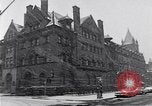
Churches of Harlem and East Harlem in New York City.
A big building in Harlem, New York City. Rain and snow are falling. Bethel Gospel Pentecostal Assembly (2 E 120th St, New York, NY 10035) at Harlem, New York City. The New York Ephesus Seventh-day Adventist Church (101 W 123rd St, New York, NY 10027, United States). The Ebenezer Gospel Tabernacle Baptist Church (227 Malcolm X Blvd, New York, NY 10027, United States). The Religious Training Institute of America's board informs about the courses and timings at institute and information to contact Reverend P.G. Neil. A Schaefer beer billboard advertisement shows woman named Marva Revis, the Miss Beaux Arts winner of 1963, holding two 6-packs of beer and reads "... When you're having more than one". Views of Mount Olivet Church (201 Malcolm X Blvd, New York, NY 10027). Moore's Temple. Saint Mary's Catholic Church. A Jewish synagogue entrance is also seen, with Hebrew words at the entrance door.