


 Francais
 Deutsch
 Italiano
Refine Your Search
Soc Trang Vietnam 1963 stock footage and images
- Showing 3151 to 3156 of 4649 results more
more Hide
Hide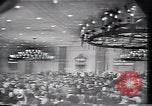
President Kennedy accepts mementos and leaves after his Chamber of Commerce breakfast speech in Fort Worth, Texas.
United States President John F Kennedy's Chamber of Commerce breakfast speech at Hotel Texas (815 Main St, Fort Worth, TX 76102) in Fort Worth, Texas. A crowd seated in the Crystal Ballroom. President Kennedy and First Lady Jacqueline Kennedy seated on the stage. The couple stands to greet the crowd after President Kennedy's speech has concluded. Attendees applaud. A COC member presents a Texan cowboy hat and a memento to the President and First Lady. He and the First Lady accept the mementos and thank the COC. The presenter invites a member of the clergy to deliver a closing prayer. He addresses the attendees. President Kennedy praying with his head bowed. President Kennedy greets the preacher. The President and the First Lady greet the dignitaries as they bid them farewell and leave the stage. These events took place on the morning of President Kennedy's assassination.
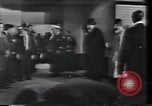
U.S. President Kennedy's accused assassin Lee Harvey Oswald is shot in the Dallas Police Headquarters basement by Jack Ruby
The murder of Lee Harvey Oswald, the accused assassin of U.S. President John F Kennedy. The basement of the Dallas Police Headquarters in Dallas, Texas. Dallas detectives, police officers and guards in the basement. Jack Ruby seen standing to right side among press persons just before Oswald is led into the corridor. Detective Jim Leavelle and others emerge with Oswald. Jack Ruby leaps in front of Oswald, and shoots him with a snub nosed Colt Cobra .38. The detectives and policemen grab Ruby and Oswald and quickly take them away. Confusion in the basement. Media persons click pictures and record films. Detectives hold off the media. Waiting police vans and cars outside the building. Entrance to the Police Headquarters.
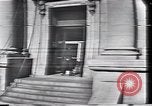
An unconscious Lee Oswald is placed in an ambulance and rushed to Parkland Memorial Hospital in Dallas.
Immediately after the murder of Lee Harvey Oswald, the accused assassin of U.S. President John F Kennedy. The basement of the Dallas Police Headquarters in Dallas after the shooting of Oswald by Jack Ruby. Detectives and police officers try to control the media. Newsmen, reporters and photographers speak to Dallas Police detectives and officers. Guards cordon off the area of the shooting. Photographers click pictures and record the event. An armored truck at the basement entrance. Reporters report on the event for various television channels. They interview police officers. An unconscious Oswald is brought into the basement on a stretcher and taken towards the entrance. An ambulance takes the armored truck's place. Oswald is placed in the ambulance as it leaves for Parkland Memorial Hospital.
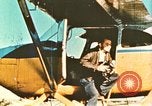
People ski down a snow covered area in the United States.
A mountainous region in the Western United States. A man wearing a hard hat as he looks skyward. A photographer leaning out of the door of a parked small plane, preparing to take a photograph. Snow covered mountains of a Western U.S. ski area. Two ski patrol members moving an unoccupied stretcher sled beside a wooden ski lodge. View of chair lift arrival area at top of mountain. Skiers on the slopes. Men ski down a snow covered slope.
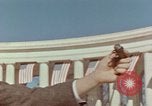
President John F. Kennedy at the Tomb of the Unknown soldier on Veterans Day in Virginia, United states.
A film about President John F. Kennedy's last Veterans Day ceremony at Arlington National Cemetery in Virginia, United States, just 11 days before his assassination. The President's Own United States Marine Corps Band plays at the Amphitheater. Honor Guard and Color Guard march amidst spectators towards the podium. Band plays as Honor Guards hand over six freedom torches to representatives of six different nations at the ceremony. Chairman of the Veterans Day National Committee addresses the gathering. He talks about the importance of Veterans Day. U.S. Army General David M. Shoe addresses the audiences. View of graves and scenes at the Arlington National Cemetery. The United States Marine Band plays. Various views of the musicians as they play, and of band director Albert F. Schoepper. People applaud. A man amongst the audiences clicks pictures. People stand as President John F. Kennedy leaves. People pay respect to the war veterans. Marine Corps War Memorial. A guard at the Tomb of the Unknowns. Wreaths at the Tomb of the Unknown soldier.
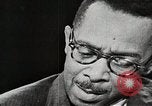
K Clark interviews Martin Luther King on non-violence movement of African Americans and the America's Promise in United States.
Doctor Kenneth Clark, Professor of Psychology at the City College of New York; Director of Fallen Youth Opportunities Unlimited and Research Director, North Pride Center for Interpretation sits in a chair. He interviews Martin Luther King Jr., the famed civil rights leader. Martin Luther King Jr. expresses his views on love, the non-violence movement, and America's promise. King reacts to reported comments from Malcolm X about King's non-violent movement. Martin Luther King, Jr. speaks about the demonstrations in Birmingham, and the teaching of the philosophy of non-violence that was effective in Birmingham in the face of violence from others.