


 Francais
 Deutsch
 Italiano
Refine Your Search
Souilly France 1916 stock footage and images
- Showing 73 to 78 of 5648 results more
more Hide
Hide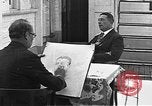
Count Felix Von Luckner visits Los Angeles on "Peace Tour," in 1927
Count Felix Von Luckner visits Los Angeles, California, while on a "Peace tour," in July, 1927. He is famous for his exploits while in command of SMS Seeadler (Sea Eagle) in 1916-1917, during World War 1. He sits, posing while and artist sketches his likeness. Next, he is seen on the deck of the sailing ship, Vaterland, with his Swedish wife, Countess Ingeborg. They hold two dachshund dogs. The Count, in mufti, accompanied by Captain, Julius Lauterbach, strolls the deck of the Vaterland "inspecting" the crew. Camera shifts to closeup of the masts and rigging of the Vaterland, and then down to her hull. Von Luckner on the bridge commanding the Vaterland, which begins to move slowly. Starboard view of the Vaterland, with 4 main masts bare and only flying jib, inner jib, and Fore Topmast Staysail set. View on deck of the Vaterland, where Von Luckner, his wife, and Lauterbach watch U.S. Navy ships of the American Battle fleet, as they pass them. They pass a U.S. Dreadnought battleship. View from land as the Vaterland passes Los Angeles Harbor Light, aka Angels Gate Light, at San Pedro Breakwater in Los Angeles Harbor.
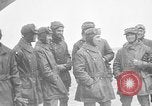
U.S. 1st Aero Squadron supports Punitive Expedition into Mexico
U.S. aviators of the 1st Aero Squadron pose in front of a Curtiss JN-3 airplane their base in Columbus, New Mexico, in 1916. The rest of their aircraft are lined up, parked, side by side. Scene shifts abruptly to views of camp below, from an airplane flying above it. Pilot is seen in open cockpit.
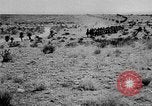
U.S. Army units enter Mexico in pursuit of Pancho Villa during Punitive Expedition
U.S. Army Cavalry moving across desert terrain in Mexico, during the Punitive Expedition against Pancho Villa. They proceed single file down a hill followed by pack horses carrying supplies. Closeup of the (only) Jeffery Armored Car Number One. (Built for evaluation, in 1916. It is armed with four .30 cal Benet-Mercie machine rifles and had two fully revolving turrets.) Here it is deployed in the Mexican desert. View of it coming along a dirt road, down a hill. Next, armed cavalrymen are seen running to their horses, mounting up and riding in loose formation. They are then seen in formations making a cavalry charge. A wagon train of covered wagons carries supplies across a bridge. Several views of such supplies in wagon trains raising dust as they proceed along dirt roads.
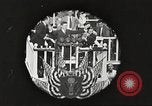
Scenes of the 1924 Democratic National Convention held in Madison Square Garden, New York City
1924 Democratic National Convention, at Madison Square Garden in New York City from June 24 to July 9, 1924. The alphabetical process of nominating candidates begins with Alabama and Forney is seen Johnston, putting Senator Oscar Underwood's name into consideration. View of men at the podium. Bernard Baruch, a supporter of William McAdoo, is seen standing in background. View of the crowded Madison Square Garden, filled with delegates. Some carry a banner reading: "Wilson 1916 for McAdoo 1924." The various State delegations are identified by signs with their State names on them. Kentucky, Massachusetts, and Hawaii (U.S. territory) are seen. As the camera pans the gathering, many more State signs are seen. Outside , in Madison Square Park, a loudspeaker is set up on a truck and a crowd is gathered to listen to events. Back inside Franklin D. Roosevelt, Al Smith's campaign manager, is seen giving a speech nominating Smith for President. Supporters hold up Posters displaying Smith's picture. Closeups of some of the banners. Ticker tape being thrown to celebrate the end of the convention, which ended on July 9th after the 103rd vote finally carried for compromise candidate, John W. Davis of West Virginia. Governor Charles W. Bryan of Nebraska was selected as the vice-presidential nominee.
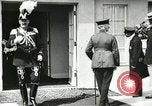
Kaiser Wilhelm II dedicates Germany's new Olympic Stadium on the 25th Anniversary of his Coronation
On June 8, 1913, the 25th anniversary of his coronation, Kaiser Wilhelm II presided over the inauguration of the new stadium (Deutsches Stadion) built near Berlin, to host the 1916 Olympics. These scenes were recorded immediately after the ceremonies. A German Admiral exits from a stadium building in Deutsches Stadion (Deutsches Stadion, Olympischer Platz 3, 14053 Berlin). Soon after, Kaiser Wilhelm II, exits, conversing with German Chancellor, Theobald von Bethmann-Hollweg. The Kaiser is attired in Hussar full dress uniform with fur busby. A German officer salutes and directs the Kaiser to athletes (German Olympic hopefuls) standing to the side, whom he introduces to the Kaiser. The Chancellor turns back into the building, and Empress Augusta Viktoria emerges and stands nearby, as the Kaiser speaks with the athletes and shakes hands with several of them. He chats amicably with the introducing officer, who smiles and salutes. The Kaiser then climbs into a waiting carriage in which the Empress is already seated. She holds a booklet or program in her hand. Attendants place a carriage robe over the Royal Couple and the carriage departs. Spectators watching the Royals are seen behind a railing at the Grunewald Racecourse track (part of the complex). The broad expanse of athletic grounds is behind them. Final scenes show many youths, walking along at the end of the ceremonies. in various uniforms (representing schools or clubs). some carry programs. some wear sashes on their outfits. Family groups are also seen. Stadium seats are seen briefly in the background to the left. A group of girls wearing dark skirts and white blouses with dark ties, are among the various small groups of youth walking together. (Note: The Deutsches Stadion was located in an area reserved as a Peoples' Park, by the Kaiser, in 1904. The property was leased for 30 years, in 1907, by the Union-Klub for the Grunewald Racecourse. But it also continued to serve general sports activities. The stadium was built on the racecourse grounds.)
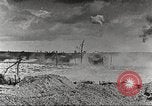
Extract from British feature film "The Somme," made in 1927, depicting warfare on the Western Front during WWI.
Reenactment of scenes from 1916 in World War 1, filmed in 1927 in Southwest England. Two British Mk V Tanks advance through shellfire. One has its gun mountings plated over and has dummy guns; the other has its gun mounts intact, though the guns might be dummies, and carries anti-grenade mesh on its roof. (These are by historical errors by the film makers, since this type of anti-grenade protection was not carried on Mark V [Mark 5] tanks, and the Mark V did not enter service until 1918.) The tank advances towards enemy trenches, followed by British soldiers who pursue German soldiers fleeing along the network of trenches. The tank, filmed from below, in the trench, as it moves over the trench. Note: (The film "The Somme" can be seen in full on the British Film Institute website.)
CRITICALPAST.COM: About Us | Contact Us | FAQs - How to Order | License Agreement | My Account | My Lightboxes | Shopping Cart | Advanced Search | Featured Collections | Website Terms & Conditions | Privacy Policy ©2026 CriticalPast LLC.
License Agreement |
Terms & Conditions |
Privacy Policy
©2026 CriticalPast LLC.