


 Francais
 Deutsch
 Italiano
Refine Your Search
Souilly France 1916 stock footage and images
- Showing 2875 to 2880 of 5648 results more
more Hide
Hide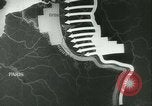
German tanks, horses and troops cross the Rhine on barges and rafts during their advance towards France in WWII.
The German assault on France during the Battle of France in World War II. An animated map depicts the German attacks on the Maginot Line and city of Paris. German Field Marshal Erwin Rommel (Desert Fox) confers with a German officer. German soldiers in a fields, pull an armored vehicle with ropes. Smoke from bomb explosions. Bomb damaged buildings. German tanks advance. The Germans cross the Rhine. Soldiers cross over a bridge and in boats, load and fire artillery. Explosions on either side of the river. Soldiers and civilians lay planks to build a bridge. Soldiers in amphibious vehicles cross the river. Tanks, horses and troops cross the Rhine on barges and rafts. Camouflaged German tanks. German officers review the advance. Soldiers eat rations, drink water and take rest. The horses are fed. Soldiers on motorbikes and in tanks on a street.
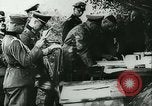
French POWs taken by Germans forces as they close in on Dunkirk during the Battle of France in World War II.
The German assault on France during the Battle of France in World War II. An animated map depicts the German attacks on the Maginot Line and city of Paris. An animated map depicts the positioning and movement of the English and French Armies on one side and the Germans on the other side of the Maginot Line (defensive line) on the French border towards Germany. Germans forces fight through a city as they close in on Dunkirk. German troops load and fire artillery. Black smoke arises due to explosions in the battlefield. A gun barrel as the gun is fired. A German officer gives orders to fire. Soldiers cover their ears with their hands as the guns are fired. French soldiers seen firing artillery at night, in defense. Blazing ruins of city at night, consumed in fire and flames. German tanks advance. Soldiers fight at night. Officers give orders to load and fire artillery. Smoke due to the explosions. Machine guns fired. Burning buildings and wrecked vehicles. German soldiers search French POWs (Prisoners of War). The prisoners seated behind a barbed wire fence at the prison camp. Captured French General Henri Giraud exits a German aircraft. He is met by German officers.

'Miss France of America' visits the Parisian set of 'Wild and Wonderful' in Universal City, California.
A party on Parisian set of 'Wild and Wonderful' at Universal City in California. People on the set. Woman clicks pictures. A car arrives. 'Miss France of America' Vivian LaForge steps down from the car. Actor Tony Curtis crowns Miss Vivian LaForge. Christine Kaufmann, German-Austrian actress and wife of Tony Curtis, looks on. Veteran Canadian American actress Fifi D’Orsay meets LaForge on set. A dog named Bernardo Barkalot also appears on set. Sign of a Parisian cafe. Miss France of America stands with a woman. Aerial view of a set based on a Montmartre, Paris Street.
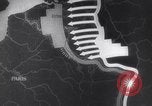
German Generals plan and execute attack west toward France, penetrating the Maginot line in World War II
Film opens with animated map showing plan to attack to the west against France, employing Heeresgruppe A, commanded by Marshal Gerd von Rundstedt. View of Marshal von Rundstedt in a planning session with staff officers. The animated map shows other German forces in the Westward offensive, including armies under Field Marshals Günther von Kluge; Wilhelm List; and Ernst Busch. It depicts the French defensive Maginot line and the concentration of German forces, under Marshals Von Kluge and List, to pass through it and drive to the coast of the English Channel, cutting off attacking English and French attacking armies. Views of German troops advancing westward. They follow a tank firing rounds. Others are seen carrying large boats to cross rivers and some unloading timbers and other items to repair bridges as they proceed under fire with shells bursting all around. A Panzer I (Panzerkampfwagen I Ausf. A) advances and German infantry gather explosives from rubber boats. Infantry follow a Panzer I tank firing its guns as it moves across a field. German infantry paddle across a river in rubber boats. They uncoil and lay long wires along the ground. Other use prefabricated timbers to cover a pontoon bridge, or barge. . German utility vehicles drive along a shallow river bed. Large numbers of German soldiers along with horses, cross a river in boats and barges. A Panzer I tank drives onto a pontoon barge. German soldiers and a civilian ride atop a Panzer I tank. Scene shifts to Field Marshal Günther von Kluge strolling victoriously to a German headquarters in France, where he exchanges greetings with other officers. Remaining scenes focus on the ordinary German soldiers.They are seen preparing meals; napping; tending to horses; dealing with their equipment and armor, including a Half Track Personnel Carrier (Hanomag Sdkfz 251/1). Brief glimpse of German officers in planning session outdoors.
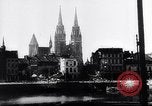
Britain attempts to recover its defensive capabilities following equipment losses in the evacuation at Dunkirk, France, in World War II
Opening scene shows a cathedral and houses near the English Channel coast in World War 2. German troops, part of a force of 100 Divisions, are seen advancing through French towns toward the coast. A German army band leads some. Others march through the countryside. Close-up of some ot the marchers, along with a Sd.Kfz.9 Half-Track pulling an artillery field piece. A column of German army trucks raising dust on a French country road and many waiting in line to cross a canal. A covered German halftrack pulling a covered trailer across a partially collapsed bridge. View from a moving railroad train with German troops and one manning an MG-08 machine gun on an open flat car. German soldiers in a "bucket brigade" passing cargo, including jerry cans, being off-loaded from a German Junkers Ju-52 transport plane at a grass airfield in France. A German Krupp K5 railway gun being run up an elevated rail. Imaginative animated map showing Nazi-dominated Europe in contrast to the British Isles. British troops marching. Change of scene to the beachhead at Dunkirk, France, during the mass evacuation of British forces ahead of approaching German armies. View from a British Destroyer of troops wading out through the water towards it. Close-up of two British soldiers being pulled from the water onto a boat, by two men in fowl weather gear. In skies above, British and German aircraft are engaged in aerial dogfights. A British Destroyer filled with soldiers evacuated from Dunkirk. Vickers/Maxim Octuple QF 2-pounder Mark VIII guns being fired by a British warship. British soldiers, some covered with oil, on the deck of a destroyer. Scene shifts to armor and weapons abandoned by the retreating British forces, including trucks, tanks, anti-aircraft guns and armored cars. Scene shifts to England where rescued soldiers begin ascending a gangway from the crowded deck of a warship to a pier above. Smiling British soldiers relaxing as they arrive on a pier. Many rescued soldiers getting organized on land. Narrator mentions that the losses of war materiel leave Britain short of its needs. Soldiers standing around a British Infantry Tank Mk.III Valentine. Soldiers manning a coastal defense machine gun position. Views of the British English Channel coastline. A British battleship (or Battle Cruiser) showing two forward triple gun turrets, is seen underway, ahead of an aircraft carrier. Silhouetted distance views of several British destroyers, and closer view on one escorting a supply shiip. (Narrator notes the British navy was absorbed in protecting supply lines all over the globe.) Animated map illustrates the overwhelming superiority of German Air Forces directed against Britain. view of British airfield displaying flag with Union Jack and RAF roundel. Several RAF personnel stand around an Avro Anson twin engine airplane, parked on the ramp. Several Supermarine Spitfire aircraft are seen parked on an airfield. Close-up of two flying in formation. View of St. Paul's Cathedral in the heart of London, England. British people are seen in a city and at home engaged in ordinary activities, scrubbing floors, chatting over drinks at a Pub, and waiting on a customer in a lady's shop. A farmer tends sheep in a field next to a church, where he converses with the Vicar. A baby crawls across pavement to his mother who reaches out from a doorway. New recruits in uniform mingle with people on a sidewalk. Mature women in uniform walk along with British Army officers in uniform. British sailor and an officer walk past the camera. A boy and older men at work in a field. Four businessmen dressed in civilian clothes are next seen in military uniforms, shouldering rifles. Home Guard civilians carrying rifles are trained in close order drills on a lawn. A home guard man points to a drawing of a tank as he asks a question during an outdoor training session. Recruits watch demonstrations with Browning M1917 water-cooled machine gun, and hand grenade launcher on Enfield rifle. A recruit takes his turn firing a single round (to save ammunition) from a Thompson M1921 submachine gun. He hands the weapon back to the instructor and returns to his place.
German invasion of France,sinking of RMS Lusitania and resignation of William Jennings Bryan
Events during World War I. Sketches : workers in a German arms factory. German soldiers advance towards France. Animation of a map shows the German invasion of France through Belgium. Kaiser Wilhelm II, the German Emperor. Buildings damaged by invading Germans. U.S. president Thomas Woodrow Wilson advises Americans to stay calm. American people read papers. Cartoon depicts the President about his domestic reforms. The German atrocities in Belgium. Man holds a dead person. Sketch depicts Germany crushing everything on its way. The apprehensive people of America. Sketches of American man against a German leader. Trucks and taxi cabs on the Orne river. A gun barrel. Bombs being dropped on the German ships. Worker at a factory in America. Sketch of a man standing beside a flag having the dollar sign shows the prosperous America. Sketch shows the various resources required by the American industries. An American ship carrying war materiel. Sailors in German submarines. German submarines target allied ships. Sketches of U.S. president Wilson warning Germany. On 1st May 1915 RMS Lusitania a British luxury ship at sea as it starts from New York. Paper shows a warning by the German government. A German sailor on board a submarine as it targets a ship. The RMS Lusitania ship sinks killing many, including Americans. The U.S. secretary of State William Jennings Bryan and Thomas Woodrow Wilson with other officials. The former U.S. president Theodore Roosevelt addresses people opposing President Wilson's policy. The President prepares a note for Germany. Sketch of U.S. Democratic Presidential candidate William Jennings Bryan during his resignation. Sketch of Kaiser Wilhelm II.