


 Francais
 Deutsch
 Italiano
Refine Your Search
Souilly France 1916 stock footage and images
- Showing 3631 to 3636 of 5649 results more
more Hide
Hide
America mobilizes for World War I and confronts demobilization afterwards
Opening scene shows Austrian Archduke Franz Ferdinand and his wife, Sophie, Duchess of Hohenberg. Newspaper swirls into the image, with headline announcing their assassinations. Glimpse of railways guns firing. View of a ship's bow as it sinks beneath the ocean, is covered by newspaper headline announcing the sinking of the RMS Lusitania, by a German submarine. U.S. President Woodrow Wilson at his desk. Newspaper headline reads: "U.S. Declares War !!" U.S. soldiers marching in Washington, DC, with U.S. Capitol building in background. Newspaper announces: "Yanks are Coming!" American General John Pershing on horseback leading a contingent of the American Expeditionary Forces (AEF). American troops going "over the top" (charging out of their trenches) in France during World War 1. Troops firing French 75 artillery pieces at point blank range. A formation of Allied Airco (de Havilland) DH9 aircraft in flight. Bombs bursting near trenches on the front lines. Renault FT-17 tanks accompanying American infantry on the Western Front. Persons playing roles as employees in the Department of Labor when they served as the War Labor Administration in World War 1. Women in the War Labor Administration working with long paper rolls of personnel records. Women in various war effort endeavors including airplane and arms manufacturing. Men working in a wartime steel plant. Marchers and a band demonstrating for the rights of workers to organize. People celebrating the at the end of World War 1, by gathering in the streets, throwing tickertape, dancing in the streets and waving effigies of the Kaiser. Stern view of the U.S. Army Transport Ship, President Grant filled with American soldiers returning from France at the end of the war. Lettering on stern reads, "U.S.A.T. President Grant" (The ship, AP-29, was originally the German ocean liner Konig Wilhelm II, and seized from Germany on 6 April 1917.) Views of United States soldiers returning home, disembarking, and assembling on a wharf home on American soil. Department of Labor persons assisting returning soldiers and prospective employers. Views of workers on farms, and in factories.

German and Russian troops battle in the Soviet Union during World War II.
Vichy French newsreel (produced in German occupied France) "France Libre Actualities," with English audio dub, shows the plans and preparation made by the Germans for the campaign in North Africa during World War II. Animated map shows the territories occupied by the Allies and the Axis powers during the war. View then shifts to action of German troops in a battlefield in Caucasus region and Soviet Union. Explosions and gun fire. The map shows the German Army troops entering Stalingrad in the Soviet Union. German artillery, aircraft and infantry in action. A number of German tanks advance in a counter offensive near Stalingrad. German Luftwaffe aircraft in flight. Damaged German aircraft on the ground. Russian and German troops battle in extreme cold conditions with tanks firing at the enemy. A fleet of aircraft in flight. Troops on horseback and foot.
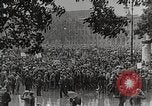
Demonstrators in front of the Altes Museum in the Lustgarten, Berlin, Germany
Demonstrations in Berlin, Germany. People gather in large numbers in front of the Altes Museum (Bodestraße 1-3, 10178 Berlin, Germany) in Lustgarten. They hold signs and banners. One sign reads, " Frankreich gieb unserer Kameraden Frei," an appeal for France to free German prisoners of war. (Note: After World War 1, France was slow to repatriate German prisoners of war, and had transported many abroad, to work in her colonies.)
Various cities in Europe being liberated from Nazi occupation (WW2)
Allied campaign against the Axis powers in 1944 during World War II. People gathered outside the Colosseum (Piazza del Colosseo, 1, 00184 Roma RM, Italy) in Rome, Italy celebrate their liberation from occupation by Nazi Germany. Allied soldiers in trucks move past the cheering crowds. Pope Pius XII addresses the people from a balcony. Victory parade in Paris, France at the Arc de Triomphe (Pl. Charles de Gaulle, 75008 Paris, France) on August 26, 1944. French children clapping. People cheer as they carry banners. In Bucharest, Romania soldiers loaded onto trucks drive past crowds cheering after their liberation. On 3rd of September 1944 people cheer on the streets of Brussels, Belgium as Allied troops enter. A woman sits on top of a moving Jeep. In Belgrade, Yugoslavia on October 20, 1944 people celebrate their liberation. In Athens, Greece women carry a Greek flag and a flag being hoisted after their liberation.
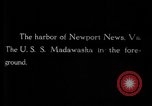
U.S. troops with their supplies depart for World War I duty on USS America and USS Madawaska at harbor in Newport News, Virginia.
American Army forces heading to France during World War 1. U.S. Army troops embark from Newport News, Virginia for France in 1918 during World War I. View of the Newport News harbor. USS Madawaska in the foreground. Other ships in the background. The troops with their supplies embark on USS America. They walk up a gangplank. The troops on the deck of USS America. The troops climb on the mast.
Recovery and improved economic conditions during the beginning of the Marshall Plan in Europe.
A documentary 'The Years of Decision' reviews the beginning of the Marshall Plan in response to recovery needs of the European people following World War 2. Busy streets and sidewalks filled with pedestrians in London as people walk in the city. Double decker buses and other vehicles driving past on a road in the background. People in France walking on streets of city, sitting in cafes, and buying food, produce, textiles and other items from market vendors with stalls and carts. Men and women buy things from shops. Scene changes to the Netherlands, with many men riding bicycles arriving or departing work at Heineken Brewery in Amsterdam (Heineken Brouwerij on Stadhouderskade). The Dutch words “Stoom Bierbrouwerij” (Steam Brewery) are seen on the building. A Dutch man in a textile factory works at a weaving machine. Scene changes to a coal mine area in the United Kingdom. British coal miners sitting in a train headed into a mine. A worker at the Fiat factory in Turin, Italy measures a small steel part used in manufacturing cars. Cattle on a farm walk near barns. A French farmer in France driving a tractor.
CRITICALPAST.COM: About Us | Contact Us | FAQs - How to Order | License Agreement | My Account | My Lightboxes | Shopping Cart | Advanced Search | Featured Collections | Website Terms & Conditions | Privacy Policy ©2026 CriticalPast LLC.
License Agreement |
Terms & Conditions |
Privacy Policy
©2026 CriticalPast LLC.