


 Francais
 Deutsch
 Italiano
Refine Your Search
Souilly France 1916 stock footage and images
- Showing 4621 to 4626 of 5648 results more
more Hide
Hide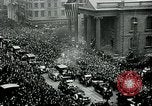
French Marshal Joseph Joffre visits the United States during World War I and is cheered at Joffre Day celebration.
A massive crowd on city streets of New York gathered to cheer Marshal Joseph Joffre of France on his visit to the United States during World War 1. (This is likely the New York City "Joffre Day" celebration on May 11, 1917). Cars move in between the crowd. People carry U.S. flags. Marshal Joseph Joffre talks with a man during his visit to United States. (World War I; World War 1; WWI; WW1)
Civilians run with their possessions as cities are bombed in World War 2
Various scenes of bombing in Europe during World War II. Scenes in the United Kingdom, France, and other European locations. Buildings burning at night following an aerial bombing raid by German aircraft. Defense soldiers on the ground working to spotlight enemy aircraft and return fire with anti aircraft guns. Buildings on fire and smoke rises. Workers try to extinguish a building fire as the building collapses. Large crowds of civilians fleeing including children. Burned building. People on streets of a European city fleeing an aerial bombing raid. Enemy planes in sky. Refugees run with their possessions, fleeing war zones.
British Prime Minister Chamberlain, Adolf Hitler, Benito Mussolini and French Prime Minister Edouard Daladier, meet in Munich
Enthusiastic German audiences in and around the Berlin Sportpalast in Germany listen to Adolf Hitler speak as he harangues them about the Sudetenland issue. Interior views and exterior views of the Sportpalast. Scenes of German military on wartime footing: German Navy sailors marching, German warships at sea, and German Air Force aircraft in flight. Neville Chamberlain departing London for a last attempt at diplomatic settlement with Hitler, while at home, the British prepare for the worst, placing sandbags around government buildings, enlisting in the military, and generally preparing to defend themselves, if necessary. Adolf Hitler walking along a train platform with Benito Mussolini, who has arrived for the Munich summit meeting, followed by Hermann Goering and Heinrich Himmler. Munich street scenes with enthusiastic German crowds lining the sidewalks waving flags as Hitler and others proceed through the city streets in a motorcade. Prime Minister Chamberlain riding in an open car with Joachim von Ribbentrop, German ambassador to Great Britain. Chamberlain of Britain, Edouard Daladier of France, German officials, and Mussolini, entering the Führerbau, with their respective retinues. While the negotiations go on in Munich, a crowd gathers and cheers Mrs. Chamberlain, in front of 10 Downing Street, London. Crowd surrounds car carrying Prime Minister Chamberlain, cheering in belief that his mission to Munich was a success. The Chamberlains appear on a balcony amidst cheers from London residents.

Invasion of Egypt during the Suez Crisis
Film opens with aerial views of City of Suez and environs during the invasion of Egypt by Israel, Britain, and France, to seize control of the Suez Canal and overthrow Egyptian President Gamal Abdel Nasser, in 1956. At TC:00:24 is an aerial view of two ships scuttled by the Egyptians in Port Said at the entrance to the Suez Canal. Many ships are seen in Port Said, itself, including a large British landing craft (L9006). Glimpse of British sailors on the landing craft with Union Jack waving above them. Formations of British soldiers, wearing Balmoral bonnet headgear, marching inland from the port. Area of the port covered with artillery pieces and war materiel being loaded into trucks. Closeup of British soldiers loading shells and ammunition into trucks. Egyptian men mingling on the streets of Port Said. A British soldier and an officer are seen amongst them. Low altitude aerial view of the Suez Canal. View of ships at entrance of the Canal in Port Said (with the scuttled ship blockade behind them) . A British Dido Class light cruiser is seen with the ships.

Signing of the surrender note aboard the USS Missouri after the surrender of Japan to the Allied Forces in World War II.
Signing of the instruments of surrender formalizing the capitulation of Japan to the Allied Forces in World War II. The Battleship USS Missouri in the Tokyo Bay. The U.S. Destroyer, Buchanan, pulls alongside bringing representatives of the Allied Powers to participate. U.S. General of the Army, Douglas MacArthur, Supreme Commander of Allied Forces boards the USS Missouri and is welcomed by Fleet Admiral Nimitz and Admiral Halsey. They proceed to the ship's Veranda deck for the signing ceremony. Japanese delegation led by Foreign Minister Mamoru Shigemitsu, accompanied by General Yoshijiro Umezo arrives in a boat. Speech by MacArthur as Japanese delegation looks on. Japanese representatives sign the surrender instruments. General MacArthur then signs using several pens that he presents to U.S. General Wainwright and British General Percival and others. Admiral Chester Nimitz signs for all U.S. forces, followed by Admiral Halsey. Allied representatives then sign for China, the United Kingdom, Soviet Union, Australia, Canada, France, Netherlands, and New Zealand. MacArthur gives closing comments. Allied aircraft fly overhead after the ceremony.
History of Germany as a group of 300 medieval princely states with feudalistic rulers.
Mix of actor portrayals and actual footage: Church, homes and schools of America. Various United States soldiers. Views of German soldiers. German soldiers marching in a parade ground. Rulers and dictators of Germany: Adolf Hitler (World War II), Kaiser Wilhelm II, Otto Von Bismarck who laid identity of Germany as Nazi, Huns, and Prussians respectively. Historic overview of Germany. Princes and feudalistic rulers of the states. In contrast the US, French and British parliamentary system. King Frederick, the Great of Prussia with his cavalry and in his court. Prussian war against Austria, Russia, Sweden, France. German women wave for victorious troops. Portraits of Scharnhorst and Gneisenau. Dictums of Clausewitz, crushing of the 1848 revolt in Prussia. Germans emigrate to the U.S. Otto Von Bismarck addresses the ministry his policies of blood and iron.
CRITICALPAST.COM: About Us | Contact Us | FAQs - How to Order | License Agreement | My Account | My Lightboxes | Shopping Cart | Advanced Search | Featured Collections | Website Terms & Conditions | Privacy Policy ©2026 CriticalPast LLC.
License Agreement |
Terms & Conditions |
Privacy Policy
©2026 CriticalPast LLC.