


 Francais
 Deutsch
 Italiano
Refine Your Search
Souilly France 1916 stock footage and images
- Showing 4711 to 4716 of 5648 results more
more Hide
Hide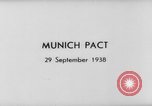
Neville Chamberlain, Édouard Daladier, Benito Mussolini, Galeazzo Ciano and Adolf Hitler sign the Munich Pact in Germany.
The signing of the Munich Pact in Germany on 29th September, 1938. The Führerbau where the agreement is to be signed. German Chancellor Adolf Hitler and other German officials look at the agreement on a table. The Prime Minister of the United Kingdom Arthur Neville Chamberlain, the Prime Minister of France Édouard Daladier, the Prime Minister of Italy Benito Mussolini and Italian Minister of Foreign Affairs Galeazzo Ciano enter a hall. All the dignitaries and Hitler stand together before signing the Munich Agreement. They sign the agreement.

Unescorted B-17 Flying Fortress planes under heavy attack by German FW-190s during Schweinfurt raid in World War II.
Scenes of the first daylight strategic bombing by the United States Air Forces against targets in German-controlled Europe. A dozen B-17s execute the first mission against railroad marshaling yards in German-held Rouen, France, on August 17, 1942. A year later, large numbers of U.S. bombers attack Schweinfurt, Germany during World War II. U.S. B-17 Flying Fortress planes take off from U.S. Air Base in England. A formation of B-17s in flight. They head towards Germany. U.S. General Dwight D. Eisenhower and his aides confer. Unescorted B-17s over Schweinfurt under heavy attack by German FW-190 fighter planes. The B-17s drop bombs over the target area. Ruins of Schweinfurt after bombings. A FW-190 goes down after facing attack. Dead and wounded men unloaded from B-17s which return from the Schweinfurt raid. Panoramic views of ruined Schweinfurt on August 20, 1943.

Italian Giulio Gaudini versus André Gardère at fencing finals event of 1936 Berlin Olympics, Germany
Fencing event at Berlin Olympics, Germany. Italian commentator relating details. In another fencing event, Giulio Gaudini from Italy defeats André Gardère of France.
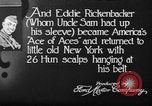
Eddie Rickenbacker returns to New York at the end of World War I
Eddie Rickenbacker returns from France, to New York at the end of World War I. A large crowd greets him, as he shakes hands with an officer. He shakes hands with a young boy. (World War I; World War 1; WWI; WW1)
Various Aircraft tow gliders during World War II.
Preparations for Allied invasion of Normandy, France during World War II. During Glider development programs, gliders come in for landing towards stake to which white flag is tied. B-25 takes off as it tows a CG-4A glider. P-38, PBY-5A, B-17 and C-54 aircraft take off as they tow gliders. C-54 takes off as it tows three gliders (a "triple tow") and aircraft in flight.
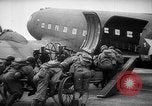
Equipment loaded in planes and gliders for Allied invasion during World War II.
Preparations for allied D-Day invasion of Normandy, France during World War II. United States Air Borne Aviation Engineers load equipment in a C-47 aircraft. An engineer backs a tractor in a glider. Men and equipment moved across a field and loaded into CG-4A glider. Men raise rear section of equipment up for loading into a ramp. Nose section of a glider raise for loading vehicles into front end. Men and equipment in preparation for fast loading. Jeep backed into front end of loading ramp of a glider. A trailer, small canon and a carriage loaded into a glider. A pilot walks into the plane and takes over controls.
CRITICALPAST.COM: About Us | Contact Us | FAQs - How to Order | License Agreement | My Account | My Lightboxes | Shopping Cart | Advanced Search | Featured Collections | Website Terms & Conditions | Privacy Policy ©2026 CriticalPast LLC.
License Agreement |
Terms & Conditions |
Privacy Policy
©2026 CriticalPast LLC.