


 Francais
 Deutsch
 Italiano
Refine Your Search
Souilly France 1916 stock footage and images
- Showing 4801 to 4806 of 5648 results more
more Hide
Hide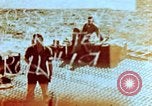
B-26 aircraft of the USAAF 323rd Bombardment Group bomb targets in Germany near end of World War II in Europe
Opening scene shows view from aircraft as general purpose bombs are dropped on German targets in World War 2. Camera in aircraft track the fall of the bombs until they explode on the ground. Scene shifts to aerial views of Martin B-26 Marauder aircraft of the 323rd Bomb Group, identifiable by their white tails. A formation of the B-26s. View of right main landing gear extending as a B-26 comes in to land at the Denain-Prouvy Airdrome, France (A-83).
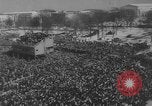
Inauguration of John F Kennedy as 35th President of United States in Washington DC and his later visits to various European nations.
Swearing in of John Fitzgerald Kennedy as 35th President of United States and his subsequent tour to various European nations, United States. Kennedy swearing in as President during a ceremony and a large crowd gathers. Crowd applauds as he takes oath. Other dignitaries stand near him. Kennedy shakes hands with the former Prime Minister Dwight D Eisenhower. Kennedy during his visit to France meets with President Charles de Gaulle. Kennedy during meeting with Soviet leader Nikita Khrushchev. President Kennedy disembarks from Air Force One plane in Britain greeted and escorted by British Chiefs of Military Staff.
European Heads of State review their respective forces mobilizing for World War I. Glimpses of trench warfare.
German Kaiser Wilhelm II walks among German troops assembled for inspection in Berlin, Germany at outbreak of World War 1. The Kaiser and senior commanders review the troops on parade. The last contingent in the parade comprises civilian officials in top hats. French Prime Minister, Alexandre Ribot, is saluted by a military honor guard as he exits a building. He doffs his hat and turns in deference, as Raymond Poincaré, President of France exits behind him. They both enter a waiting car, followed by the French Minister of War, Jean Brun., who joins them. As they are being made comfortable in the car, French General Ferdinand Foch, exits the building (wearing a great coat) and is escorted by another General. In Russia, Emperor, Tsar nicholas ll, leads military commanders as they review a contingent of Russian guards in formation on the platform of a train station in Moscow. Camera pans across crowds filling the Palace Square, St. Petersburg, upon the declaration of war on 20, July, 1914. Base of the Alexander Column visible in center of crowd. Russian troops file into well established trenches. Huge explosions raise tons of earth amongst the trenches. Troops flee for safety. Many take cover in large shell craters. Several fall to machine gun fire, near barbed wire. A book is opened to a page entitled: "Military Program Proletarian Revolution" (in Russian). German troops are seen from above and behind sheltered in a trench with a desolate battlefield in front of them. Closeup of the troops. Next, Russian troops who died are seen in a water-filled trench. One is holding an M1891/Mosin–Nagant firle. Closeup of another soldier, covered in mud leaning against sandbags. Bodies of two soldiers at a pond of water in their trench. One is immersed, with face up, in the pond and the other is reaching down into it. What appear to be the bodies of soldiers entangled in barbed wire at edge of trench..
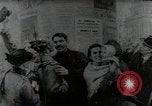
Nations in various stages of mobilization before and during World War I
Nations mobilizing for World War 1 (The Great War).from 1914 through 1917-18. Civilians in a Slavic country react to information fastened on a large circular post. Closeup of British Mark II tanks moving near the camera, followed by view of British Whippet tank in front of army trucks. Uniformed, armed, German troops assembling in a town square. German General Paul von Hindenburg leading members of his staff and a diplomat, on inspection of troops. A Russian officer on horseback with troops assembled in a city park. Unusual grouping of Military officers from Germany (wearing Picklehaube helmets); France; and Russia (including a Cossack), gathered in front of a Russian Orthodox Church (presumably somewhere in Russia) prior to World War 1. Anachronistic view of middle-aged Winston Churchill giving an address, before numerous microphones. U.S. Marines hurrying along a waterfront pier, past a variety of boats docked in a city marina. American soldiers looking at a U.S. Connecticut-class battleship docked at a pier, displaying a large American flag, during World War 1. Camera pans across the pier. Crew members seen on Japanese battleship, Settsu. Japanese troops disembarking from a transport ship covered with ice.
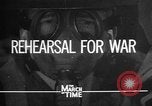
U.S. Military experts evaluate the Spanish Civil War and militarization of fascist Italy and Germany under Mussolini and Hitler.
Documentary titled the "'Rehearsal of War." Film begins showing shells bursting in hills as a soldier runs for cover in foreground. Next, a Republican Soldier helps a wounded comrade walking along a road. More views of combat in Spain. View of the State, War, and Navy Building in Washington, DC. Sign over a doorway reading: "Chief of Staff." Inside, General Malin Craig, in civilian clothes, flanked by two officials, examines a report entitled, "Analysis of the "Brihuega Campaign." The document also reads: "Guadalajara Front." and is dated 3/27/1937. A document (Classified "Confidential") is shown that discusses the capabilities of the French 20mm Moteur canon firing 300-400 shots per minute with explosive shells.Glimpse of an Army officer's hand marking a map in a book. On his table is a book entitled,"Two World's in Conflict, We or They." Flags of Germany and Italy are seen. Closeup of Benito Mussolini in arms-crossed pose. Italian crowd cheering. View of Adolf Hitler standing with Marshal Hermann Goering, German Army Chief of Staff, Werner von Fritsch, and Rudolf Hess (just barely seen). Animated map of Europe shows Germany and Italy with desired expansion of both. Mussolini walks with military officers past a large Italian trimotor transport aircraft. A field filled with Italian light tanks armed with one small gun each. Each is crewed by one man. A parade of German Sd.Kfz.7 halftrack transporters filled with troops and each pulling an 88mm Flak gun on a Sonderanhänger 201 trailer. Brief view of formation of high wing monoplanes with fixed landing gears, flying overhead. German troops in realistic field exercise of infantry and Panzer I Ausf. A tanks. Closeup of tank with troops. Flame throwing tanks firing in a desert area. Adolf Hitler addressing an audience, finishes with a half-hearted Nazi salute. U.S. Military officers discuss Axis blitzkrieg tactics charting reports from the Spanish campaign on maps. View of Saint Jean de Luz, France, where U.S. Ambassador to Spain, Claude Bowers, is seen on the telephone at the Miramar Hotel where he has taken temporary refuge. Final scenes show a 4-stacker U.S. Navy warship patrolling in Spanish waters and the Captain and officers inside aboard ship reviewing maps and positions.
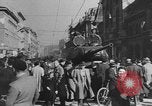
Scenes of insurrection in Budapest, Hungary during Hungarian Revolution of 1956; reactions throughout the world.
Hungarian Revolution of 1956 against the Stalinist government in Hungary. Civilians, police and military mingling amiably. Hungarian Communist Leader, Janos Kadar enters a car with an Army General. Civilians walk around a Soviet tank in a market. Hungarian soldiers stand on roads and talk to each other. Animated map shows flow of Soviet Forces surrounding Budapest to put down the insurrection. Soviet tanks firing point blank into buildings. Fires raging. A radio announcer is seen at a center from which multilingual broadcasts are being made about the events in Budapest. A technician in broadcast center. Speaker labeled "Hungarian." Brief view of UN meeting in New York. Revolutionaries fire on Soviets from remnants of destroyed buildings. Damaged Soviet tank. Hungarian National flags fly over abandoned litters in a small park. Dead revolutionary in a coffin being transported for burial in a cemetery. Some snow on the ground. People in various parts of the world express sympathy for the Hungarian insurrectionists. Black wreathes are hung. Youth in West Berlin, Germany, carry banner calling for Freedom for Hungary. Supportive demonstrations in Vietnam, France, and Italy. Black wreathes are placed in Poland.
CRITICALPAST.COM: About Us | Contact Us | FAQs - How to Order | License Agreement | My Account | My Lightboxes | Shopping Cart | Advanced Search | Featured Collections | Website Terms & Conditions | Privacy Policy ©2026 CriticalPast LLC.
License Agreement |
Terms & Conditions |
Privacy Policy
©2026 CriticalPast LLC.