


 Francais
 Deutsch
 Italiano
Refine Your Search
Souilly France 1916 stock footage and images
- Showing 49 to 54 of 5648 results more
more Hide
Hide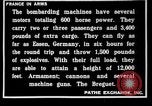
French military aircraft of World War II. Brequet 14; Caproni Ca.3; Voisin V experimental twin engine aircraft
Several french aircraft of World War 1. Right rear view of the French Brequet 14 biwing bomber. Gunner's circular ring gun mount seen in rear cockpit. Camera pans along right wings. View, from right side, of a Caproni Ca.3 trimotor biwing bomber taxiing forward, with nose wheels off the ground, after ground crewman steps out from under from under right wing. Diamond 5 painted on its fuselage. Characteristic triple tail,tail skids, double wheels, and tricycle gear,are visible. view from left side of another Caproni, with Diamond 1 painted on its fuselage. Aviators occupy tandem seats. The aircraft rests on its tricycle gear. Ground crew pull chocks from wheels and it makes right turn out from parking position. Rear view of a parked Caproni shows twin forward engines and rear pusher engine of the aircraft. Next sequence shows an unusual Voisin V experimental aircraft, tail number V.1889, parked in front of a hangar. As the camera pans from the tail forward the aircraft looks like a standard model 5. However, as the view extends to the cockpit, the fuselage is seen to extend much further, forward, and a mechanic works on something (engine) in the extended fuselage. As the camera continues panning, it appears to show another propeller (puller) installed at the front. So this aircraft number V.1889, appears to be the Voisin V (only one) that was modified as an experimental twin engine (pusher-puller) version, in 1916.
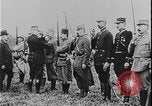
French Commander-in-Chief Marshal Joseph “Papa” Joffre awards ribbons, kisses the cheeks of French soldiers during WW1
Commander-in-Chief of the French forces, Marshal Joseph “Papa” Joffre, awards ribbons to French soldiers during World War 1. Marshal Joffre pins a ribbon on a soldier before giving a “faire la bise” kiss. Marshal Joffre pins ribbons, kisses the cheeks of two colonial soldiers wearing Fez hats (likely of Moroccan descent). This is possibly the award ceremony for Verdun that took place in 1916.
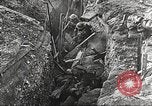
Scenes from British movie about the Battle of the Somme in First World War.
Excerpts from British movie about World War One Battle of the Somme. Map shows area of the Battle of the Somme and points to the region of Montaubon siezed by the British 30th Division on July 1, 1916. British World War I forces are seen entering former German trenches and resting. They clean debris from the trenches under German artillery fire. German troops counterattack out of trenches and cross the battlefield to engage entrenched British infantry. British fire at them with Lewis machine guns. Both sides sustain casualties.
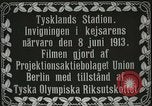
Kaiser Wilhelm II arrives to officially open Germany's new Olympic Stadium near Berlin.
Official opening of Germany's Olympic stadium (Deutsches Stadion Berlin, also at that time known as Grunewald-Stadion) on the 25th Anniversary of the Kaiser's coronation. Kaiser Wilhelm and Empress Augusta Viktoria, in their carriage, drive into the center of the new stadium grounds (Deutsches Stadion) built near Berlin, to host the 1916 Olympics. They are accompanied by several horse guards. The Kaiser is dressed in Hussar uniform including fur Busby adorned with Totenkopf (Death Head) emblem. The Royal couple step from their carriage. In next sequence, they are seen silhouetted with a number of dignitaries, under a canopy. Members of various athletic clubs parade across the grounds, carrying banners and flags, many adorned with award ribbons. The Kaiser watches from under the canopy, with Empress Augusta Viktoria, standing behind him. The Kaiser salutes some marchers. A large contingent of girls marches past, all dressed in dark skirts and white blouses. Bicyclists race around a track, as spectators watch from the stadium stands. Formation of German men and women perform calisthenics in unison on the field. Another glimpse under the canopy, shows the Empress conversing with an officer behind her, dressed in Hussar garb, similar to the Kaiser, who continues to salute as various groups pass in review. (The 1916 Olympic games were canceled due to World War 1, and the stadium was destroyed 20 years later and replaced by the Olympiastadion Berlin, or Berlin Olympic Stadium.)
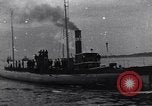
The German Merchant Submarine, Deutschland, arrives with merchant cargo in Baltimore, Maryland, during World War I.
The German merchant submarine Deutschland being assisted by the tugboat "Thomas F Timmins" into Baltimore Harbor (Maryland) on July 9, 1916. Her crew stands on deck and she flies the German flag. The Captain (Paul Koenig, sometimes spelled König, or Konig) and crew pose on shore for a photograph, behind a sign reading: Deutschland, Bremen. (Note: This commercial submarine was operated by the North German Lloyd Line. Submerging to avoid British patrols, she was able to carry valuable cargoes through the British (and other Entente Powers) WWI blockade. On this first trip to the U.S. She carried industrial dyes and gemstones. The Deutschland left Baltimore about 3 weeks later and returned safely to Bremen with with cargo of nickel, tin and rubber.)
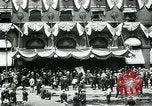
President Woodrow Wilson nominated for second term
Large crowd gathers at Coliseum in St. Louis for Democratic National Convention in 1916 in the United States. Al Smith of New York poses for picture. President and Mrs. Wilson in an open car. President Wilson accepts nomination for a second term. Crowd cheers and wave their hats. William Jennings Bryan poses for closeup picture and is then seen with other dignitaries on the back of a railroad train from which he shakes hands and waves to the crowd.
CRITICALPAST.COM: About Us | Contact Us | FAQs - How to Order | License Agreement | My Account | My Lightboxes | Shopping Cart | Advanced Search | Featured Collections | Website Terms & Conditions | Privacy Policy ©2026 CriticalPast LLC.
License Agreement |
Terms & Conditions |
Privacy Policy
©2026 CriticalPast LLC.