


 Francais
 Deutsch
 Italiano
Refine Your Search
South Vietnam 1969 stock footage and images
- Showing 1375 to 1380 of 6014 results more
more Hide
Hide
Motor cars are rolled off a hill, driven at full speed, collided during a test in South Bend, Indiana.
Brand new automobiles are demolished in spectacular head-on collisions as part of the proving process of modern motor car manufacture. A motor car is rolled sideways down a 45 degree hill, righted and then driven off. A camera man records the stunt with a film camera. A motor car driven at high speed during the test. Tires are blown at 70 miles an hour. All kinds of skidding is indulged in from 30 miles an hour up. Two motor cars are driven at full speed, drivers jump out, resulting in a head on collision.
Axles, gears and many other engine parts being manufactured in Studebaker automobile factory in South Bend, Indiana.
Film starts showing a steam driven hammer forging a Studebaker automobile engine part from a flaming hot steel ingot. Two men, in protective clothing and gloves, work together to position a hot steel billet under a steam hammer to forge it into an engine part. Next, a factory worker uses a chain hoist to remove a rough engine crankshaft from a stack. The crankshaft is moved to a machine shop where it is placed in a type of lathe and machined. Closeup of the crankshaft rotating in the machining process. Next, a machinist places the crankshaft between two spindles and spins it by hand to check its balance during rotation. A slate states that the gear cutting machine to be seen next was invented by a woman. Closeup of a gear being cut with cutting tool cooled by fluid. A huge milling machine made by Ingersoll Company of Rockford, Illinois, is shown. Closeup of it milling six engine blocks at the same time. Next, a drilling machine is seen making 36 holes at the same time in an engine part. (Note: The comment about gear cutting machinery and a woman, undoubtedly refers to Catherine “Kate” Anselm Gleason (1865-1933). She worked in the family business which burgeoned as a world wide gear manufacturer when her father, William Gleason invented and patented the first bevel gear planer machine in 1874. During the restrictive culture of her time, she helped shape the global cutting tools industry as a sales engineer for her family’s gear cutting business.)
President Franklin Roosevelt at the unveiling ceremony of the sculpted face of Thomas Jefferson in Rushmore, South Dakota.
President Franklin Roosevelt moves in a car towards Mount Rushmore. Face of former President Thomas Jefferson unveiled. President Roosevelt along with dignitaries watches the unveiling. Sculpted face of George Washington clearly seen on the mountain. The workers continue to work on the monument.
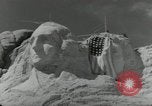
The unveiling ceremony of sculpted face of Thomas Jefferson in the monument at Mount Rushmore in South Dakota.
Sculpted face of Thomas Jefferson in the mountain is covered with flag of United States. Unveiling of the sculptor takes place. Sculpted face of George Washington also seen in the mountain. People move down in a cable car. A ladder lies near the sculpted face of Thomas Jefferson. A hut is seen over the mountain
The face of Jefferson unveiled by workers at Mount Rushmore, sculptor speaks to Franklin Roosevelt, South Dakota.
President Franklin Roosevelt arrives at Mount Rushmore in a car. He waves his hat to the crowd. He sits inside his car parked at the base of the monumental mountain. Gutzon Borglum gives an introduction to the audience regarding his on Mount Rushmore. Sculpted face of Thomas Jefferson is covered by a flag of United States. Sculpted face of George Washington is also clearly seen on the mountain. Blasting takes place at the mountain. Stones fall from the mountain along with smoke and dust. An aircraft is moving in the sky over the monument. President Franklin Roosevelt keeps his hand over the eyes to see the aircraft. President Roosevelt, wearing sunglasses, speaks to the crowd. Roosevelt's son holds one of the microphones. Gutzon Borglum briefs the president regarding the sculptures.
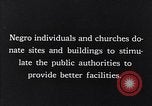
Discrepancies between the schools of African Americans and whites, including government funding, in South Carolina.
Educational inequalities between children of white and African American communities. African American students and teachers standing outside a dilapidated house donated by the Mt. Arat Baptist Church. House is being refurbished as a school. Charts depict that the state government provides only the small salary to the teachers and nothing for facilities at the school for black students. Pupils of this school are seen gathering on the front porch of the school, which has limited basic infrastructure and inadequate facilities, including no toilets for the students. (As the students and teachers gather on the porch, the last man walking out behind them and crossing the porch is Thurgood Marshall, who was documenting these conditions on film during a trip together with Charles Hamilton Houston). Next scene shows a building close to this school that is not in use but has not been given to the black school. Views of nearby school for white students called Richberg School (or possibly Richburg School), 2 miles away, which enjoys good facilities. Buildings, water pump, and transportation buses of Richberg School are seen.
CRITICALPAST.COM: About Us | Contact Us | FAQs - How to Order | License Agreement | My Account | My Lightboxes | Shopping Cart | Advanced Search | Featured Collections | Website Terms & Conditions | Privacy Policy ©2026 CriticalPast LLC.
License Agreement |
Terms & Conditions |
Privacy Policy
©2026 CriticalPast LLC.