


 Francais
 Deutsch
 Italiano
Refine Your Search
South Vietnam 1969 stock footage and images
- Showing 1513 to 1518 of 6014 results more
more Hide
Hide
President Eisenhower speaks at Press Conference in White House in 1956.
View of newsmen seated and cameramen at a press conference. President Eisenhower enters the conference room. Journalist asks him questions regarding violence resulting from "Segregation Issues" (racial segregation) as schools reopen after the summer in the United States, under desegregation orders. President replies how local governments need to enforce the laws including federal law, and that the United States of America is ready to help. Journalists writing in notepads. Close view of President speaking. President is asked what he would say to young people who are responsible for unrest and tension during desegregation. The President states that it is difficult through law and courts to change the hearts of people. He advises people to explore the issues, and that we need to "bring about a change in spirit, so that extremists on both sides do not defeat what we know to be a reasonable and logical conclusion of this whole affair, which is recognition of the equality of man." He says the south is full of people of good will, but that we only hear from others in the south who are full of prejudice and who resort to violence, and the same way on the other side with people who want to have the whole matter settled today. President Eisenhower says of desegregation, "this is a question of leading, and training, and teaching people and it takes some time."
U.S. Air Force Generals flying aboard B-17s operating from Australia, during World War II
B-17 flying fortress bomber taxiing on Royal Australian Air Force Base at Laverton, near Melbourne, Australia during World War 2. Several other B-17s are parked in the background. Armorer crews loading bombs aboard B-17s. American Army Air Forces crews boarding B-17s. Closeup of Brigadier General Ralph Royce, Chief of U.S. Air Operations in the South Pacific, as he looks out from copilot's window in a B-17. View out left window in cabin ofthe B-17, on takeoff roll. View of two left engines from pilot's window at low altitude. View of crew members in cabin of B-17. Change of scene to cockpit of B-17 named "The Swoose," in flight, being piloted by Lieutenant General George H. Brett, Commander of all Allied Air Forces in the South Pacific. Closeup of General Brett. Glimpse of navigator charting position at his station. The plane's pilot and aircraft commander, Major Frank Kurtz, is occupying the copilot position and converses with General Brett. Waist gunners preparing for battle in the aircraft. View out gunner's opening.
Invalids and convalescents take healing baths at Merano Spa in Italy
Radioactive mineral springs are used to give healing baths at the Merano Spa (Terme Merano, Piazza Terme 9 I-39012 Merano/Meran South Tyrol) in Merano, South Tyrol, Italy. A man works on pipes in Merano. Invalids and convalescents at the health spa. A bartender serves a stylish woman a drink. A view of the building of the Merano Spa. Interiors of the building. Sign reads “Laboratorio di Geo-fisica”. People are seen in the building. People climbing the stairs and reading in reception area. Several beds are seen. Women bathing in a huge swimming pool.
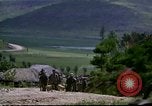
United States Marine troops march up side a hill in Korea
United States Marine troops march up side hill and along side of a road at Naktong River area in Korea, during Korean War. A Marine limps. Marine troops move along the roads. Men carry casualties on stretchers. South Korean Troops carry supplies. Marines assist wounded Marine with casualty tag down road. Smoke rises from foot of a hill in the background. South Korean civilians move through the side of a hill. Explosions and smoke rises from the hill. Plane dive bombing. Plane drops a bomb. Smoke rises due to explosion.
Tourists walk around at Trafalgar Square in London, United Kingdom.
Tourists walk around at Trafalgar Square in London, United Kingdom. View of bronze lions in Nelson's Column in the background. Flocks of Trafalgar Square pigeons on the ground. The South Africa House building (South Africa House, Trafalgar Sq, London WC2N 5DP, United Kingdom). Fountain in the center of Trafalgar Square. Equestrian statue of King George IV of England. British police officers patrol on foot. Tourists visit the place.
Japan extends its empire into Manchuria, Mongolia, and China in 1931 and 1932
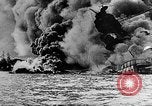
Brief opening scenes show ships being engulfed in flames and smoke from Japanese attack on Pearl Harbor, December 7, 1941 in World War 2. Focus is primarily on the USS Arizona. Scene shifts to Japanese troops assembling on a pier and boarding troop transport ships bound for Manchuria and China, following the Mukden Incident of September, 1931. Japanese troops are then seen marching into Manchuria on September 18, 1931. A formation of Japanese soldiers presents arms. In another formation, they shoulder swords. Closeup of a Japanese soldier in a steel helmet with chin strap in place. A steam locomotive pulls a train into the Chin Hsien station on the South Manchurian Railway. A Japanese train on that line had been dynamited, triggering a Japanese push into Mukden. View from behind a train leaving Chin Hsien on the South Manchurian Railway. Japanese battalions place bundles of straw across a stream to facilitate troop crossing. A column of Japanese troops is seen crossing the water on the makeshift straw crossing. Japanese troops advancing along with supplies carried by pack animals. Troops traverse a sandy berm past an abandoned two-wheel cart. A formation of 12 Japanese G3M bombers flies overhead in a "V" formation en route to bomb Mukden. View of Chinese population running for shelter from the bombing. Chinese walk past some civilian casualties lying in a street. The League of Nations headquarters in Palais Wilson, Geneva, Switzerland. A memorial to Woodrow Wilson at the Palais Wilson reads: "A La Memoire De Woodrow Wilson President des Etats-Vnis,Fondatevr DL La Societe Des Nations, La Ville de Geneve." A car driving away from the entrance of the League Headquarters. Closeup of doorway with sign identifying it as the entrance for delegates and members of the Press. League delegates are seen inside its meeting hall. Japanese warships are seen next, attacking 15 miles from Shanghai with naval gunfire.Three Mitsubishi 2MR4 (Type 10)Reconnaissance biplanes are seen in flight above the barrel of a large naval gun. Japanese troops marching into Shanghai, as people on the roadside wave Japanese flags. Next, they are seen marching out of Shanghai at the insistence of the League of Nations. After signing a truce with China, on May 4, 1932, Japanese troops are seen entering Mongolia, in September, 1932, which they reconstituted as the Puppet State of Manchuko. A Japanese soldier standing atop a building waving a Japanese flag. Japanese statesmen resigning and leaving the League of Nations in protest after it labeled Japan an aggressor. Japanese forces fire a long barrel Type 89 cannon (150mm) as they push into China proper. Group of Japanese artillerymen use range finders, Periscopic viewers and binoculars to guide the gunners. Shell explodes raising large amount of earth. More views of artillery firing and infantry advancing. Infantry crossing a bridge and raising siege ladders to scale a fortress. Engines running on Japanese Ki 30 Type 97 airplanes, as pilots get final briefing and orders. They salute, board their aircraft, and are seen in formation aloft, dropping bombs. View from the air of bombs striking below. View from a bomber of its bombs dropping from the aircraft (bombs away view) and exploding on the ground. A column of Chinese soldiers moves along a section of the Great Wall of China heading into the interior of China. Civilians moving all manner of equipment and machinery into the interior.
CRITICALPAST.COM: About Us | Contact Us | FAQs - How to Order | License Agreement | My Account | My Lightboxes | Shopping Cart | Advanced Search | Featured Collections | Website Terms & Conditions | Privacy Policy ©2026 CriticalPast LLC.
License Agreement |
Terms & Conditions |
Privacy Policy
©2026 CriticalPast LLC.