


 Francais
 Deutsch
 Italiano
Refine Your Search
South Vietnam 1969 stock footage and images
- Showing 1963 to 1968 of 6014 results more
more Hide
Hide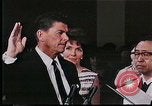
Film tracing Ronald Reagan's political progress from Governor of California to President of the United States.
Closeup of Ronald Reagan taking oath of office as Governor of California. His wife, Nancy Reagan, standing at his side. Views of Governor Reagan signing a document, and conversing with members of his staff. Reagan is seen addressing an audience from a stage; mingling with State legislators; speaking before an informal gathering of his backers. Reagan mingling with people at a political convention, and congratulating Richard Nixon when he became the Republican nominee for President. Next Gerald Ford is seen taking the oath of office as President in the wake of Nixon's resignation. President Ford and challenger Ronald Reagan on the occasion of their debate. People congratulating Jimmy Carter on his election as President. Carter and his wife, Rosalynn. Ronald Reagan speaking to members of a South Carolina Kiwanis Club. Reagan campaigning for President in 1980. Reagan being celebrated as the Republican candidate for President at the party's national convention in Detroit. He standing with his choice for Vice Presidential candidate, George Bush. Reagan makes a brief statement and the convention celebrates with balloons dropping from the ceiling, among other things. Closeup of Candidate Reagan and his wife, Nancy, at the podium, waving. Glimpses of Reagan during his campaign. Carter and Reagan in a nationally televised debate a few days before the election. Newly elected President Reagan with outgoing President Carter at the White House to arrange an orderly transfer of power.
African American champion plays tennis at the National Youth Administration center in the United States.
Southern champion member of the NYA (National Youth Administration) plays tennis in the United States. Junior champion plays a game pf tennis on ground at the NYA center.
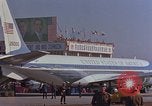
U.S. President Lyndon B Johnson visits Korea and returns back to United States.
United States President Lyndon B. Johnson visits Korea after attending the Manila Summit Conference. View of the United States Air Force One presidential plane after landing in Seoul. South Korean Air Force performs aerobatics to welcome President Johnson. Korean crowd welcomes President Lyndon B Johnson. Koreans hold American flags in hand. School girls, wearing traditional chima jeogori, sing to welcome the President. President Johnson reviews Korean troops. Sign says “Welcome President and Mrs. Johnson”. President Johnson holds both American and Korean flags in front of crowds. President Johnson leaves in his aircraft after his visit in Korea. Koreans sing the traditional “Arirang” song upon President Johnson’s departure from Korea. The President talks about his visit to different nations and the local people he met.
German view of the beginning of the the Battle of the Bulge in World War II
Beginning of the German counterattack into Belgium, during winter of 1944-45 of World War 2. Opening scenes show German artillery barrages by Grille (Cricket) self-propelled artillery firing 15 cm sIG 33 infantry guns. This is the beginning of German Field Marshal Gerd von Rundstedt's Ardennes Counteroffensive (aka the Battle of the Bulge) in December, 1944. German soldiers riding on Jagdpanzer IV tank destroyer moving forward in Ligneuville, South of Malmedy, Belgium. German infantry walk past a knocked out tank on their way toward the front, where smoke rises ahead. They pass burning American armor and vehicles destroyed by the German Luftwaffe (Air Force). Sounds of artillery fire are heard. Closeup of one soldier carrying an MP44 7.92 x 33 mm (7.92 Kurz) caliber assault rifle. The German infantry move along a ditch parallel to a burning column of U.S. armor and vehicles on the road, where it was wiped out by German aircraft. A United States 3" anti-tank gun abandoned at the roadside. German soldiers retrieve American cigarettes from a knocked out U.S. tank, and share them. At TC:02:00 the German gunner with a belt of ammunition around his neck, is Hans Tragarsky aka Walter Armbrusch, a soldier in the Kampfgruppe Hansen battle group formed during the Battle of the Bulge from SS-Panzergrenadierdivision Regiment 2, an infantry regiment of SS Pz Rgt 2 "Das Reich". (His image is well known but his identity is subject to debate.) German troops relax as they smoke cigarettes. A group of German soldiers sharing cigarettes, atop a Stug III tank destroyer. A German army Type 82 Volkswagen Kübelwagen drives past detritus of combat, near a village church. Glimpse of damage in City of Antwerp from a German rocket.
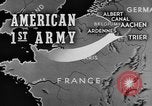
The United States First Army enters Roetgen and supplies are dropped to and retrieved by the Belgian White Army (WW2)
The United States First Army enters Roetgen, Aachen and other German border towns without opposition during World War II. Map showing the capture of the Ardennes, Albert Canal, Aachen, and Trier by the First Army. View of Luxembourg’s Ardennes. A dugout in Wallendorf, in the state of Rhineland-Palatinate. A captured pillbox displays sign in German reads “Der führer besichtigte diese anlage am 15. mai. 1939” (“The Führer visited this facility on May 15, 1939” in English). The town of Wallendorf with heavily damaged buildings from recent Allied shelling. Civilians saving their belongings outside the bombed “Gastwirtschaft von Franz Wenzel” in Wallendorf. Troops on moving M4 Sherman tanks and Jeeps. Soldiers climb the hill and enter Germany. The troops maneuver over fields. Troops occupy the Roetgen, located approximately 16 km (10 mi) south-east of Aachen. 'Roetgen' written on building. White flag on building of 'The Deutsche Reichsbahn'. View of village and huts. Belgian White Army lights fire for supplies by airborne. They gather hay to make bonfires. A White Army soldier with bayonet scans the sky. Another soldier holds a rifle. Soldier watches through binoculars towards plane. A passing bomber drops supplies for the Belgian White Army. Parachutes landing on earth. Supplies and arms are dropped to and retrieved by Belgians. Parachute are rolled and returned to England. Men load supplies into a truck. Horse cart moves away.
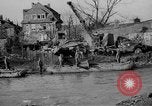
3rd Division fires rocket barrages and First United States Army Infantry advances through German towns east of Inde River
Activities of First United States Army pressing eastward in Germany during World War 2. U.S. engineers and soldiers build a bridge over the Inde River since all nearby crossings had been destroyed by retreating German forces. Army vehicles cross the completed bridge. Soldiers bring heavy artillery and adjust it. View changes to Mausbach area to the South, where rockets are launched by 3rd Armored Division toward the river. Line of 75 U.S. Army rockets seen being loaded by U.S. soldiers and then fired together. Bright flashes and smoke as rockets are fired. Tanks of the 3rd Division moving out from the town. A U.S. vehicle in the advancing column toward Gressenich is hit by German guns. U.S. Army tanks, lined up like artillery, fire on German forces at Gressenich. Continuous line of 3rd Armored Division tanks, armored vehicles, and 6x6 vehicles come to the front and advance on roads of cities and villages moving eastward, and supporting the U.S. First Army Infantry. 1st Army infantry move through Hurtgen forest near Aachen. Ruined German factory is used as an observtion base by U.S. forces to coordinate attack on Gressenich, which was captured on November 19, 1944. 3rd Armored Division tanks move into open fields to continue offensive toward Werth, with U.S. infantry soldiers staying close to tanks for cover. Soldiers carry the wounded U.S. tank commander after German counter fire hits lead U.S. tank in the column. The wounded soldier is dragged to safety. Men of U.S. Army 1st Division Infantry enter town of Werth under German mortar fire and move from house to house clearing enemy snipers and mopping up in the ruins. U.S. Army soldiers guard a column of German prisoners (POW) who surrendered in Werth. View of ruined and destroyed buildings in German towns like Hamich after defeat. U.S. Army soldiers move through the town on foot with a small church in the background. U.S. Army trucks arrive in a rubbled village with food and ammunition for the offensive drive toward the Ruhr.
CRITICALPAST.COM: About Us | Contact Us | FAQs - How to Order | License Agreement | My Account | My Lightboxes | Shopping Cart | Advanced Search | Featured Collections | Website Terms & Conditions | Privacy Policy ©2026 CriticalPast LLC.
License Agreement |
Terms & Conditions |
Privacy Policy
©2026 CriticalPast LLC.