


 Francais
 Deutsch
 Italiano
Refine Your Search
South Vietnam 1969 stock footage and images
- Showing 1981 to 1986 of 6014 results more
more Hide
Hide
Farm production for war effort in World War 2 with farming and processing of hemp, dried milk and dried eggs in United States
Agricultural progress motivated by the demands of World War II production in the United States. American farmer holding raw hemp for making rope. Farmers in Kentucky or Tennessee harvesting hemp to replace sources lost in the Philippines due to war in the Pacific. Hemp seed harvesting in southern states. A bag of hemp seed. Thick planting of the seeds yields straight, long fiber hemp plants. A boy on a farm stands next to tall hemp plants. A tall harvester attachment is seen cutting the hemp plants at harvest. Workers tie hemp plants in bundles and stack them for breaking. Hands of a man shown tearing and testing strong hemp fibers on a dried hemp plant stalk. Butter and milk bottles stacked closely in a cooler. Large metal bins of eggs are shown. Exterior view of a factory for egg drying. A tank truck parked outside the plant containing broken raw eggs to save space. Large dryers are shown producing a dried golden yellow powder from the eggs. Factory worker sits at a vibrating table that shakes and sifts the dried egg powder and loads it into bags. Scrambled eggs cooked in a pan over a stove. View of raw dozen eggs and packaged box of dried eggs side by side. The small box of one dozen eggs weighs only 5 ounces. View of a wooden barrel that holds the dried equivalent of 5000 eggs. Cows graze on a field. A milk tank truck parked at a drying factory. Cans of dried milk move on a factory assembly line. A machine applies a lid to each can. A wall of 15 gallon barrels of dried milk are shown, each containing the equivalent of 150 gallons of raw milk. Blocks of cheese shown in a dairy case display.
German soldiers fire artillery on the front in Mechelen, Belgium during World War I
Teams of horses transport German 21cm morsers (heavy siege morters) along a road leading toward the front during World War 1. Gunners walk along beside them. Battery of the mortars being set up in a field by some houses near Mechelen (also called Malines) Belgium. The gun crews load and fire their mortars. Supplies are brought by horse-drawn wagon. Officers, soldiers, and some medical corpsmen (with red crosses on their sleeves) stand nearby as the battery of mortars fires. . (Note: The church shown, beginning TC: 1:28 is reportedly St. Joseph's, of the St. Joseph-Coloma parish on the southern outskirts of Mechelen/Malines, a city midway between Brussels and Antwerp. The church survived the war and still stands in 2014, although it is also reportedly in a bad state of repair.)
The United States mobilizes and joins Allies in World War II. A montage of numerous World War 2 period images.
Film opens with views of goosestepping German, Italian, and Japanese soldiers during parade reviews in their respective countries. Emperor Hirohito, on a white horse. American battleships burning in the Japanese attack on Pearl Harbor. U.S. General Douglas MacArthur decorating a soldier in Manila, Philippines. Air raid sirens sounding in Manila and residents hurrying to take cover. Heavy black smoke rising from a bombed site and emergency vehicles responding and rushing to several bombed and burning locations. A burning rickshaw amidst other bombing rubble and bodies of victims. U.S. Army General MacArthur greeted by Australian officials at his headquarters in Brisbane, Australia. Sign reads: Headquarters UNITED STATES ARMY FORCES in Australia. American flag flying on tall flagpole. View from ship underway in supply convoy. A battleship seen on horizon and a destroyer passing the camera ship. U.S. President, Franklin D. Roosevelt signing the "Lend Lease Act" of 1941. A U.S. industrial plant with four tall stacks emitting smoke. A steam locomotive belching steam. A locomotive pulling an open car and some tank cars. New 1941 Plymouth automobiles coming off a production line. A new M3 Medium Tank in a U.S. factory. View of Liberty Ships, including the "Zebulon Pike" and the "Henry Knox" under construction at the California Shipbuilding Corporation yard, Terminal Island, California. U.S. Navy Destroyers constructed at Federal Shipbuilding & Dry Dock Company, Kearny, New Jersey. One is being launched, next to DD-446 (the USS Radford). A formation of U.S. Navy aircraft including Curtiss SBC Helldiver scout bombers and Douglas TBD Devastator torpedo bombers. A tight formation of U.S. Army Douglas B-18 Bolo medium bombers in flight. A formation of U.S. Army Curtiss P-36 Hawk aircraft in flight. Closeup of a U.S. Army Lockheed P-38 Lightning aircraft in flight. Several huge gun barrels for guns under construction at a U.S. war plant. Large artillery shells lined up in a manufacturing plant. U.S. Army M3 Medium tanks under construction at a factory. Steam and smoke rising from a U.S. industrial plant. Aerial view of open pit iron mine. Sparks shooting up inside a steel plant. A virtual "forest" of oil well derricks in the Western U.S. drilling for oil. Coal being transported by railway. View from stern of a warship in a convoy. An Atlanta-class light cruiser leading three destroyers at sea. Transport ships in convoys to places like Australia, Britain, and the Middle East. Troops on a pier near a large transport ship. A stack of wartime supplies on a pier next to a ship destined for Russia. Glimpse of wake from a U.S. warship having triple guns astern. Silhouette of a U.S. Navy Enterprise-class Aircraft carrier, with an aircraft taking off from her deck. The aircraft carrier, USS Saratoga. U.S. Army soldiers marching on parade, followed by numerous jeeps with machine guns mounted in their rears. Young men being drafted into the U.S. military. A draft lottery being conducted. New recruits doing calisthenics. Trucks pulling artillery pieces. B-18 Bolo bombers flying over U.S. tanks. Closeup of M3 tank. Cavalry fording a stream. Soldiers on motorcycles. Troops crossing a pontoon bridge. A loaded troop ship. A troop transport at Newfoundland. Sentry in Trinidad. Troops encamped in Bermuda. Troop transport ship docked in Greenland. Troops disembarking in Iceland. Formations of Curtis P-36 Hawk aircraft. Douglas DC-2 aircraft factory. P-36s with engines running. M3 tank suspended on factory crane. Officials of Pan American nations siding with Allies. Allied troops including Dutch, Belgian, Yugoslav, Greek, Czech, Filipino, Polish, Norwegian, Free French, Australian, New Zealand, South African and Canadian. British warships. British Hawker Tempest aircraft. British commandos. Russian troops on parade. Chinese troops on the Great Wall of China.
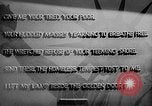
Montage of images chronicling the settlement and development of the United States of America over many years.
The last portion of Emma Lazarus’sonnet,"The New Colossus," is shown as engraved on a tablet inside the pedestal of the Statue of Liberty. Illustrations of immigrants arriving and felling trees to build dwellings in America. Reenactments of early English, Scottish, and Dutch settlers building houses and working at crafts in New England. Italian sulphur mine workers in Louisiana. Immigrants, from France and Switzerland, planting vineyards in California and New York State. Danes, Norwegians, and Swedes, sowing seed and cultivating crops in the Midwest. Polish and Welsh immigrants in American coal mines. African Americans harvesting cotton on farm fields in the United States south, including a woman picking cotton with her baby riding on her long collecting bag. A Spaniard on horseback in the Southwest. Mexicans working in Texas oil fields and on ranches of New Mexico. Greek and Portuguese fishermen with huge catches of fish. A German technician working with fine instruments. Hungarian and Russian immigrants working in steel mills. Irish, Slavs, and Chinese, building railroads. Closeup of lumberjack's axes and saws cutting trees. A forge and a blacksmith shoeing a horse with horseshoes. A woman at work with a spinning wheel. Railroad ties and rails being placed. An antique railroad workman's locomotive and car. Men installing telegraph wire on rough poles. A early historic railroad 0-4-0 steam locomotive (appears to be one of the few replicas of "The Atlantic" which had been built in the 1830s) pulling a single small passenger train car. Cowboys on horseback rounding up steers. Herds of cattle,sheep, and pigs, bound to market. Farmers tilling soil with horse-drawn cultivators, preparing tobacco leaves for drying, and loading cotton bales. Machines spinning thread in a textile mill or factory. Fabric weaving machines at work. An early steam boat underway in a river. Early model automobile driving on dirt road. Wright Brothers' Wright Flyer airplane in flight with several persons on board. Early tractors and harvester machinery working on a farm. Glimpses of American industrial plants and transportation in rapid succession (some of it showing building of Hoover Dam and building of the Chrysler Building in New York City). Oil well drilling and a "gusher" oil well spouting oil upward. Steel mills, locomotive trains, and then a scientist in a laboratory working with beakers and a solution. Dynamite charges blasting away sides of mountains and gorges, and scenes of dam construction and dams opening to allow water gushing. Large electrical control levers being thrown to run electricity, and scenes of electric transmission towers and facilities. Natural gas storage areas. Golden Gate bridge under construction and high rise skyscraper buildings being constructed, including the Chrysler Building circa 1930 while still under construction in New York City. Aerial view of New York City. Camera panning over the gravestones in Arlington National Cemetery.
Scenes from World War 1, and world events in the period between World War I and World War II.
Rail guns firing in World War 1. U.S. troops charging out of trenches. Allied gunners firing "French 75s" Allied twin-tailed biplane bombers. French Renault F17 tanks. Crowds in cities celebrate Armistice Day and end of World War I. Treaty of Versailles. Destruction of warships. Scenes of Paris. A pagoda in Japan. Temples in Siam, China, and Manchuria. Two Kayan women in Myanmar or Thailand perform a dance. Both Kayan women wear long brass coil neck rings. In the U.S., a boy hits a baseball and runs toward first base. Scenes of Japan invading Manchuria. Newspaper with headline: Henry Stimson denouncing Japan. U.S. Army troops dispel World War I veteran bonus marchers. Men lined up in bread line for unemployed during Great Depression. Brief shot of Gangsters in gun battle in an American city. Scenes of dust bowl in American with farmers and families heading West in caravans. Family standing by tent. Torchlight parade in Germany. Adolf Hitler standing with German President Hindenburg circa 1933. Adolf Hitler, Heinrich Himmler, and Victor Lutze, at 1934 Nazi Rally in Nuremberg. Italian Caproni bombers over Ethiopia. Ethiopian tribesmen and Haile Selassie. U.S.Neutrality Act. American youths with a 1930 Ford coupe. Scenes from Civil war in Spain. Spanish Rebel forces in ground combat with Nationalist forces. German and Italian aircraft participate in bombing Spanish Nationalist targets in Spanish Civil War. Spanish civilians flee bombing, tend to wounded and dead victims following bombings. Italian Savoia-Marchetti S.M.79 Sparviero bombers. Crowds running for shelter. Women and children victims of bombing, some crying and in shock. Spanish General Francisco Franco arrives by train in southern France to meet with Hitler. View of Gallup Poll forms, and findings, with Americans against entering European war and preferring neutrality. Japanese planes and warships attack China. Naval Chinese civilians run for cover; bodies of Chinese in trucks. Japanese freighters, Buenos Aires and Tatsuno Maru, in U.S. ports being loaded with scrap iron and metals. Hitler, Goering and other officers in 1938. Adolf Hitler, Neville Chamberlain, Edouard Daladier, Benito Mussolini, Count Ciano sign Munich Agreement. Hitler riding standing up in an open car during a rally in Germany. Elevated view of Los Angeles, then view of traffic on streets of Los Angeles California and newspapers being sold to pedestrians. View of faces of American citizens in a movie theater watching Confessions of a Nazi Spy. German-American Bund activities including outdoor rallies in the U.S. (Camp Siegfried in Yaphank, Long Island, New York, in 1937), and an indoor rally in New York City at Madison Square Garden in 1939. Emperor Hirohito reviewing World War 2 troops of Japan. Japanese steel production and arms production in Japanese factories. The Hokoku Maru Japanese ship being launched with fanfare from Tama Shipyards on July 5, 1939. Meeting of United States Military Affairs Committee of the U.S. House of Representatives in late 1939 to consider national defense matters. In meeting of Naval Affairs Committee, representative asks for increase of 25 percent in authorized naval tonnage.
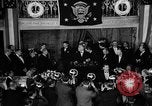
U.S. President Franklin Roosevelt delivers his address at Mayflower Hotel in Washington D.C. during the Navy Day Dinner.
U.S. President Franklin Roosevelt at Mayflower Hotel in Washington DC for the Navy Day Dinner. President delivers his address. People seated at tables. The President on the podium. Cameramen recording the event. The President talks about the state of emergency, U.S. Naval contribution to the country's defense. He mentions Hitler's attack on U.S. destroyers, killing of American soldiers, and Hitler's purpose. He discusses Hitler's plan to invade and divide South America. He voices his decision to stop Hitler and his people. He talks about America's defense and the Navy's contribution to the same. The crowd applauds. The President leaves the podium. Note: The President prefaces his remarks by acknowledging the presence of General William Donovan, who shares the stage with him. Donovan headed the Office of the Coordinator of Information (COI), later renamed the Office of Strategic Services (OSS). (World War II period).