


 Francais
 Deutsch
 Italiano
Refine Your Search
South Vietnam 1969 stock footage and images
- Showing 2131 to 2136 of 6014 results more
more Hide
Hide
U.S. Army aircraft patrol for forest fires, in 1919, in the United States. Bulldozers and forest plows introduced in 1932
World War I scenes of U.S. Army airplanes in action at the front. A picture of U.S. Army Major Henry A. (Hap) Arnold and California Forester Kurt Dubois, who, together, started the fire patrol practice by United States Army aircraft in1919. Army flyers lined up on a field. Army Curtis JN-4 (Jenny) airplanes in flight as smoke rises from the forests below. Weighted messages with ribbons attached, being dropped by pilots while in flight to inform about a forest fire. Later on after the installation of radios a pilot sends a message on a radio set in case of a forest fire. In 1920s, Crawler tractors used to skid logs out of the forest. In 1925, tractor with a blade was developed and used to build forest roads. In 1932, a Bulldozer being used to create firebreaks during a Southern California fire. A fire plow in operation.
"Operation Firestop" experiments in aerial firefighting. Various aircraft used in firefighting.
World War II scenes of German Stuka dive bombers in operation. U.S. B-25 bomber in flight, and views of firestorms from Allied incendiary bombing of Axis targets. Scenes of the "Operation Firestop" project in 1954-55, in California. U.S. Forest Service and other agencies cooperate in a one-year project headquartered at Camp Pendleton, California. Aerial views of Camp Pendleton area, in Southern California. A modified Grumman TBM Avenger torpedo bomber in flight discharges water from its torpedo bays. Men installing fabric water container into the bomb bay of the TBM. The aircraft seen in low level pass, dropping water contents onto field. Cropduster pilot Floyd Nolta, seen flying his Stearman biplane over California landscape, and then taxiing in to park, after landing. On the ground, we see how he modified his airplane to release water from a hopper in its bottom. On August 13, Vance Nolta flies the Stearman on multiple sorties, dropping water on a fire in the Mendecino Forest. Nolta filling his water tank from a hose at Willow Airport, and dropping water from the air, above the fire. View at Willow Airport, of 7 Stearman and N3N airplanes modified for aerial firefighting. Views of these aircraft dropping chemically treated water from the air. TBM aircraft equipped with 400 gallon tanks drop water from the air. PBY flying boat seen in flight. A B-26 bomber passing low and dropping chemically treated water. A U.S. Navy Martin Mars flying boat passing overhead. The aircraft drops water from a 7000 gallon tank.
Position of UN forces below the38th Parallel during the Korean War.
The United Nation forces during the Korean War. An animated map shows the position of UN forces below the 38th Parallel in Korea. UN forces begin offenses in certain areas after 25th January, 1951. On 8th February UN forces cross over Han river and reach the south of Seoul. Activities of 10th Marine Corps on the central front of the war. Counter offensive launched by the Chinese across the 38th Parallel on 11th February. The position of UN forces after 18th February.
United Nation forces advance in various Korean towns and villages during the Korean War.
The United Nation forces during the Korean War. Activities and advance of United Nations forces in Korea from 22nd to 29th January, 1951. United Nation Forces move north wards. United States 25th Division Combat Team loaded on tanks as they advance into a village. United States 35th Regimental Combat team pushes on in Osan, Korea. A soldier checks and cleans a machine gun. Civilians being searched for weapons. Task Force troops of the UN enter a town. Refugees being questioned with the help of a South Korean interpretor. A soldier works on shells,he looks through the gun sight and artillery being fired. UN troops take Koreans as prisoners and a soldier speaks on a field phone. UN task force in Suwon. Soldiers loaded onto an American tank as they move towards Han river, U.S. General Joseph S. Bradley with an officer as they confer. Soldiers of the United States 25th Infantry Division rest against a wall.
Spring offensive launched by the Chinese forces on UN troops during the Korean War.
Spring offensive during the Korean War. An animated map of Korea shows the position of United Nation forces behind the 38th Parallel. Events and attack from 20th April, 1951 to May 20th 1951. Chinese forces launch a Spring offensive on 23rd April, 1951. Another Red offensive is launched around the Hwachon Reservoir area. United Nation forces are forced back and move towards south. Later they recover some ground around Seoul. Second phase of Spring offensive being launched around Chunchon in the Central sector of Korea. Later the UN forces strengthen their position in Central part of Korea.
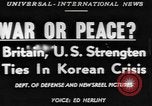
UN troops retreat in Korea and the leaders of U.S. and England meet in Washington D.C., United States to discuss the situation.
United Nation troops retreat during the Korean War. UN forces comprising of the British and American soldiers retreat south wards in Korea as a result of Chinese aggression, Soldiers loaded in military trucks as they cross a bridge. Displaced Korean civilians in a barge, on rail road tracks and along the roads. In Washington D.C., United States British Prime Minister Clement Attlee meets United States President Harry S. Truman. United States Secretary of State Dean Acheson also attends the meeting. Prime Minister Attlee during his address before the National Press Club emphasizes on resisting the aggression by the Red China. He also affirms the firm faith of the two countries in the principle of Rule of Law.
CRITICALPAST.COM: About Us | Contact Us | FAQs - How to Order | License Agreement | My Account | My Lightboxes | Shopping Cart | Advanced Search | Featured Collections | Website Terms & Conditions | Privacy Policy ©2026 CriticalPast LLC.
License Agreement |
Terms & Conditions |
Privacy Policy
©2026 CriticalPast LLC.