


 Francais
 Deutsch
 Italiano
Refine Your Search
South Vietnam 1969 stock footage and images
- Showing 2251 to 2256 of 6014 results more
more Hide
Hide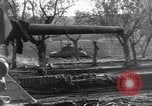
U.S. troops fire guns, advance on a field and drop bombs at a historic abbey in Italy during the Battle of Cassino.
A documentary television program depicts the role of U.S. soldiers in the Battle for Cassino which was a part of the Italian Campaign during World War II. U.S. 6th Armored Infantry Regiment troops advance on trucks. A barrel of a gun in the foreground. Fire by tanks and artillery. Mountains in the foreground. A town on the foot of Monastery Hill. A historic abbey which contains many medieval treasures. A German official at the abbey. A German soldier looks through binoculars. Troops around an artillery fire. A hand holding a leaflet. Leaflets are fired. A U.S. aircraft in flight over Monastery Hill and a pilot in the cockpit. Aircraft drop bombs over the abbey . Smoke rises due to an explosion. Soldiers fire guns. German troops at the abbey look through the binoculars. They fire guns. 5th Army troops on tanks advance. Aircraft in flight. Colonel William W. Quinn seated in a chair talks about the next story that is the invasion of Southern France.
A U.S. officer and an Italian officer exchange greetings after the Italians land their bomber at an Allied field (WW2)
Italian fliers land their aircraft at an Allied occupied air base (probably in Southern Italy) to join the Allies for the war against Nazi Germany during World War II. A three-engine Italian Savoia-Marchetti bomber in flight. The aircraft lands at the airfield. Other aircraft parked on the airfield. A hangar in the background. Italian fliers step from the aircraft. U.S. and Italian officer exchange greetings. Aircraft in formation. Italian fighter aircraft land and taxi at the air base. Officers and fliers. The fliers leave their aircraft. Italian fliers seated around a table eat American meal.

John F. Kennedy speaks about Berlin crisis at Washington News Conference in the United States.
U.S. President John Fitzgerald Kennedy speaks at Washington News Conference in the United States. Kennedy at a podium. Journalist seated in a hall during the conference. Kennedy speaks over a microphone. He speaks about the Berlin crisis. He also speaks about the areas in South East Asia where U.S. can be involved. He also expresses his concern as he mentions the era as the most dangerous time in the history of human race.
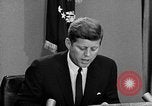
U.S. President Kennedy asks for support of the citizens for ending the discrimination against African Americans, in his speech in the U.S.
U.S. President John F. Kennedy's Civil Rights Address in Washington DC. United States President Kennedy seated at a desk and speaks over a microphone. Following events in Alabama, the President speaks about ending the discrimination of blacks by whites in the United States. He says that it's time for the Congress to act. President Kennedy says that he will ask the Congress of the United States to act, to make a commitment it has not fully made in this century to the proposition that race has no place in American life or law. He talks about the necessary measures that Congress can provide. The President, in his speech, asks the Congress to enact legislation giving all Americans the right to be served the facilities which are open to the public. He talks about his meeting with the business leaders and urges them to take voluntary action to end this discrimination. The President says that he has also asked the Congress to authorize the Federal Government to participate more fully in lawsuits designed to end segregation in public education. He also speaks about giving employment for African American citizens. President Kennedy, in his speech, pays tribute to those citizens of North and South who have been working in their communities to make life better for all. The President asks for support of all the citizens so that the discrimination can be removed and civil rights upheld.
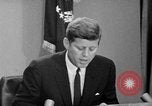
U.S. President Kennedy asks for support of citizens and business leaders to end racial discrimination in the United States
Second part of U.S. President John F. Kennedy's speech in Washington DC following events at the University of Alabama when two African American students, Vivian Malone and James Hood, attempted to enroll. United States President Kennedy seated at desk and speaks over a microphone. The President speaks about ending racial discrimination and importance of equality and civil rights in the United States. He says that it's time for the Congress to act. President Kennedy says that he will ask the Congress of the United States to act, to make a commitment it has not fully made in this century to the proposition that race has no place in the American life or law. The President talks about the necessary measures that Congress can provide. President Kennedy, in his speech, asks the Congress to enact legislation giving all Americans the right to be served the facilities which are open to the public. He talks about, and scenes are shown from his recent meeting with business leaders in the white house, together with Vice President Lyndon Johnson, as Kennedy urged them to take voluntary action to end workplace discrimination. The business leaders in a large room of the White House. The President says that he has also asked the Congress to authorize the Federal Government to participate more fully in lawsuits designed to end segregation in public education. He also speaks about giving employment to African Americans. President Kennedy, in his speech, pays tribute to those citizens of the North and South who have been working in their communities to make life better for all. The President asks for support of all the citizens so that discrimination can be removed. Many television cameras and cameramen. The President gets up from the desk and leaves.
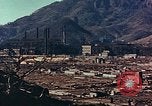
Children walk through the ruins of the University Hospital and the collapsed square column after the atomic blast in Nagasaki.
Physical damage caused by the atomic bombings in Nagasaki, Japan at the end of World War II. Damaged Mitsubishi Small Arms plant in the background. Foundations of the buildings that has collapsed in the foreground. The collapsed square brick column. An intact round concrete structure. The entrance of shrine. A set of stone lanterns on the steps leading up to the shrine. The lantern on the left falls west while the lantern on the right remains standing. The stone railing on the north side of the step which is protected by a blast from a stone wall. The south railing is blasted. The shrine and steps leading to shrine , the railings, stone lanterns and arc at head of stairway. Five children walk through the ruins of the University Hospital. A concrete wall support bent. A bridge with railing fallen and one standing. A view of the fallen side and the hospital in the background. The round concrete structure shows little effect of blast, while on of the square brick collapsed.
CRITICALPAST.COM: About Us | Contact Us | FAQs - How to Order | License Agreement | My Account | My Lightboxes | Shopping Cart | Advanced Search | Featured Collections | Website Terms & Conditions | Privacy Policy ©2026 CriticalPast LLC.
License Agreement |
Terms & Conditions |
Privacy Policy
©2026 CriticalPast LLC.