


 Francais
 Deutsch
 Italiano
Refine Your Search
South Vietnam 1969 stock footage and images
- Showing 2311 to 2316 of 6014 results more
more Hide
Hide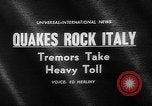
Italian Premier Amintore Fanfani makes a survey of earthquake affected area in Ariano Irpino, Italy.
1962 Irpinia earthquake in Ariano Irpino, Italy. Damaged buildings and deserted streets after a series of earthquakes. Collapsed façade of a Southern Italian house. Disturbances centered in Ariano Irpino, near Naples. Homeless civilians gathered on streets. Dilapidated sign reads “Montecalvo”. Italian woman holding a child. Italian Premier Amintore Fanfani makes a survey of the affected area. Damaged belltower of a church. International relief agency crew start rescue work.
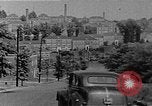
Residential apartment developments east of Pennsylvania Avenue and near Oxon Hill and other areas outside Washington DC
1940s views of new housing units in the form of residential apartment buildings east of Pennsylvania Avenue in Washington, D.C. Apartments with parking garages under them across the South Capitol street bridge near the Oxon Hill area. A 1940s sedan car pulls into a parking garage under an apartment building. Next view is out Maryland Avenue and over Bladensburg Avenue to the northeast, showing apartments and other buildings in the Greenbelt area. Car traffic is seen driving through the University of Maryland campus. Apartment construction underway in areas near the University of Maryland. Construction of Colonial Village, with aerial and ground level views of the site. Traffic driving along the Mount Vernon Highway with the Potomac River beside it (later George Washington Parkway). Apartment building construction in Alexandria. Busy traffic scene of commuters arriving in Washington DC on a work day. People get on and off trolley car lines in Washington, D.C. Other commuters wait to board a bus. Late 1940s automobile traffic on street in Washington, D.C.
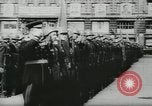
U.S. Regular Army, National Guard, and Army Reserve units operating together in combat, in Korea, and returning home after the truce
Soviet military forces in massed formations at Red Square, in Moscow, Russia. Joseph Stalin stands on balcony above. Scenes of rebellion in Europe and Asia. A map of Korea. June 25, 1950, as Korean War war broke out between North and South Korea. Buildings burning. Refugees fleeing. View of United Nations building on East River in New York City, where American ambassador Warren Austin is speaking. View of the Capitol in Washington, DC. President Truman, speaking, committed U.S. forces to action. U.S. Reservists are recalled to active duty to fight in Korea. Some are seen getting off a bus at a military base reception center. Recalled reservists with full field gear, starting their journey overseas, and later seen in Korea. U.S. tanks moving over the road manned by soldiers with World War Two experience. Numerous scenes of heavy artillery firing, mostly at night. U.S. regular Army, National Guard, and Army reserve soldiers engaged in fire fights in Korean War using tanks, artillery, mortars, and rifles. Soldiers administer first air and assist wounded comrades. American troops slogging through rain and snow in Korea. Soldiers eating from mess kits, and reading the Stars and Stripes newspaper, during a lull in combat. North Korean officers arriving, in snow, for armistice talks. Following the truce, American soldiers are seen packed up and heading home from Korea.
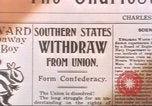
Reenactments of American military in action during the Civil War and Indian Campaigns
John Charles Daly, standing in the Hall of Heroes at the Pentagon in Arlington, Virginia, speaks about recipients of the Medal of Honor during the Civil War and Indian Campaigns. Excerpts from films about those events are then shown. A newspaper headline reads 'Southern States withdraw from Union'. Dramatized scenes: Men fire artillery during the American Civil War in 1861. Soldiers mounted on horseback advance on a battlefield. A montage of current day scenes show battlefield at Gettysburg and various memorial statues commemorating Union soldiers of the Civil War. . Mr. Daly points at names of Civil War Union heroes (1861-1865) and heroes of Native American Indian Campaigns (1861-1898) in the Hall of Heroes at the Pentagon in Virginia.
Color scenes of WWII including Pearl Harbor, D-Day, and Pacific campaign.
Montage of scenes dealing with Japanese attack on Pearl Harbor in World War 2. Bombs exploding and ships on fire; Japanese airplane diving from formation; a jeep driving past a burning airplane; hangars burning; Sailors firing anti-aircraft guns from an American ship; A New Orleans class American Cruiser firing her 8-inch guns; A South Dakota Class battleship firing her 16-inch guns; Group of American M3 Stuart light tanks in a field; U.S. Aviation Cadets marching between rows of Boeing Stearman Model 75 training biplanes; American soldiers marching in huge formations; Paratroopers in training jumps from towers; U.S. soldiers climbing down netting on side of troop transport ships to board small landing ships in the Pacific.; Marines in a landing craft carrying a large American flag; Landing craft in an amphious assault; Troops coming ashore from a Higgins boat, during training; An amphibious invasion task force at dusk; Troops wading ashore during the invasion of France in World War II, with barrage balloons aloft and support ships offshore. Staged scene of soldier on transport ship using flash light to read letter from home. Capital warships firing heavy guns and soldiers descending rope nets to enter landing craft. Soldiers landing on shore from Higgins Boats during training, and then on the shores of Normandy during the D-day invasion. American tank crew on an M26 Pershing tank. Major General George Patton with 1st Armored Division patch on his uniform sleeve. General George Marshall. General Dwight D. Eisenhower decorating an officer. Lieutenant General Henry (Hap) Arnold. Paratroopers jumping en masse from C-47 transport planes. German forces retreating in trucks along a road. Japanese General Yoshijirō Umezu, Chief of the Army General Staff, signing Surrender document aboard the USS Missouri, ending World War II, in the pacific. Glimpse of troop ship arriving in a U.S. harbor. View of U.S. military cemetery. Scene shifts to John Charles Daly, speaking in front of wall with names of Medal of Honor recipients, in the Hall of Heroes at the Pentagon, Arlington, Virginia, in 1968.
Presidential election debate in Washington DC. Richard Nixon, debating John F. Kennedy, speaks about the spread of Communism.
The second Kennedy-Nixon Presidential Debate in Washington DC, United States. Moderator Frank McGee introduces the candidates - Republican candidate U.S. Vice President Richard M. Nixon and Democratic candidate Senator John F Kennedy. The Moderator tells the rules to the candidates regarding questioning by the reporters. The reporters include Paul Niven, Edward P. Morgan, Alvin Spivak, and Harold R. Levy. Paul Niven asks Nixon to comment on whether Truman Administration was responsible for the loss of China to the Communists. Nixon answers and says that he disagrees with Senator Kennedy's statement that Cuba is lost and certainly China was lost because of Truman Administration. He talks about the decrease in the number of dictators in Southern and Central America in the past years. He speaks about Kennedy's book 'The Strategy for Peace' which prohibits the Americans from interfering in internal affairs of any other state. Kennedy presents his views and says that he never suggested that Cuba was lost. He criticized Nixon because in his press conference in Havana in 1955, he praised the competence and stability of the Batista dictatorship. He criticized the failure of the administration to use its great influence to persuade the Cuban government to hold free elections. He hopes that some day Cuba would rise if the U.S. changes its policies towards it.
CRITICALPAST.COM: About Us | Contact Us | FAQs - How to Order | License Agreement | My Account | My Lightboxes | Shopping Cart | Advanced Search | Featured Collections | Website Terms & Conditions | Privacy Policy ©2026 CriticalPast LLC.
License Agreement |
Terms & Conditions |
Privacy Policy
©2026 CriticalPast LLC.