


 Francais
 Deutsch
 Italiano
Refine Your Search
Spittal Austria 1945 stock footage and images
- Showing 595 to 600 of 6933 results more
more Hide
Hide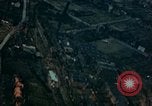
American aircraft attacks town and factory area.
American aircraft in flight strafing factory area and town through clouds and attacking railroad marshalling yards, in 1945, near end of World War II in Europe.
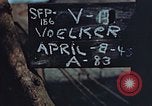
The flight line at Denain Airfield (A-83) in France at end of WW II in Europe. B-26s of 323rd Bomb Group.
View of the flight line at Denain Airfield (A-83) in France in April 1945, just prior to the end of world War Two in Europe. Martin B-26 Marauders of the 323rd Bomb Group taxiing. Airmen standing, around Army Ambulance number 728234, in the foreground. A derrick in the foreground. One of the taxiing B-26s has tail number 43-34138. All the aircraft have broad white stripe on top of their vertical stabilizers. (The aircraft of the 323rd are called the White Tails.) B-26s in flight overhead. Crew chief covers turret guns on a B-26.
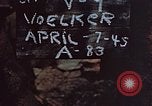
Activities of U.S.airmen in 323rd Bomb Group, at Denain Airbase (A-83) near end of World War II.
A number of Martin B-26 Marauder aircraft of 323rd Bombardment Group (9th Air Force) are lined up for takeoff. As they taxi past camera, tail number of one: 43-34344, is visible. All aircraft display the distinctive White Tail identifying the 323rd BG. (The Group is known to some as Wood's Rocket Raiders, so-named for their Commanding Officer, Lieutenant Colonel Wilson r. Wood.) The location is Denain Airfield (A-83), near the City of Valenciennes, France. The time is April, 7,1945, a month before VE Day. Several airmen are pitching horseshoes, while others watch. They use a shoe to measure how close one came to the pin. Two airment use a two-man saw to saw a timber while a third sits on it to hold it still.
Preparations for bombing, and bombing of Tokyo, Japan, by the U.S. Army Air Forces in World War II.
From "The Last Bomb", shows U.S. Army Air Forces conventional bombing of Japan in 1945, during World War 2. Map shows take off points in Saipan, Guam and Tinian. Guam Island shores. Houses and mountains in Guam. Civilians in village. U.S. military equipment, ammunition, vehicles and aircraft parked at airfield. Men around tents. Men at airfield engaged in morning activities. B-29 aircraft parked and others taxi at airfield. Technicians work on aircraft engines. Men manning B29s. Men board B29s. Sign reads 'Headquarters XXI Bomber Command'. General Curtis LeMay around chart planning raid on Japan's industrial areas. Other officers in room. Officer stand up as General Curtis leaves. Officers discuss the plan of attack. Bombs including GP bombs transferred at airfield. Submarines speed up in water to take up positions. Officers at headquarters in discussion. Officers talk on phone. Officer around flight status panel carry out visual progress of the flights. Officer marks positions. Time table for statistics of each wing on wall. B29s taxis for take off at airfield.
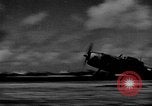
United States soldiers in combat with Japanese forces in towns and in city of Manila, Philippines (WW2)
Street fighting in Asia during World War II (Pacific Theater). Republic P-47 Thunderbolt fighter takes off from field. P-47 fighters dive bombing Japanese-occupied towns as American infantry squads advance in battle-scarred town. The U.S. soldiers employ rifles, bazookas, rifle grenades, hand grenades, and flame throwers (which destroy wood and other lightly constructed buildings). Americans advance under fire from Japanese snipers and return fire. United States soldiers use flamethrowers on wooden houses. A dead Japanese sniper in rubble of building. A Japanese soldier running to surrender, carrying a white flag. A staged exercise in a Burmese village, to demonstrate proper techniques for combating occupying enemy in such a setting. Huts and building in village. Soldier signals other soldiers. Two persons acting as Japanese soldiers inside a building. American soldiers wade through water. Acting Japanese soldier walks to the river side with an empty bucket. American soldier attacks the acting Japanese soldier from behind. Views of various Japanese cities, like Tokyo, Yokohama and Nagoya. Traffic with pedestrians on road. Smoke arising from U.S. artillery shelling of Manila. U.S. Army artillery battery firing field pieces at targets in Manila. Smoke in the streets during the 1945 Battle of Manila. U.S. Soldiers advance through burning Filipino buildings. They advance in groups. U.S. soldiers firing in streets and helping wounded soldier to cross street in front of the import-export business Levy & Blum Inc (345 Echague, Quiapo, Manila, Philippines). They take cover behind rubble. Soldiers engage in street fighting against the Japanese in front of boarded store in Ongpin street, Binondo (Manila Chinatown district). Troops pass by a wrecked building. U.S. soldiers gathered around a chart. They fire gun from hole in wall. Soldiers check houses for booby-traps. Soldier at window of building. Tanks and troops advance. Smoke screen in street. Soldier talks into radio. Captured Japanese march under guard.
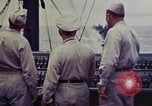
General Shepherd, Commodore Herbert B Knowles and Marine officer William T Clement aboard ship.
U.S. Naval and Marine officers aboard ship following L-Day landings of Okinawa. General Shepherd, Naval officer Commodore Herbert Bain Knowles and other Marine officer William Tardy Clement (Assistant Commanding Officer of 6th Marine Division, and in 1945 commanded Third Fleet landing force in Japan) look over bridge of ship. They turn around and pose. General Shepherd speaks.
CRITICALPAST.COM: About Us | Contact Us | FAQs - How to Order | License Agreement | My Account | My Lightboxes | Shopping Cart | Advanced Search | Featured Collections | Website Terms & Conditions | Privacy Policy ©2026 CriticalPast LLC.
License Agreement |
Terms & Conditions |
Privacy Policy
©2026 CriticalPast LLC.