


 Francais
 Deutsch
 Italiano
Refine Your Search
Spittal Austria 1945 stock footage and images
- Showing 613 to 618 of 6933 results more
more Hide
Hide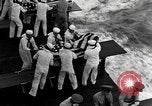
Bodies committed to ocean and Marine rifle salute in mass funeral ceremony aboard USS Hancock (CV-19) in the Pacific Ocean.
Mass funeral aboard the USS Hancock (CV-19) in the Pacific Ocean. Bodies committed to ocean in Mass Funeral Ceremony. Multiple crews of six men each carry dead sailors, wrap each in the U.S. flag, place them on a board and tip them into the ocean. Marines fire rifle salute. View of sheet covered bodies on lower deck awaiting burial at sea. The 50 men were killed in a January 21, 1945 accident when a TBF Avenger returned from a sortie in the area of Formosa (Taiwan). It landed on the deck and taxied near the island, and then exploded killing 50 men and injuring 75. (World War II period).
Mob uprisings against Fascists in Europe, during the end of World War II. The Third Moscow Conference of the Allied occupying powers. The Belsen trials.
A mob, seeking revenge against Fascist leaders, fills a city square. They pound on steel gates of a government building. Soldiers and police attempt to protect various persons from the mobs. Others are unprotected and suffer beatings and death. Bodies of Benito Mussolini and his Mistress Clara Petacci are seen hung upside down by Italian Partisans in Milan, Italy, on 28 April 1945. Scene shifts to image of postwar occupying powers, United States, Soviet Union, and Great Britain, whose flags are displayed in the center of a conference table during the Third Moscow Conference. Principals signing agreements, in November, 1943, providing, among other things, for lawful and orderly trials of war criminals, following World War 2. Seen signing are: Soviet Foreign Minister Vyacheslav Mikhailovich Molotov; U.S. Secretary of State, Cordell Hull; and British foreign Secretary, Sir Anthony Eden. View of General Dwight D. Eisenhower, leading a contingent of American wartime Generals on a mission to document Nazi atrocities at liberated German concentration camps. Closeup of a man directing local German citizens who were forced to observe the horrors of the camp. Closeup of an oven used to dispose of bodies of victims. Dead bodies of concentration camp victims strewn in a heap. A room filled with documentary evidence to be analyzed and used in war crimes trials. the body of German General Admiral Hans-Georg von Friedeburg , and of Heinrich Himmler, both of whom committed suicide. A hand holding cyanide capsules. Body of Leipzig City Council deputy mayor Dr. Ernst Kurt Lisso slumped over his desk, following suicide. Body of his daughter, Regina Lisso also a suicide victim. Nazi war criminals being rounded up by Allied military.One being carried on a stretcher. Another, a German officer, is taken into custody. Next, Josef Kramer, the Commandant of Bergen-Belsen concentration camp is seen under guard by a British soldier. British soldiers guarding the court room of the second Belsen trial, convened by the Allied occupational forces, in the Gymnasium building of Luneburg. View of the courtroom with defendants wearing numbers. Closeup of numbers 1 and 2, Josef Kramer, and Fritz Klein, respectively. View of Allied military officers sitting in judgment. Closeups of women defendants, including Irma Grese (number 9) and Elisabeth Volkenrath (number 11). Camera pans around the courtroom.
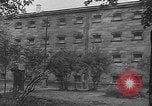
Post World War II trials of German and Japanese Leaders for war crimes
Film opens with exterior view of Nuremberg cell prison, just north of the Palace of Justice, holding war criminals for the Nuremberg Trials. Interior view showing cell bloick area and guards patrol the halls. Cell door with name Karl Doenitz on it. Views of German Admiral Doenitz and Admiral Erich Raeder, looking over war planning charts. Ships burning at sea in nighttime. Glimpse of German U Boat Captain observing through periscope. Back at Nuremberg Prison, an American soldier checks cell of Joachim von Ribbentrop. German Foreign Minister von Ribbentrop seen on steps of an airplane. Scene shifts to Nazi–sponsored so-called American Rally in Madison Square Garden, New York City, on February 20, 1939. A huge picture of George Washington dominates the stage where drummers play while flag-bearing marchers fill the stage. View of audience of 20 thousand persons, rendering Nazi salutes. Someone trying to interfere with the activity is quickly subdued on stage by men in military style uniforms. Scene shifts back to Nuremberg prison, where a soldier guard passes food through cell door to Julius Streicher (unseen). Closeup of Streicher speaking to crowd of people in Germany. Views of German Paramilitary Brown shirts (Storm troopers, or Sturmabteilung) during boycott preventing people from patronizing Jewish merchants. Next, victims liberated from Nazi concentration camp are seen being sprayed in delousing powder by American soldiers. Back at Nuremberg prison, a soldier stands outside the cell of Hermann Goering. Next, Goering is shwon in a scene eating at an outdoor table with other men, at a Nazi-sponsored public feeding event before World War 2. Brief view of German Chancellor, Heinrich Bruening, who fled Germany in 1934 as the Nazis were coming to power. A Graf Zeppelin airship, bearing Nazi Swastika insignia, is seen in flight over New York City. Crew member inside the Zeppelin, looking out a window as he plots a position on a chart. The Zeppelin casts a shadow over an ocean liner at sea, as it passes overhead. Back at Nuremberg cell prison, a guard opens a door with a key. Next seen shows several prisoners walking into a prison yard at an unidentified prison. A firing squad (unseen) is heard marching into position and firing their guns. Scene shifts to Japan, where a Japanese twin engine passenger plane is seen overhead, coming in for a landing. Official buildings are seen in Tokyo and jurists who will participate in war crimes trials. Scene shifts to war crimes trials authorized in Manila, by General Douglas MacArthur. Seen are Japanese General Tomoyuki Yamashita and another Japanese officer on trial at the High Commissioners Residence in Manila, in 1945. Views of ordinary Japanese soldiers. A court convening.
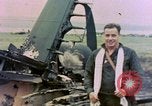
U.S. Navy fliers examine wreckage of FG-1D Corsair airplane, at the Omura airfield in Nagasaki, Japan, after World War II.
U.S. Navy flyers at the Omura Air Field in Nagasaki, Japan after the end of World War 2. They poke around the wreckage of a U.S. Navy Corsair(FG-1D Corsair BuNo.88056 flown by Lt.Col. D.K. Yost of MAG-51, US Navy, lost on 11 September, 1945.) They are accompanied by a Sergeant, carrying a long handle axe that he jokingly swings a couple of times at the fuselage of the Corsair. Camera shows numerous Japanese military airplanes parked randomly on the grass field.
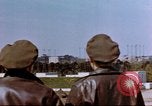
United States Airmen visit the Zeppelinfeld and Zeppelintribüne in Nuremberg, Germany
Activities of United States Airmen in Germany very soon after end of World War II in Europe. United States Army Air Forces Lieutenants visiting the war-damaged Zeppelintribüne, at the zeppelinfeld, in Nuremberg, Germany, 1945. They climb the stairs of the Zeppelintribüne grandstand. Later, the American soldiers look at the remains of the Swastika and Eagle that formerly adorned the Zeppelintribüne, and was blown up by the U.S. Army. One tries to pick up a piece of it. Airmen stand and chat. One Lieutenant helps another to lit up a cigarette. They smoke cigarettes, and pose for a photograph on the field.
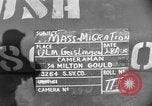
Trucks loaded with refugees and their luggage drive past through the streets in Ulm Germany.
Mass movement of German refugees in Germany during World War II. Trucks loaded with the refugees and their luggage drive past on streets in region of Ulm, Germany. A group of refugees rests alongside a highway with their luggage. They load their luggage on a truck. A directional board on a street. Second part of clip is from September 13, 1945, again at Ulm: At a railroad train station: German refugees gathered at the station with their luggage. A blond German girl child sits on a suitcase. A German family stands at the door of a boxcar.
CRITICALPAST.COM: About Us | Contact Us | FAQs - How to Order | License Agreement | My Account | My Lightboxes | Shopping Cart | Advanced Search | Featured Collections | Website Terms & Conditions | Privacy Policy ©2026 CriticalPast LLC.
License Agreement |
Terms & Conditions |
Privacy Policy
©2026 CriticalPast LLC.