


 Francais
 Deutsch
 Italiano
Refine Your Search
Spittal Austria 1945 stock footage and images
- Showing 643 to 648 of 6933 results more
more Hide
Hide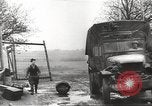
U.S. 4th Armored Division Commander Col. Hayden Sears forces German civilians to visit the Ohrdruf Concentration Camp in Germany (WW2)
The liberation of the first Nazi concentration camp Ohrdruf near the end of World War II. On April 6, 1945, troops from U.S. Combat Command A, 4th Armored Division, commanded by Colonel Hayden Sears forced local town's people to tour the camp. Captured Nazi German officials get out of an army truck. A German Major (Doctor) also accompanies the group. Dead bodies on ground. Nazi officials are forced to watch heaps of bodies found inside a room. Burned bodies of Polish, Czechoslovakian, Russian, German Jews and political prisoners. The policy of requiring local German officials to view every captured concentration camp began with this episode. The rationale was the "They will never be able to say they didn't know what happened here." (Col Sears as reported by his son.)
United States Army Air Force 365th Fighter Group strafe German held positions during World War II.
United States Army Air Force 365th Fighter Group over German held targets in February 1945. Aerial view of smoke rising from bombed buildings on the ground. View of green fields. A bomb damaged building.
Views of Wiesbaden and Mainz, Germany, at end of World War II in Europe. German soldiers being relocated.
Opening slate reads April 17, 1945, Wiesbaden, Germany. A brick building in Wiesbaden with large arrow pointing downstairs, labeled "LSR", meaning Luftschutzraum (Air-raid room). Signpost in front of a building with damaged roof reads, "Radfahr-weg" (bicycle path). Below it an American army sign reads "WP-Water Point." U.S. soldier directs military vehicles, carrying surrendered German soldiers, as they cross the Rhein (Rhine) river, from Wiesbaden to Mainz on a pontoon bridge. The dome of Christuskirche (Christ Church) across the river, dominates the skyline
President Truman and his party at RAF Station Harrowbeer near Plymouth, England during World War II.
United States President Harry S. Truman, and his party, make unplanned stop at RAF Station Harrowbeer during return from the last 4-Power meeting of World War 2, held at Berlin in July, 1945. (Their planned destination, RAF Station St Mawgan, was fogged in. So the President instructed his pilot, Lieutenant Colonel Henry T. Myers, to land at Harrowbeer, when they saw it was clear.) Truman descends steps from the Presidential Airplane (Douglas VC-54C named the "Sacred Cow," used by Presidents Roosevelt, and Truman). Two other C-54 aircraft have also arrived (unseen). One carried Secretary of State, James F. Byrnes, who poses with the President and three members of the British WAAF (Women's Auxiliary Air Force) identified as: Section Officer Eira Buckland Jones, Corporal Clarice Turner, and Leading Aircraft Woman Audley Bartlett. Views from inside car taking members of Presidential party to Plymouth Harbor. Groups of local people wave as the car passes through the English countryside. Larger numbers of spectators line the streets of the city of Plymouth. View of Plymouth Harbor from launch taking members of President's party out to the USS Augusta, anchored in Plymouth Sound (not seen).
General Jacob Devers and other U.S. Generals seated with German delegates at a surrender conference in Haar Germany.
German Surrender Delegation conference at the Thorak Estate in Haar, Germany, to accept the surrender of German Army Group G, towards the end of World War II. United States Army officers at the surrender conference include General Jacob "Jake" Loucks Devers of United States Sixth Army, who says "This is an unconditional surrender" while seated at a table with German and U.S. officers. Other U.S. Generals included in the delegation are: General Alexander McCarrell "Sandy" Patch; Lieutenant General Wade Hampton Haislip; Major General John W. "Iron Mike" O'Daniel; Brigadier General Reuben E Jenkins; Brigadier General William S Ott; Brigadier General Pearson Menoher. German delegation includes: Delegation head, Lieutenant General Hermann Foertsch, Commander of the 1st German Army; Colonel Hermann Zolling; Major Foeker; Major Coelle; Major Murray; Captain Behrendt; Captain Cartellieri and 1st Lieutenant Von Weber. Lt. General Foertsch signed the surrender document, effective 12:00 the next day (May 6, 1945). U.S. Army First Lieutenant John H. Brunswick is seated left of Foertsch. Lt. Brunswick translated General Dever's terms and statements, including "unconditional surrender," into German.
Montage of World War II scenes, encompassing the allied Pacific campaigns and Big Three wartime meetings.
Allied campaigns against Imperial Japan during World War II. Animated map depicts Allied victories in various Pacific islands like Guadalcanal, Palau, and the Mariana Islands. A map of the Philippines. United States troops invade the Philippines. Naval guns fire at a shore and flak bursts are seen. Dramatic shot of a Japanese Zero aircraft approaching United States Navy ships that are firing guns. The Japanese aircraft is hit at close range to the ship, a wing ruptures, it is consumed in fire and crashes with explosion in the sea beside the ship. Many landing craft with U.S. Army forces landing at beach on Leyte. Soldiers land and advance inland. United States Army General Douglas MacArthur and President Sergio Osmeña of the Philippines wade ashore. Filipino women and children on the island are assisted by U.S. forces and provided with food and protection. Following are meetings of wartime Allied leaders, shown briefly in the ending of the film: Prime Minister Winston Churchill meeting President Franklin D. Roosevelt on the battleship, USS Augusta, at Newfoundland, during the Atlantic Conference, 1941. Roosevelt stands at the railing, assisted by his son, Army Captain Elliot Roosevelt. Roosevelt and Churchill meeting with Generalissimo Chiang Kai-Shek, at the Cairo conference, in 1943. Joseph Stalin, Roosevelt, and Churchill pose outside the Livadia Palace (Baturyna St, 44-а, Livadiya, 98655) during the Yalta conference in 1945. Soviet Foreign Minister Molotov, American Ambassador Harriman, British Foreign Minister, Anthony Eden, and Churchill's daughter, Sarah, in uniform, are among those standing behind the seated Big Three. Delegates from 51 Nations gathered for the first meeting of the UN General Assembly, in Westminster Central Hall, London, England, in 1946.
CRITICALPAST.COM: About Us | Contact Us | FAQs - How to Order | License Agreement | My Account | My Lightboxes | Shopping Cart | Advanced Search | Featured Collections | Website Terms & Conditions | Privacy Policy ©2026 CriticalPast LLC.
License Agreement |
Terms & Conditions |
Privacy Policy
©2026 CriticalPast LLC.