


 Francais
 Deutsch
 Italiano
Refine Your Search
Spittal Austria 1945 stock footage and images
- Showing 703 to 708 of 6933 results more
more Hide
Hide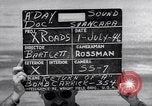
B-29 "Dave's Dream" returns to airfield in Marshall Islands after Test Able atomic bomb drop on Bikini Atoll
The B-29 "Dave's Dream" returns to airfield in Marshall Islands, after dropping atomic bomb on Bikini Atoll, in Test Able of Operation Crossroads, on July 1st, 1946, during U.S. nuclear testing. The B-29 lands and taxis to a parking place on the ramp. The area around the aircraft is cordoned off and the crew is confined therein as they deplane. Navy photographers take photos. An interviewer talks to crew members. The crew walks away from the aircraft along a cordoned pathway between numerous military personnel on hand to greet them on this historic occasion. The aircraft, number 44-27354, was actually participating in its second atomic mission. It also served as a photographic platform for the mission to Nagasaki on August 9, 1945, when it was named "Big Stink.". Pilot for the Bikini mission was Major Woodrow Swancutt of Wisconsin Rapids, WI. The aircraft was renamed "Dave's Dream" in honor of Captain David Semple, a bombardier killed during the crash of another B-29 on March 7, 1946, near Albuquerque, New Mexico. (World War II period).
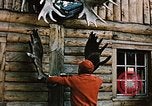
Man placing moose antlers on log cabin in Alaska.
Man securing Moose antlers for display on a former homsteader's log cabin, maintained for airmen's recreational use at Elmendorf Air Force Base (now Joint Base Elmendorf-Richardson, Alaska). He fastens the antlers below another set fastened near the cabin roof. Another take of the same event. Snow visible on roof of the cabin. (Note:The land for Fort Richardson and Elmendorf was purchased by the U.S. Federal Government, from private landowners and homesteaders during 1939 through 1945.)
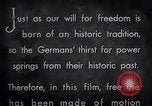
U.S. Army orientation film "Here is Germany" showing the contrast in life in Germany pre-war and during World War 2
U.S. Army training film titled 'Here is Germany'. Circa 1930 - 1938 views of pre-war German countryside, and German cities including Berlin and others before destruction in World War 2. Shots include famous German landmarks and buildings in major cities including Brandenburg Gate and Victory Column sculpture close-ups and other monuments all before bombing of World War II. Lifestyle of German people with families and children in their routine lives in the decade of 1930 before the war. Farmers working fields, mined coal transported by rail, potatoes poured from a full sack, a boy shepherd with geese; a farmer counting pigs descending a ramp at a farm. City port or harbor scene with ships and a modern looking railroad train arriving at a station, sign on side reads Deutsche Reichsbahn (German Reich Railway). High speed highway roads like the Autobahn. German cruise ship at sea. Aerial view of airport with "Berlin" sign on ground. German schools, offices, factories and markets. German woman braiding a girl's hair. German woman taking in washed clothing from a clothesline. German men, women, and children cleaning and polishing work areas and possessions. A German library with people studying and others at book shelves. German classroom with a teacher instructing children and writing on a blackboard. Scenes of German musicians and symphony orchestra and musical instruments, artisans, masons, cooks. Busy roads with cars. Narrator then presents a darker other side, showing an arms factory during rearmament of Germany, German soldiers escorting away a religious priest. German military officials. Scenes circa 1945 of victims of German armies and of the concentration camps. Lumps of dead bodies from massive public shootings, a man being tortured, burning chambers, prisoners of war, concentration camps, human ovens, gas chambers. Survivors of the German custody in relief camps of Red Cross. Evidence of atrocities committed by Nazi Germany. Articles made of human skin and bones. Daily utility items like toys and brushes made from human body parts. Scenes of survivors of concentration camps. Polish people dead from Nazi atrocities at Lublin Castle. Italians and Belgians murdered by Germans, American POWs murdered by Germans. Scenes return again to 1930s views of peaceful German citizens and German lifestyle juxtaposed with views of German soldiers and military actions in World War 2. Some famous Americans of German roots: Wendell Willkie, Admiral Chester Nimitz, Henry J. Kaiser. Narrator talking about American customs and values. View of two teenage American boy students viewing a housing area and taking notes. One of the teenage boys is African American. Some men gathered at a bar in an American town. A man holding a long fly fishing pole preparing to depart on a fishing trip. Woman neighbors in discussion. Young American women walking down a sidewalk in an American town as a group of American boys watch and admire them.
Officer paints nose art on B-29 bomber Deaner Boy of U.S. Army Air Force at their base on Tinian, Mariana Islands during World War II
United States Army Air Force crew at their base in the Tinian, Mariana Islands during World War II. A Army Air Force officer stands on a hoist near the cockpit of a B-29 bomber paints a picture on it. Picture of a baby wearing boxing gloves. Officer paints the baby's diaper with white paint. Soldier looks at nose art painting on the B-29 nose with written wording "Deaner Boy" on it. Another soldier walks up and looks at the nose art painting. (Note: Painter might be Lieutenant Dean C. Forburger, based on examination of image reflected back from aircraft body. Forburger was a B-29 pilot stationed at Tinian at the time, and images exist of him standing beneath this nose art. Forburger was not a member of the crew on Deaner Boy when it perished in a mid-air collision accident in February 1945. The Deaner Boy nose art was painted at least twice on this aircraft, as there are also other images of it in existence with a side-facing baby and cursive lettering for "Deaner Boy").
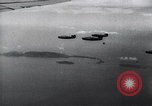
American and Japanese aircraft attack each others airfields in World War II. B-24 and B-29 heavy bombers strike Japanese targets
Formation of U.S Army Air Forces B-24 Liberator bombers, flying over Iwo Jima during World War 2. View from one of the aircraft of Japanese air field below. Nightime view of American anti-aircraft fire directed at Japanese bombers attacking Saipan. Explosions and fire silhouetting American aircraft on Saipan's Isely field during Japanese air raid. Burning U.S. B-29 bombers. Scene changes to Japanese aircraft destroyed on the ground at the air base on Iwo Jima. Bodies of dead Japanese airmen on the air field. Later view of P-51Ds from the 21st Fighter Group at Central Field on Iwo Jima, in the summer of 1945,after the field had been substantially upgraded to allow B-29 operations. A B-29 is seen displaying an "F" tail code. A formation of B-24 Liberator bombers in flight on a bombing raid. Waist gunner inside a B-24 firing at attacking Japanese fighter aircraft. A Japanese fighter going down in flames at night. View from a B-24 of another, off its left wing, flying in formation with its number 3 engine shutdown and propeller feathered. View from B-24 bombing oil facilities at Balikpapan, Borneo. Bombs bursting on the ground. Glimpse of B-24s in formation. Aerial views of bomb bursts carpeting target areas below. Aerial view of B-24s flying above smoke rising rapidly from bombs bursting below. View of bomb craters left below (probably from later reconnaissance flight).
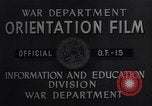
U.S. orientation film for Allied occupation forces, to provide background for understanding Japanese and their society
Background information for United States occupation forces in Japan after end of World War II. At start, the film shows sky filled with U.S. Navy airplanes flying in formations. They include Vought F4U Corsair aircraft, among others, and are seen overhead above the Battleship USS Missouri (BBB-63). Closeup of the USS Missouri with her crew in formation on deck wearing dress whites. Next, General Douglas MacArthur is seen and heard speaking from a podium on the Missouri's deck. He invites the representatives of the Emperor of Japan, and the Japanese Government, and the Japanese Imperial headquarters, to sign the instrument of surrender. The date is September 2, 1945, just after the end of World War 2. Closeups of the Japanese delegation, which includes envoys Foreign Minister Mamora Shigemitsu and General Yoshijiro Umezu, and of MacArthur. Japanese Foreign Minister Mamora Shigemitsu sits at a table. Closeups of him signing the surrender document. Change of scene to Japan, where camera pans over many thousands of Japanese people assembled to learn of their fate. Closeups of Japanese soldiers and family members, as Narrator asks how should the U.S. occupying force treat them. View of soldiers in plain non-military uniforms. Views of Japanese responding en masse to a leader, during World War 2. Views of child victims of the war. Closeup of Japanese soldier firing a short barrel light machine gun. Views of Japanese pedestrians including families, most in western dress. Japanese workers in an office. Film shows artists view of one worker's brain, and then many brains, as Narrator refers to need for reorienting Japanese thinking. View of learned wise Japanese leader at a podium. View of a Japanese soldier posed with his sword above the head of a war prisoner. Japanese mother feeding her baby. Closeups of Japanese babies. Closeups of Japanese school age children, in a group, and some doing things in school, and some at a playground. Group of uniformed Japanese students studying the art of Japanese calligraphy. Students doing artwork, studying nature outdoors, and paying attention to a teacher using a black board to explain how to calculate volumes of different shaped vessels. Students in classes of Geography and of geology. Japanese chemists, architects, and lawyers at work. Telephone switchboard operators at work. Electrified train moving on a track.
CRITICALPAST.COM: About Us | Contact Us | FAQs - How to Order | License Agreement | My Account | My Lightboxes | Shopping Cart | Advanced Search | Featured Collections | Website Terms & Conditions | Privacy Policy ©2026 CriticalPast LLC.
License Agreement |
Terms & Conditions |
Privacy Policy
©2026 CriticalPast LLC.