


 Francais
 Deutsch
 Italiano
Refine Your Search
Spittal Austria 1945 stock footage and images
- Showing 727 to 732 of 6933 results more
more Hide
Hide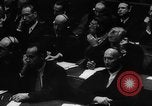
Nazi criminals are questioned during the Nuremberg Trials in Nuremberg, Germany.
Events related to the Nuremberg Trials held at the Palace of Justice (Fürther Str. 110, 90429 Nürnberg, Germany) in Nuremberg, Germany. German attorneys defend the accused. One by one the accused are cross examined. Rosenberg is examined on the count of high mortality rate among Russian prisoners of war. Joachim von Ribbentrop is questioned about the military pressure on Russian from Germany. Goering is questioned about his knowledge of the policy to exterminate Jews. Speer testifies about negative things Hitler said about Goering in response to Goering's telegram suggesting that Goering took power in April 1945.
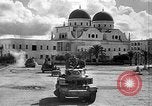
UN Commissioner Adrian Pelt and members of an Advisory Council meet people and the Emir of Cyrenaica in Libya.
A film depicts steps in Libyan independence. Allied soldiers on tanks during World War II. A tank goes past a ruined building. People gathered look as the Union Jack is unfurled. People read a proclamation pasted on a wall. Ruins of World War II. A meeting in the United Nations in 1945 where it is suggested that Libya be placed under temporary UN trusteeship. A resolution in the UN on 21st November, 1949 to create an independent Libya. The Russian delegate to the UN states his disagreement. The United Kingdom delegate speaks in favor of the resolution. A UN aircraft lands and taxis in Libya. Advisory Council members, led by Mustafa Qasim Mizran, who is first to exit the plane and is head of the National Party and Director of the School of Arts and Trades in Tripoli, are joined by UN Commissioner in Libya Adrian Pelt as they are greeted by dignitaries. The headquarters of the Commissioner and the Advisory Council in Tripoli. A sign reads 'Office of the United Nations Commissioner in Libya'. Members of the Advisory Council include representatives from Tripolitania, Cyrenaica, Fezzan, Egypt, France, Italy, Pakistan, the United Kingdom, the United States and a minority group delegate. Cars carrying the representatives drive out of the gates of the headquarters. They meet people to become aware of their problems. People greet the UN Commissioner and the members of the Advisory Council. A visit to Benghazi where they meet the Emir of Cyrenaica. People holding placards in front of the Emir's palace to greet the Advisory Council. They meet the Emir, who is the religious Muslim leader, in his place. The headquarters of the Commissioner and the Advisory Council, where Mustafa Qasim Mizran is seen touching his face, as he stands behind king Idris,
Scenes of Manila, Philippines, early during the Japanese occupation in World War II
Title card with title “Roaring color Manila” in Japanese. A street corner in Manila after the Japanese invasion and occupation in World War 2. Japanese flag in storefront as Filipinos walk pass store. Closeup of the statue of St. Anthony of Padua with a kneeling woman and child, in front of the Church of St. Francis (the former San Francisco Church, now site is occupied by Mapúa University), Church of Our Lady of Angels, Intramuros, Manila, Philippines. Camera pans down over the statue. View from above, at a short distance, of parishioners going in and out of the church. (This church was destroyed in the battle of Manila, 1945, but the statue survived.) A Japanese sign outside of a building. View inside the building, where many school children are seen walking through an exhibit of artwork and other displays of school projects. Closeup of one drawing on display, depicting a Spanish Toreador. Several displays of Japanese calligraphy. A model of two small structures. Closeup of several schoolboys interested in small objects on display. A group of schoolgirls at exhibits of clothing designs and patterns. A cartoon sign in the building, in Japanese but mostly in English. It shows two small girls and a boy in different exercise poses and two ducks walking past them near their feet. The sign announces in Japanese and English, "Radio Taisou Daily Calisthenics on the air." It also reads: "Health First" and "Mass exercise at Luneta Park." A man conducts calisthenics in the open in front of a rotunda. Jorge B. Vargas, chairman of the Japanese-sponsored Philippine Executive Commission, sits inside the rotunda observing a vast field filled with school children following the lead of the exercise director, as they perform calisthenics. The Rizal Monument (1225 Roxas Blvd, Ermita, Manila, 1000 Metro Manila) is seen far in the background. Some closeups of the children as they exercise. Wide view of the children organized in lines across the field. The French renaissance-style Luneta Hotel (414 Kalaw Ave, Ermita, Manila, 1045 Metro Manila, 1000 Metro Manila) is seen in the background.
Russian advisers with Nationalist Chinese (KMT) military during 2nd Sino-Japanese War (WW2)
Passengers jam a train at an open air railway platform in China. Many sit, together with their belongings, on roof of the train. Some persons on the station offer to sell food to occupants of the train. Change of scene shows Soviet Lieutenant General Vasily Chuikov, advisor to Chinese Generalissimo Chiang Kai-Shek, having an amicable conversation with a Chinese Major General and his aide in World War II.(The latter has injury to his nose.) Next, several Russian troops are seen standing guard in unkempt town square, containing a monument. They appear unsettled by the presence of the cinematographer. Building in background flies Soviet flag and has large picture of Stalin on it. Views are shown of a modern building with drive up ramp to entrance (airport terminal?) and then of a stylish train station displaying Chinese (KMT) and Soviet flags and pictures of Lenin and Stalin. ( Glimpse of a tall white monument with a Soviet T-34 tank on top, followed by another view of the train station.) Next a corner building in the city is seen with Armed Chinese guards protecting sacks of food supplies piled up next to it. A Chinese officer walks past the guards and into the building. View of car and pedestrians on a dusty city street. More views of the Chinese guards and foodstuffs. (Note 1: The images seen here are mixed in place and time, including 1941 and 1945..) (Note 2: Soviet Lieutenant General Vasily Chuikov was recalled from China at end of 1941, and placed in command of the Soviet 62nd Army responsible for the defense of Stalingrad.)
Czechoslovakia and Soviet relations after World War 2; Dubcek liberalization during Prague Spring; Soviet occupation in 1968
History of Czechoslovakia from 1919 to 1968 depicts lives of its people and various crisis. Clip shows combination of still images and moving images, with background of Czech musical soundtrack. A burning Nazi plane shot by Soviet military during World War II. Soviet Red Army marches in Prague, Poland in May 1945 to rescue from German occupation and atrocities. People destroy Nazi emblems and symbols from buildings. People assemble in large numbers on roads and cheer for the incoming Soviet troops and tanks. Civilians of Czechoslovakia during normal life after World War 2. Workers in mines, farmers in field and women work in houses. Spread of communism and communists make a star formation during a rally in Prague (sometimes called the Prague Spring). President Edvard Benes in 1948 signs pact with Soviet government. Photos of Soviet General Joseph Stalin and other Soviet leaders in his office. Various Presidents and leaders of Czechoslovakia during the 1950s. Military and civilian communist groups march on streets in 1956. Czech Skoda automobile production factory scenes in mid 1960s. Workers work in factories and shops till night hours. A Czech textile factory scene. Czech men and women in 1960s fashions enjoying mugs of beer. Several scenes with Alexander Dubček, (Alexander Dubcek), then Soviet leaders Nikita Khrushchev and Nikolai Brezhnev arrive for meeting with Dubček. Smiling Czech people walk in cities and at a cafe during liberalization measures. Soviet and Warsaw Pact tanks, armored vehicles, infantry and aircraft start their occupation ending the Prague Spring in Prague, Bratislave and other cities in August 1968. Civilians protest, demonstrate, and argue with Soviet troops and demonstrate in streets. Some approach tanks and attempt to damage the tanks. Large crowd of civilians watch the retreating Soviet forces from Czechoslovakia in 1968. Red Army met with agitation and resistance on streets by civilians. Soviet troops fire at some demonstrating civilians.
The United States demobilizes following World War II
Opening illustrated slate shows reduction of Amercan Armed forces personnel from more than 12 million in 1945 to only a little over 1 and a half million in 1947. U.S. Navy submarines are seen docked in storage. Men work spraying protective coatings over guns on Navy ships as they are placed in storage in the "Mothball Fleet." A lone sailor is seen on the deck of a ship with vast number of mothballed Navy destroyers in the background. A B-24 Liberator bomber being dismantled and a B-17 parked with engines removed, seen through stack of propellers in foreground. Airman sets a demolition charge. Views of several bomber aircraft being blown up as junk. Stacks of junked and scrapped American war materiel rusting. View inside a mill where molten metal is being processed (ostensibly recycled from junked war materiel). Narrator speaks of beating guns into plow shares. Several views of molten metal being poured into and from ladles. Views inside post-war factories returning to peace-time production, where industrial heavy equipment, railroad wheels, kitchen appliances, home appliances, rubber tires, and new 1946 Ford automobiles are assembled (looking exactly like the 1942 models).
CRITICALPAST.COM: About Us | Contact Us | FAQs - How to Order | License Agreement | My Account | My Lightboxes | Shopping Cart | Advanced Search | Featured Collections | Website Terms & Conditions | Privacy Policy ©2026 CriticalPast LLC.
License Agreement |
Terms & Conditions |
Privacy Policy
©2026 CriticalPast LLC.