


 Francais
 Deutsch
 Italiano
Refine Your Search
Spittal Austria 1945 stock footage and images
- Showing 79 to 84 of 6933 results more
more Hide
Hide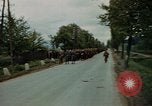
German prisoners march on a road in Austria.
German prisoners march in Austria during World War II. The prisoners march on a road. Allied soldiers lead them. German prisoners carry bags in their hands. Views of German prisoners marching.
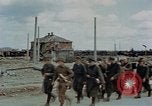
German prisoners march and horse carts and prisoners move along a road in Austria.
German prisoners march in Austria during World War II. German prisoners march on a road. A hut in the background. Trucks drive past on a road in the foreground. German prisoners with their belongings loaded on a horse cart move out. Horse carts and prisoners move along a road. The belongings loaded on carts.

Sepp Bradl of Austria sets a new world record with a 400-foot ski jump on the Austrian Alps in Kulm.
Ski-flyers at a ski leap or ski jumping competition in Kulm Austria. Competitors climb atop a hill in the Austrian Alps. The competition begins. The ski-flyers take a long start and jump over the slope. Spectators watch the event. Officials monitor the weather and wind conditions. Some competitors like Roy Sheerwood of Connecticut fail to execute a successful jump. Photographers click pictures. Sepp Bradl of Austria executes a 400-foot leap on his third try to set a new world record.
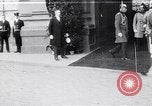
Scenes depicting social activities in Germany, Hungary, and Austria, before World War I.
Social life of wealthy in Germany, Hungary, and Austria before World War 1. Kaiser Whilhelm II of Germany and his wife, Empress Augusta, in Berlin. The Empress The enters their open back limousine, followed by the Kaiser, who is dressed in military uniform with Prussian style helmet. They drive off while German Officer salutes. Complete change of scene shows well-dressed crowd of spectators gathered in Budapest, Hungary, to watch a horse race. Some spectators use binoculars. View of horses in final stretch and crossing finish line. Next scene shows "Flower Day" in Vienna Austria. Wealthy citizens crowd shopping area and contribute to help the poor. Finely dressed pedestrians walking in shopping and commerical areas. They receive flowers as token of contribution. Some men wear flowers in their lapels. Little girls with baskets of flowers participate in the activities, standing in front of the Cafe Scheidl and "Zum Fenstergucker" house near corner of Kaerntner Strasse and Walfischgasse next to the Opera House. A street car decorated with garlands of flowers is a center of the activity. Women on the top deck of the street car reach down with small nets on long poles to retrieve contributions from passersby.
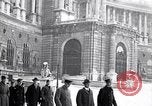
Professor Archibald Cary Coolidge and members of his staff in Vienna, Austria, in 1919
Professor Archibald Cary Coolidge of Harvard University, special assistant to the Department of State, assigned to the American Commission to negotiate peace after World War 1. He is seen in this sequence, with members of his staff, headquartered in Vienna, Austria, from where they assessed postwar political conditions in Austria-Hungary and neighborhood countries, and made recommendations for the U.S. participants at the Paris Peace Conference, 1919. The sequence begins with staff members walking from the Hofburg (Hofburg, Michaelerkuppel 1010 Wien). It is January, and snow is on the ground. Professor Coolidge holds gloves in his left hand and warms his right hand inside his coat in Napoleonic manner, as he chats with others. Staff members are predominantly military officers and include both U.S. Army and Navy personnel.
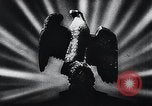
Views of Kufstein, in Tyrol, Austria during World War II
Opening scene shows Tyrolean town of Kufstein nestled in Brandenberg Alps in Austria. A young Austrian woman and a soldier in uniform sit on a hillside with part of the Kufstein Fortress in the background (Festung 2, 6330 Kufstein, Austria). A Music professor named "Butler" sits at the famous organ (Heldenorgel), the world's largest open-air organ, in the Kufstein Kaiser turm (Imperial tower). He plays music as a wedding party stands, listening, outside. View through the building window shows the bride and her new husband, a German officer in uniform, surrounded by family and friends in a courtyard, outside. Scene shifts to the courtyard in sunlight and shadow, where townsfolk, including many children, are assembled. A large military style German Cross of stone dominates the foreground. Closeups of wounded German soldiers attended by a nurse. A German sailor in uniform stands with several girls. The organ music permeates the scene. View from behind spectators leaning over a railing shows the courtyard to be somewhat oval. Locals in traditional Tyrolean costumes are part of the crowd. Closeups of various persons in attendance. Glimpse of the organ pipes showing this to be an impressive instrument. Camera pans from the pipes to an opening in a tower, where they are located, revealing a panoramic view of the town and landscape below. Among things seen below are Saint Vitus Church and other significant buildings. View from afar of Kufstein Fortress and Brandenberg Alps with clouds behind. View framed by fruit tree blossoms across a field being plowed by farmer and team of oxen. The town in the background. More scenic views.
CRITICALPAST.COM: About Us | Contact Us | FAQs - How to Order | License Agreement | My Account | My Lightboxes | Shopping Cart | Advanced Search | Featured Collections | Website Terms & Conditions | Privacy Policy ©2026 CriticalPast LLC.
License Agreement |
Terms & Conditions |
Privacy Policy
©2026 CriticalPast LLC.