


 Francais
 Deutsch
 Italiano
Refine Your Search
Spittal Austria 1945 stock footage and images
- Showing 313 to 318 of 6933 results more
more Hide
Hide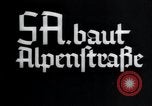
Nazi Storm troopers officiate at the opening of a new Alpine road in Austria
Building Alpine highways in Germany in 1930s: View of idyllic lake and mountain scene with a boat moving, in the Austrian Alps. Ceremonies marking the opening of new roadway in the Alpine region. Stormtroopers (brownshirt Sturmabteilung or SA) are formed up for inspection by leaders, in an Alpine field. A banner across a new road says that German labor will pave the way to freedom. Stormtroopers and spectators line a new road as an official car begins to travel it beneath the banner. The car breaks a ribbon, officially opening the new road. A stormtrooper leader stands in the car. Several cars form a motorcade filled with Stormtroopere leaders, on the new road. A motorized Cornucopia float travels the new road, along with a float of flowers and an open truck filled with local citlzens. Scenic views of mountains and valleys from the new road.
Family members outside farm house in rural village in Austria
Amateur home movie showing a farming family at a house in a rural Austrian village. Elderly man poses with young girls, possibly granddaughters. Two women walk with children on dirt road behind houses. Family members pose in backyard. Man leads calf on a rope. Visiting family members in nicer clothing walk in grass behind house, with man carrying bucket full of water. View of house with pond in front of it. Large group of family walking in grass.
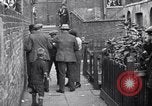
Events that initiated World War I and animated map showing involvement of nations from 1914 through 1918
Opening scene shows a man being roughed up by a group of men in an alleyway with pushing and shoving as they fight. A slate comments (in French) that when nations are bellicose, an assassination can cause a world war. Next, a slate shows picture of the world and states (in English) "One murder may start a world war." Another slate (in French) states that In 1914, while Europe's armies and fleets were more powerful than they had ever been, the nephew of the Emperor of Austria (Archduke Ferdinand) was assassinated. A front page is shown of newspaper, "Journal De Geneve" carrying the story. Next scene is a view of the city of Sarajevo. The ancient Emperor's Mosque dominates the scene. A slate appears asking Where is Sarajevo? It is followed by a map of Europe in 1914, which zooms in on Austria and Serbia and identifies and labels Sarajevo,in Austria, close to the Serbian border. Slates (in French) says Austria accused Serbia of War and other nations enter the melee. Animated World map shows the nations getting involved, starting with the German Empire in 1914, including its African colonies, and then successively showing Russia, France, Belgium,Great Britain, Japan, and the Ottoman Empire. Map advances to 1915, showing the Italian empire, Bulgaria,and Central Arabia. In 1916 it adds Portugal, Roumania. Next, the U.S.A. is added in, 1917, along with Central and South America, Greece, Siam, and China. Finally, the slate shows the war ending in 1918. Slate shows Armistice Day, the 11th hour of the 11th day of the 11th Month (November), with time shown on hands of Big Ben in London.
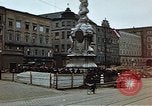
U.S. Army troops guard German prisoners of war around base of Trinity Column in Linz Town Square
End of World War II in Europe. Quiet street scene. U.S Army soldiers collect German prisoners of war in Linz, Danube, Upper Austria. The prisoners are assembled under guard around the base of the Trinity Column in the Town Square of Linz. A German General is seen at front of one contingent of prisoners, as they walk under guard to the holding area. M4 Sherman tanks and army vehicles are seen in the area.
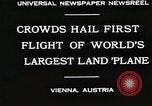
President W Miklas and Foreign Minister I Seipel arrive at an airport in G-38 plane amidst large crowd in Vienna, Austria.
G-38 flying in air near air port in Vienna. The large crowd watches and cheers. President Wilhelm Miklas is helped by an attendant to get down from the plane. Foreign Minister Ignaz Seipel follows him. Policemen join hands to restrict the crowd from coming towards the plane.
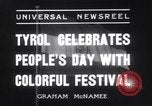
Tyroleans parade to celebrate the signing of a treaty in Austria
Tyrolean men and women wear traditional costumes and parade to celebrate the signing of a treaty that eases tension along their frontier. Men in Lederhosen and women wearing Dirndl. Children in traditional Tracht. Tyrolean people also parade their cattle. A bearded man wearing a large hat.
CRITICALPAST.COM: About Us | Contact Us | FAQs - How to Order | License Agreement | My Account | My Lightboxes | Shopping Cart | Advanced Search | Featured Collections | Website Terms & Conditions | Privacy Policy ©2026 CriticalPast LLC.
License Agreement |
Terms & Conditions |
Privacy Policy
©2026 CriticalPast LLC.