


 Francais
 Deutsch
 Italiano
Refine Your Search
Stalingrad Russia Soviet Union 1943 stock footage and images
- Showing 757 to 762 of 5654 results more
more Hide
Hide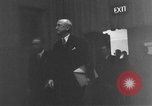
James F. Byrnes urges that Iran be given a chance to speak at UN Security Council meeting regarding Soviet military in Iran
Segment from the United Nations Security Council meeting at Hunter College, New York City, United States, on March 27, 1946. At the time, the Soviet Union, with its troops in Iran, and with interest in the governance and autonomy of Azerbaijan, was pushing to postpone discussion of the appeal by Iran that the action of the Soviet Army in Iran was a threat to international peace and security. American statesman James F. Byrnes, Edward R. Stettinius, Soviet diplomat Andrei Gromyko and representatives of the UN Security Council member countries are seen entering the conference room at Hunter College, New York City. The dignitaries seated at a table. Delegates and spectators present. Gromyko, the Soviet representative to the United Nations, speaks in Russian. Other delegates listen, seated behind. A delegate from China speaks. Several delegates raise their hands with questions. U.S. representative James Byrnes demands that the Iranians be given a chance to be heard. The Soviet delegation stands and exits the talks abruptly. Iranian delegate Hossein Ala', Iran's Ambassador to the United States approaches the table and is seated. The delegates listen as Mr. Hossein Ala addresses the council. Mr. Ala urges the council to take action, saying, "Iran views with grave concern any delay in the consideration by the council of the merits of these disputes. For these reasons, on behalf of my government, I request the council to take up these matters at once and reach, without reference to further negotiations, a solution consistent with the principles of the charter."

Georgy Zhukov inspects troops during unveiling of Soviet War Memorial and Russian Revolution anniversary celebrations in Berlin, Germany.
Unveiling of new Soviet War Memorial (Tiergarten) in Berlin Germany, during Russian Revolution anniversary celebrations (28th anniversary), in Berlin, Germany, soon after the end of World War II. Marshal of the Soviet Union Georgy Konstantinovich Zhukov inspects British, French, American and Russian units. Trees in the background. Zhukov and United States Army Major General James Maurice Gavin in a grandstand. A Russian officer speaks from the grandstand in front of the Soviet War Memorial (then also called Russian Victory Monument by Allied forces) on Charlottenburger-Chaussee. A Russian Army band plays. A statue of a Russian soldier atop the Victory Monument. Russian troops parade after unveiling of the Memorial. Honor company of United States Army 82nd Airborne Division marches past. Allied troops seen marching in formation on nearby streets of Berlin. Major General Gavin shakes hands with Soviet leader Marshal Zhukov. Officers place wreaths at the Soviet War Memorial. Russian artillery fires salute. Photographers take photographs. The officers salute in front of the War Memorial. Wreaths placed at the base of the Memorial.
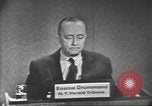
John Kennedy and Nixon debate over the prestige of America prior to the presidential elections in the United States.
Presidential election debate held between Democratic nominee Senator John F. Kennedy and Republican nominee U.S. Vice President Richard Nixon in the United States. New York Herald Tribune newspaper correspondent Roscoe Drummond asks Senator Kennedy that how can American prestige be measured abroad. Senator Kennedy responds stating that America is identified with the cause of freedom and if other countries have to choose between America and a Communist country, they would choose America. He further speaks that there are many indications that prestige of the United States is not as high as it once was. Kennedy summarizes some of these indications and relates to it by mentioning the example of Sputnik space program by the Soviet Union in 1957 (during the Space Race). Kennedy speaks about the economic development of the Soviet Union. He says the Soviet Union will be ahead of any other country scientifically and militarily by 1970. He mentions votes by different countries in the United Nations dealing with Red China. He says that Guinea and Ghana, two independent countries now are supporting Soviet foreign policy at the UN. NBC correspondent Bill Shadel asks Richard Nixon to speak on the topic. Vice President Nixon responds by speaking about the economic development of the Soviet Union. He speaks that the Soviet Union is a very primitive economy and that the United States is well ahead economically. He says that if the United States is going to maintain its strength and its prestige, they must not only be strong militarily and economically but must be firm diplomatically also. Bill Shadel says that an entire hour was devoted to answering questions from the reporters. He says that each candidate was questioned in turn and each had the opportunity to comment on the answer of his opponent. Shadel says that the reporters were free to ask any question on any subject, neither candidate was given any advance information on any question that would be asked. He says that the fourth debate is scheduled for Friday, October twenty-first.
University students' demonstration in front of the Soviet Consulate-General, Garden Bridge, other streets in Shanghai after WW2
Chinese University students stage a demonstration calling for the early withdrawal of Russian forces from Manchuria in front of the Consulate-General of the Soviet Union after World War II. The students gather outside the Soviet consulate in Hongkou District, Shanghai (20 Huangpu Rd, Hongkou District, Shanghai, China). Nationalist Chinese flags wave during student demonstration outside Soviet consulate. Student leaders shouting, addressing the crowd. Students march during demonstration from Soviet Consulate-General toward Garden Bridge. Students march during demonstration in Shanghai.
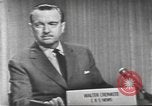
Candidates Nixon and Kennedy debate over prestige of the U.S. overseas prior to the presidential elections in the U.S.
The fourth presidential election debate held between Democratic nominee Senator John F. Kennedy and Republican nominee U.S. Vice President Richard Nixon in New York, United States on 21st October 1960. ABC News correspondent Quincy Howe allows CBS News correspondent Walter Cronkite to ask a question to Vice President Nixon. Mr. Cronkite asks Vice President Nixon if the Eisenhower Administration was suppressing a report by the United States Information Agency that shows a decline in United States prestige overseas as pointed by Senator Kennedy. Vice President Nixon replies and talks about Sputnik space program launched by the Soviet Union (compared to NASA efforts during the Space Race). He further compares the United States and the Soviet Union in terms of education and science. He speaks about UN General Assembly votes called on the Soviet Union to end its Hungarian intervention in 1956 and relates to American prestige. Senator Kennedy says that he did not make most of the statements that Vice President Nixon said he has made and he refers to the first one about Sputnik Program launched by the Soviet Union. Senator Kennedy refers to slums in the United States and talks about support housing legislation which the Eisenhower's Administration has opposed and also speaks about scientists and engineers United States has produced in comparison to the Soviet Union. He further says they were the first in other areas of science but in space, which is the new science, they are not the first
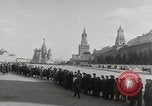
Long lines of visitors wait to visit Lenin's tomb on Red Square.
An extremely long line of Soviet people wait to visit Lenin's tomb in Moscow, Soviet Union. A column of Soviet people enter the mausoleum in Red Square. Soviet guards look at the people entering the building. Bas relief sculpture of Marx, Engel, Lenin, and Stalin. Saint Basil's Church in the background.
CRITICALPAST.COM: About Us | Contact Us | FAQs - How to Order | License Agreement | My Account | My Lightboxes | Shopping Cart | Advanced Search | Featured Collections | Website Terms & Conditions | Privacy Policy ©2026 CriticalPast LLC.
License Agreement |
Terms & Conditions |
Privacy Policy
©2026 CriticalPast LLC.