


 Francais
 Deutsch
 Italiano
Refine Your Search
Stalingrad Russia Soviet Union 1943 stock footage and images
- Showing 775 to 780 of 5654 results more
more Hide
Hide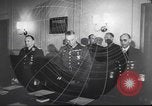
German surrender, UN founding, and Chiefs of Counsel meet before conducting Nuremberg and other trials after World War 2.
A film on preparations that are made for prosecution of axis war criminals following World War 2. Ratification of the surrender documents (from surrender two days earlier at Reims) held at Soviet headquarters in Karlshorst, Berlin, on May 9, 1945. German officers Colonel-General Hans-Jürgen Stumpff as the representative of the Luftwaffe, Field Marshal Wilhelm Keitel as Chief of Staff of OKW, and Admiral Hans-Georg von Friedeburg as Commander-in-Chief of the Kriegsmarine enter room and are seated. View of Keitel signing the surrender document. Scene change to Hall of the United Nations Conference, held in San Francisco from April 25 to June 26, 1945, with delegates from 50 Allied nations creating the United Nations. This was officially the United Nations Conference on International Organization (UNCIO). Leaders of various United Nations countries address delegates present in the War Memorial Opera House of San Francisco, including Edward Stettinius Jr of the United States. Next: A meeting of the military tribunal Chiefs of Counsel of many nations, including France, Russia, Great Britain and the United States, held in London, England, United Kingdom. They sign the International Military Tribunal Charter governing how the major war criminals from World War 2 would be tried.
Animation and footage depict American strategies to attack the Nazis in the European Theater during World War II.
A film about U.S. response to the activities of the Axis powers Italy, Germany and Japan during World War II. U.S. Army Chief of Staff George Marshall praises the United States Military offensives in Europe and Africa. George Marshall narrates rest of the clip. Animation of a globe depicts the Allied forces in the middle east planning to isolate China and Russia. The animation depicts the German Forces crossing the British allies, joining Japan and then attacking America. It depicts U.S. plans to stop the collaboration of Germany and Japan. Scenes of American shipyards are shown, with workers building new war ships. Some workers welding. A sign reads, "Work must continue during launching. Positively." The animation depicts the shorter routes to the European Theater. Aerial footage of a large fleet of U.S. Navy Ships at sea, underway during World War 2. Next scenes shows smoke pouring from ships at Pearl Harbor in Hawaii following attack by Japan. View of Soviet Russian horse cavalry forces charging toward enemy German positions during a battle in World War 2. Scenes of Allied artillery being fired at night in North Africa. Animation depicts the need to establish American air bases closer to Japan before launching successful air attacks. Footage of U.S. soldiers running out of landing crafts and coming ashore at a beach head during World War 2. Animation depicts U.S. plan to defeat Japan. Animation depicts strong German Army. Animation depicts U.S. plan to defeat the Nazi and the Fascist power in Europe.
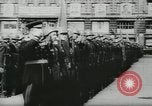
U.S. Regular Army, National Guard, and Army Reserve units operating together in combat, in Korea, and returning home after the truce
Soviet military forces in massed formations at Red Square, in Moscow, Russia. Joseph Stalin stands on balcony above. Scenes of rebellion in Europe and Asia. A map of Korea. June 25, 1950, as Korean War war broke out between North and South Korea. Buildings burning. Refugees fleeing. View of United Nations building on East River in New York City, where American ambassador Warren Austin is speaking. View of the Capitol in Washington, DC. President Truman, speaking, committed U.S. forces to action. U.S. Reservists are recalled to active duty to fight in Korea. Some are seen getting off a bus at a military base reception center. Recalled reservists with full field gear, starting their journey overseas, and later seen in Korea. U.S. tanks moving over the road manned by soldiers with World War Two experience. Numerous scenes of heavy artillery firing, mostly at night. U.S. regular Army, National Guard, and Army reserve soldiers engaged in fire fights in Korean War using tanks, artillery, mortars, and rifles. Soldiers administer first air and assist wounded comrades. American troops slogging through rain and snow in Korea. Soldiers eating from mess kits, and reading the Stars and Stripes newspaper, during a lull in combat. North Korean officers arriving, in snow, for armistice talks. Following the truce, American soldiers are seen packed up and heading home from Korea.
Ambassador Henry F. Grady is interviewed about the nationalization of Iran's oil industry.
United States Ambassador to Iran Henry F. Grady gives an interview for Longines Chronoscope on CBS Television. Advertisement for Swiss watchmaker Longines-Wittnauer watch company. Longines Chronoscope moderation Frank Knight introduces himself, with Frazier Hunt and William Bradford Huie the panelists for the interview. Former Ambassador to Iran Mr. Henry F. Grady is introduced to the audience. The panelists and Mr. Grady discuss about the nationalization of the Iranian oil industry. Mr. Grady talks about the control of private companies, mainly American and British, of the Iranian oil industry before the nationalization. “I don’t think Russia could get any of the oil” Ambassador Grady said when asked about the possibility of Soviet takeover of the Iranian oil industry. William Bradford Huie asks Grady about Premier Mohammad Mosaddegh, the leader behind the nationalization movement. Ambassador Grady briefly gives his opinion about a possible settlement between foreign companies and Iran until he is interrupted by Huie. Frank Knight introduces the panelists and guests again before advertising Longines watches to the audience. Longines clock gears and mechanism moving. Display of international gold medal awards won by Longines. Longines wristwatches for men and women on display.
World tensions after World War II. The Baruch Plan. The Berlin Airlift. The Korean War. The Cold War. The Atomic age. Ballistic Missiles
Speaking before United Nations Atomic Energy Commission (UNAEC) in its first meeting in June 1946, Bernard Baruch proposes international control of all atomic energy -- the so-called Baruch Plan. Low level aerial view of ruined post World War 2 European city. Goods including heavy equipment, locomotives, being loaded aboard ships to aid in the postwar recovery of Europe (The Marshall Plan). Workers in Western Europe making use of Marshall Plan materials to rebuild their national infrastructures. West European farmers restoring agriculture. View from overflying light airplane of parts of postwar Berlin in 1948. Blocked roads and empty railroad tracks leading from East Germany to West Germany, blocked by the Soviet Union. Barge traffic at standstill due to Soviet actions. U.S. C-54 transport aircraft flying supplies into West Berlin (The Berlin Airlift) during the Soviet blockade of that city. West Berlin citizens watching U.S. transport aircraft bringing fuel, food and other essentials into the isolated city. A C-54 flying low over empty railroad lines, as it prepares to land in West Berlin. Supplies offloaded from a DC-3 ( AKA C-47 or British Dakota) equipped with unusual set of rear cargo doors. Supplies being moved on Tegel Airport with many C-54 aircraft in the background. Numerous C-47 aircraft operating at Tempelhof airport. An East German official opening a barricade as Soviet blockade of West Berlin ends on May 12, 1949, and supply trucks begin to move over roads again. Flags of Western nations flying on high flagpoles. Glimpse of Allied warships underway during the Cold War. Formation of P-38 Lightning aircraft in flight overhead. NATO troops marching and NATO armor on parade. Flashes of heavy artillery firing at night. Korean refugees moving South in 1950 with the outbreak of the Korean War. View of UN Security Council meeting in the absence of Soviet representative. U.S. tanks firing guns and American infantrymen in conflict with North Korea in Korean War. American wounded on stretchers.Delegates of both North and South Korea signing the Korean Armistice Agreement in P'anmunjŏm, on July 27, 1953. A rocket is launched. Images of earth from inside a space craft in orbit. Narrator mentions the first satellite to circle the earth, the soviet Sputnik 1 in 1957. View of Soviet pilots in low pressure altitude chamber. A test subject in an aircraft making a maneuver that allows him to experience "weightlessness." Objects in his cockpit float about. A military rocket launch monitored by arrays of radar. An object being retrieved from space by means of a parachute. A nuclear powered submarine. Rockets on display during a military parade in Red Square, Moscow, the Soviet Union. A U.S. Air Force B-52 bomber taxiing. More views of rockets seen during a Soviet military parade in Red Square, Moscow.
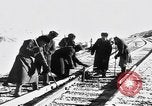
Ceremonies inaugurating new railroad link between Trans-Siberian Railroad to Jining, China, via Mongolia
Inauguration ceremony to open railroad link Southward, from Soviet Trans-Siberian Railroad, at Naushki, to Ulaanbaatar in Mongolia and thence to Jining (Tsining), China. Men connecting the two rail lines. They use levers and a screw jack device. Men push a rolling measuring device to check accuracy of rail track width. Mountains in the background. A railway station with pictures of Soviet leaders. A large crowd of local people gathered for the festivities. They carry flags and pictures of Chinese, Mongolian, and Soviet leaders, including Mao Zedong, Dashiin Damba, Voroshilov, Lenin, and Stalin. A large reviewing stand holding several dignitaries, and displaying pictures of Dashiin Damba, Voroshilov, and Mao. Several Soviet officers were seen. Chinese and Soviet spokesmen make short speeches, after which the Chinese spokesman cuts a ribbon to officially open the railroad link Behind him, in the background, is seen a map of the railroad connection going South, from the Soviet Union, toward Ulaanbaatar, Mongolia. A woman railroader waves a flag and gives a signal. A train decorated with pictures of Kliment Yefremovich Voroshilov, Dashiyn Damba, Mao Zedong, and the Soviet, Mongolian, and Chinese flags, moves over the tracks. Soviet rail line construction in snow: A crane places something into a truck. Field engineers refer to a map. A bulldozer levels the ground. A crane places a section of prefabricated track on the new roadbed. View of newly laid track.
CRITICALPAST.COM: About Us | Contact Us | FAQs - How to Order | License Agreement | My Account | My Lightboxes | Shopping Cart | Advanced Search | Featured Collections | Website Terms & Conditions | Privacy Policy ©2026 CriticalPast LLC.
License Agreement |
Terms & Conditions |
Privacy Policy
©2026 CriticalPast LLC.