


 Francais
 Deutsch
 Italiano
Refine Your Search
Stalingrad Russia Soviet Union 1943 stock footage and images
- Showing 895 to 900 of 5654 results more
more Hide
Hide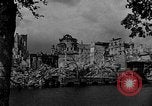
People in the U.S. listen as President Truman speaks during the United States flag raising ceremony in Berlin at end of World War 2
Filmed shortly before the Potsdam Conference in Berlin, Germany. A view of the devastated city of Berlin shortly after the end of World War 2 in Europe. Aerial views of bomb damaged Berlin and point of view shots from a moving car passing destruction, rubble, and skeletons of buildings from bomb damage. U.S. President Harry Truman surveying the damage from an open car, and view of his car approaching the Brandenburg Gate and driving on the Unter den Linden. Three flag towers each decorated at the base with an image of Truman, Stalin, and Churchill. U.S. President Harry S. Truman is riding through Berlin with General Secretary of the Communist Party of the Soviet Union Joseph Stalin and Soviet Foreign Minister Vyacheslav Mikhailovich Molotov. Flashback shows German Fuhrer Adolf Hitler parading in Berlin. People crowd on either side of a street to cheer. Close up back and side profile view of Hitler as he stands in a moving car waving to the crowd. Hitler speaking at a Nazi Rally, forcefully and animated, about Germany wiping out inferior races, and decrying America's society of mixed people, saying that it has a ridiculous notion of equality and freedom that cannot stand up against Germany. The German people in the hall applaud. Truman speaks into a microphone in Germany after the war. U.S. delegates stand in the background. A radio tower. A U.S. military serviceman operating controls for the radio broadcast. People in the U.S. listen to President Truman speaking from a Berlin Radio Station. A hand on a typewriter. People of the United States in groups listening to radio: Men gathered at a city store listening to the radio speech; a woman typist listening to the radio beside her typewriter; men in a rural general store gathered around a radio near a wood stove; farmers listening to a radio; office workers gathered around a radio; a family in a living room listens to the radio; group of U.S. Army soldiers gathered to listen to the radio . Truman speaking on the grounds of the United States Group Control Council Headquarters in Berlin. He is in a courtyard that had been the home of the German Air Defense for Berlin. An honor guard from Company 'E' of the 41st Infantry is present, along with Secretary Stimpson, Assistant Secretary McCloy, and Generals Eisenhower, Patton, Clay, and Bradley. Soldiers stand in formation in the background. He speaks about peace in the world during the ceremony raising the United States flag over the U.S. controlled area of Berlin. His words included the statement, "Let's not forget that we are fighting for peace and for the welfare of mankind. We're not fighting for conquest."
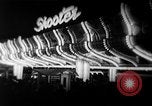
Reconnaissance photographs showing Russian Beagle bombers and missiles in Cuba during the Cuban Missile Crisis of 1962.
Events held in the United States during the Cuban Missile Crisis of October 1962 when the United States and the Soviet Union confronted each other with nuclear destruction. A sign reads 'Shooter'. Seattle fair closes. A poster regarding the sale of elephants. A girl walks with a baby elephant. U.S. President John F. Kennedy resumes pre-election touring. He boards an aircraft. President Kennedy and Soviet Foreign Minister Andrei Gromyko talk to each other. President Kennedy in the back of a limousine with advisors. Reconnaissance photographs showing Russian Beagle bombers and missiles in Cuba. A map depicts the range of Russian missiles.
Fallout shelters are set up and supermarket shelves are stripped by people in the U.S. during the Cuban Missile Crisis of 1962.
Events in the United States during the Cuban Missile Crisis of October 16, 1962 when the United States and the Soviet Union confronted each other with nuclear destruction over Soviet missile positions in Cuba. A sign reads 'Fallout Shelter'. Supermarket food store shelves stripped by people eager to stock rations in case of nuclear war. Queues and lines at grocery checkouts as shoppers stock up.

Vyacheslav Molotov and staff enter building to attend the Potsdam Conference in Potsdam,Germany during World War II.
Representatives of Allied nations gathered for Potsdam Conference at Schloss Cecilienhof Palace in Potsdam, Germany during World War II. Soviet People's Commissar for Foreign Affairs Vyacheslav Mikhailovich Molotov and staff enter building. President of the United States Harry S. Truman ,Prime Minster of the United Kingdom Winston Leonard Spencer Churchill and Premier of the Soviet Union Joseph Vissarionovich Stalin shake hands as they pose for the photographers in front of the doorway. They enter the building.
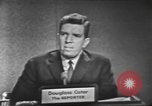
Kennedy and Nixon comment on nuclear disarmament before summit conference during a presidential election debate in the U.S.
The third Kennedy-Nixon Presidential Debate in the United States. Douglass Cater from Reporter magazine asks Democratic candidate Senator John F Kennedy about what sort of prolonged period does he envisage before there could be a summit conference and if he thinks that there could be any new initiatives on the grounds of nuclear disarmament during that period. Kennedy answers and talks about the need of strengthening of U.S. conventional forces and increasing missile production. On the question of nuclear weapon disarmament he states that the new administration should renew negotiations with the Soviet Union. He disagrees with the present administration's efforts regarding nuclear controls and general disarmament. He states that if he would get a chance he would make efforts to provide for control of nuclear weapons testing and begin general disarmament levels. Republican candidate U.S. Vice President Richard M Nixon mentions about his speech on this subject. He disagrees with Kennedy's statement that the administration is not making any effort because this is the highest level of operations in the whole State Department which is under the President himself. Roscoe Drummond from New York Herald Tribune asks Vice President Nixon about defending Quemoy and Matsu islands. Nixon answers and states that the U.S. should not deal with dictators and should not indicate which particular area it would defend. He gives the examples of the Korean War and World War II where the U.S. made a mistake. He says that Kennedy should change his position in this regard and not encourage the Chinese Communist and Soviet aggressors to react. Kennedy says that the treaty with the Republic of China excludes Quemoy and Matsu from the treaty area. He states that the treaty only includes defending of Formosa (Taiwan) and the Pescadores. He concludes that the U.S. should meet its commitments and raise war if the Chinese Communists attack the Pescadores and Formosa.
U.S. Secretary of State James F. Byrnes reports in the U.S. on the first meeting of Council of Foreign Ministers in London.
U.S. Secretary of State James F. Byrnes in the United States reports about a London meeting He speaks at his desk and says that the first session of the council of foreign ministers closed in a stalemate in London, England. But that need not and should not deprive them of a second and better chance to get on with peace. The foreign minister of the Soviet Union has not rejected proposal of the United States for a peace conference. Byrnes says that Soviet government will agree that the all the nations that fought the World War II shall have a chance to make world peace. This has been a people's war and it must be a people's peace.
CRITICALPAST.COM: About Us | Contact Us | FAQs - How to Order | License Agreement | My Account | My Lightboxes | Shopping Cart | Advanced Search | Featured Collections | Website Terms & Conditions | Privacy Policy ©2026 CriticalPast LLC.
License Agreement |
Terms & Conditions |
Privacy Policy
©2026 CriticalPast LLC.