


 Francais
 Deutsch
 Italiano

Refine Your Search
Stalingrad Russia Soviet Union 1943 stock footage and images
- Showing 973 to 978 of 4682 results more
 Hide
Color Sound

Iron ore is being delivered by a train and workers perform different tasks at Kuznetsk Metallurgical plant in Siberia.
Kuznetsk Metallurgical Works in Siberia, Soviet Union. Soviet workers at Kuznetsk Metallurgical plant. Iron ore being delivered by train and workers perform different tasks.

Different activities at a phosphate mining site in Karatau Mountains, Kazakhstan.
Phosphate mines in Kazakhstan, Soviet Union. A man drives camels loaded with material at a mining site in Karatau Mountains. Explosive is detonated. Workers climb a hill. An equipment in operation on hillside. Interiors of an electric power station showing technicians at an instrument panel with gauges. Sprinklers in operation.

A folk dance of the Ural Cossacks performed by the amateur dance group of the Chelyabinsky Steel Works.
A folk dance of the Ural Cossacks performed in Chelyabinsk, Soviet Union. Members of Amateur dance group performs on stage. Orchestra performs folk melodies for dancers in the background.
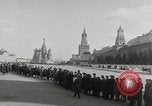
Long lines of visitors wait to visit Lenin's tomb on Red Square.
An extremely long line of Soviet people wait to visit Lenin's tomb in Moscow, Soviet Union. A column of Soviet people enter the mausoleum in Red Square. Soviet guards look at the people entering the building. Bas relief sculpture of Marx, Engel, Lenin, and Stalin. Saint Basil's Church in the background.

Lake Chagan formed by Cold War era Chagan nuclear test.
Formation of Lake Chagan (or Lake Balapan, and sometimes called "Atomic Lake") by the Chagan nuclear test conducted as part of the Soviet Union's Nuclear Explosions for the National Economy program during the Cold War. A wired atomic bomb seen installed at ground level. Infrastructure around the dry bed of the Chagan River. A clock and oscilloscope during countdown. A 140-kiloton nuclear bomb explodes in a 178-metre-deep (584 ft) hole in the dry bed of the Chagan River, creating a crater that would become Lake Chagan. A massive dark cloud from nuclear blast and soil from the dry riverbed. A man walking near the blast crater. Aerial view of the Lake Chagan crater without water. Bulldozers pushing soil to break through the Chagan River. Flood water filling the crater of Lake Chagan as water flows from the Chagan River to Lake Chagan. Scientists in a boat retrieve a sampling device from the water. Female Russian scientists test water samples from Lake Chagan inside a lab. A woman scientist points to waveform on an oscilloscope. A man wearing snorkel gear jumps into Lake Chagan. Aerial view of Lake Chagan.

Polish Refugees travel three years and 3 thousand miles to Iran during World War II.
Many Polish refugees are seen in the final phase of their monumental trek of three years and three thousand miles from Poland, during World War 2. Scene shifts to Poland in 1939, where polish refugees crowd roads carrying their belongings in wooden carts and other conveyances. They are seen at a rest stop where they obtain food. Animated map shows path of refugees fleeing East into the Soviet Union, following the German invasion in August, 1939. The path continues Southeast in 1941, as they flee from the German campaign, Operation Barbarossa, into the Soviet Union. Their journey continues along the west coast of the Caspian Sea, through the Caucasus, to Persia (Iran). Views of refugees arriving at the Persian border, where they are seen near many tents, and being provided with articles of clothing from British and American Red Cross Stations. Refugees donning new shoes and other items. Young girls having their hair styled. Refugees sit at long tables where they receive hot meals. A teacher conducts an outdoor class for Polish refugee children. Closeup of children at their desks. Refugee women are seen tilling soil to plant crops, while fathers and grown sons and daughters leave to join the new armies of the Polish Government in Exile. Views of Polish women, in uniforms marching and of uniformed armed Polish soldiers, as well becoming part of the Allied war against the Axis powers. Polish refugees at an outdoor shrine, offering prayers for the safety of their members in the military. New polish refugee arrivals at the Persian border being greeted by others, many of whom are family members.
CRITICALPAST.COM: About Us | Contact Us | FAQs - How to Order | License Agreement | My Account | My Lightboxes | Shopping Cart | Advanced Search | Featured Collections | Website Terms & Conditions | Privacy Policy ©2026 CriticalPast LLC.
License Agreement |
Terms & Conditions |
Privacy Policy
©2026 CriticalPast LLC.