


 Francais
 Deutsch
 Italiano
Refine Your Search
Stalingrad Russia Soviet Union 1943 stock footage and images
- Showing 997 to 1002 of 5654 results more
more Hide
Hide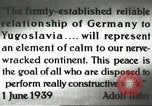
Tripartite Pact signed by Germany, Italy and Japan in Berlin, Germany. Ensuing attacks by Germany and Japan in World War II
This film is a scattering montage of World War 2 scenes from 1939 through 1945. Part of an agreement between Nazi Germany and Yugoslavia is shown in English. It is dated June 1, 1939 and ostensibly signed by Adolf Hitler. Next, German Ju 87, Stuka dive bomber aircraft are shown peeling off from formation, on April 6, 1941, to attack Yugoslavia. Bombs bursting on the ground. Closeup of a Stuka airplane in a dive, making its characteristic whine, and dropping bombs. Bombs exploding just outside some concrete walls. German infantry running along railroad tracks and entering backyard of house in a village. German soldiers observing from overlooking hill; climbing over rubble; and marching along a road toward a village. Animated map showing German invasion areas early in World War II, extending through most of Europe and into Norway, by 1941. Animated map shows further invasions into France, Belgium, low countries, the Balkans, and Eastern front towards the Soviet Union. Map highlights Tokyo, Rome, and Berlin. Delegations walking in hall of Reich Chancellery in Berlin, to sign Tripartite pact, on September 27, 1940. The group is led by by Count Galeazzo Ciano (Italian Foreign Minister, and Mussolini's son-in-law); Joachim von Ribbentrop, Germany's Foreign Minister and Japan’s Ambassador Saburō Kurusu. The diplomats are seen, next, standing near a table as Adolf Hitler enters rendering Nazi salute. He shakes hands with Count Ciano and Ambassador Kurusu. Hitler is seated to watch the proceedings. Von Ribbontrop is seen signing for Germany. Next scenes show German armored units heading East in Operation Barbarossa (June of 1941). A sign identifies the town of Eydtkau (Eydtkuhnen) on the German-Lithuanian border. German armor and artillery moving eastward. German troops destroying international crossing barriers. German troops firing siege guns. Montage with glimpses of German battle scenes showing tanks, guns, rockets in action with attendant explosions, fires, and destruction. Formations of German warplanes in flight, including Junkers Ju-52s that carry troops, including paratroops. View from above of Junkers Ju-87 Stuka dive bombers in formation. Battle of Britain scenes, with view of St. Paul's Cathedral in London, England (which miraculously survived the Blitz). The Tower Bridge in London, seen through a haze following blitzkrieg. German Junkers 87 Stuka dive bombers peeling off from formation to attack. British anti-aircraft searchlights shining beams skyward. Diving bombers illuminated by the lights. Anti-aircraft guns firing. Nighttime scenes showing gunfire flashes, explosions, tracer bullets and fires in London. British fire brigades fighting fires in London buildings as some collapse from the German bombing during the so-called "Blitz." Scene shifts to Pearl Harbor, December 7, 1941, as a Japanese bomb explodes on a U.S. Navy warship. The USS Arizona billowing smoke and listing as it succumbs to Japanese bombing. Another view of the Arizona sinking. Smoke rising from Battleship Row, at Pearl Harbor. Glimpse of postwar Nuremberg trial.
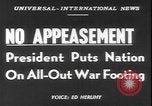
President Truman addresses the nation on the issue of Korean War and signs an emergency proclamation in Washington D.C.
United States President Harry S. Truman addresses the nation in Washington D.C., United States. President Truman in his speech blames the Soviet Union for the on going crisis in Korea. He states that United States will up hold the principles of United Nations, strengthen combined defenses, make more weapons, expand the economy. He states that war is not inevitable and America would make every possible effort to avoid general war. But it would not engage in appeasement. Later on President Truman signs an emergency proclamation.
German film giving their perspective on Allied invasion of Europe in World War II
Film opens with slate showing date: 6 June 1944, in World War 2. German newspapers report that combined forces of Britain, and the Soviet Union finally decided to launch their invasion of Europe. Headlines say "Invasion launched at Moscow's orders." A map highlights cities along the coast of France. Formations of Allied warplanes shown in flight overhead. Light signals seen in the dark as German forces send information about the attacks. Closeups of German military men communicating by radio and telegraph. Defense forces are called to battle stations by alarms and announcements. Responding soldiers grab rifles from a rack and rush through tunnels in their fortifications. They climb to man weapons atop their bunkers. Artillery shells being raised by hoists to them from bunkers below. Searchlights scan the dark sky for Allied aircraft, and anti-aircraft guns fire in the night, including a 2 cm Flakvierling 38, four-barreled gun. German forces firing on Allied paratroopers. German sailors aboard destroyers and fast attack "E" boats fire at Allied warships. Daylight scenes of Allied ships and German shore batteries firing at them. U.S. Porter-Class, and Benham-class destroyers firing at land targets in France. German soldiers loading and firing Atlantic Wall coastal defense guns. An allied ship explodes off the coast. More views of German coastal guns firing and another Allied ship hit and exploding. More coastal gunfire.
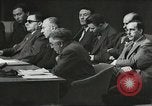
Spokesman for Jewish Agency for Palestine and National Council of Jews of Palestine presents statement to UN Security Council
Meeting of the United Nations Security Council at Lake Success, New York, in 1947. A representative of the Jewish Agency for Palestine and National Council of the Jews of Palestine [possibly Abba Hillel Silver] presents a statement approved by those groups on march 23, 1947. They object and are disappointed in the position taken by the United States regarding Palestine's administration, and state that at the end of the mandatory administration, a provisional Jewish Government will be established, not later than May 16th. The Soviet Union's representative to the UN, Andrei Gromyko, is seated at the same table, wearing dark glasses.
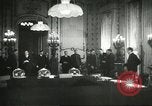
William Strang, F.T. Gousev and John Winant head a European Advisory Commission in London, England.
Three representatives of the United Nations, heading a European Advisory Commission, in talks at Lancaster House in London, England during World War II. Sir William Strang of Great Britain, F.T. Gousev of the Union of Soviet Socialist Republics ( USSR) , John Winant of the USA and others seated at a table.
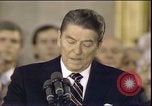
President Ronald Reagan addresses people and talks about togetherness and domestic goals of people in Washington DC.
Inaugural Ceremony of U.S. President Ronald Reagan at the United States Capitol in Washington DC. People gathered for the ceremony. President Reagan addresses them. He states that the American people will build a society in which all will live with a feeling of togetherness with no discrimination. He also talks about domestic goals and the limitations which they should put on the National Government. He says that the Soviet Union has conducted the greatest military buildup, building arsenals of offensive weapons. He says that we have made progress in restoring our defense capability. But much remains to be done. There is only one way to reduce the cost of national security, and that is to reduce the need for it.
CRITICALPAST.COM: About Us | Contact Us | FAQs - How to Order | License Agreement | My Account | My Lightboxes | Shopping Cart | Advanced Search | Featured Collections | Website Terms & Conditions | Privacy Policy ©2026 CriticalPast LLC.
License Agreement |
Terms & Conditions |
Privacy Policy
©2026 CriticalPast LLC.