


 Francais
 Deutsch
 Italiano
Refine Your Search
Stalingrad Russia Soviet Union 1943 stock footage and images
- Showing 1039 to 1044 of 5654 results more
more Hide
Hide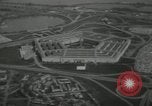
U.S. Army Secretary Wilbur M. Brucker calls a conference for the senior commanders of all U.S. Army components in the U.S.
U.S. Army components in the United States. Aerial view of the Pentagon armed forces installation in Arlington, Virginia, just outside of Washington DC, and ground level views of the Pentagon from nearby roads such as the Shirley Highway (Interstate 395) and possibly the George Washington Memorial Parkway. A sign board in the Pentagon reads ' Department of Defense'. View of Secretary of the Army Wilbur M. Brucker. Two newspaper headlines about the Cold War, space race, and the space satellite programs of the Soviet Union. U.S. Army soldiers at attention during inspection in their barracks. Men of U.S. Army National Guard and Reserve Units march across a field. A formation of many L-2 observation planes flies very low over the marching troops. Close up views of faces of U.S. Army soldiers. They perform calisthenics exercise drills during their physical training and stand in formation.
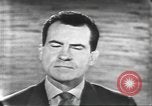
Nixon and Kennedy comment on the Cold War and Communist prestige during a presidential election debate in Washington DC.
The second Kennedy-Nixon Presidential Debate in Washington DC, United States. Edward P. Morgan of ABC News asks Republican candidate U.S. Vice President Richard M. Nixon to comment on whether the United States was doing well in the Cold War. Nixon states that they were not doing as well as they should have in the Cold War because of the presence of the Communists on the international scene. He says that the Communist prestige in the world is lower than the American prestige. He comments on cost cuttings on programs like mutual security and defense by the Democratic Congresses. Democratic candidate Senator John F Kennedy disagrees with Nixon's statement that the Congress has not provided funds for national defense. He also disagrees on the question of U.S. position in the United Nations. He mentions that various reports of Congressional committees indicate that the relative strength of the U.S. compared to that of the Soviet Union and the Chinese Communists together has deteriorated in the past years. Alvin Spivak of United Press International asks Kennedy how the losing prestige can be regained, and programs accomplished without damaging economy. Kennedy talks about the breaking off of the sugar quota with Cuba, passing of an authorization, and the development of the Inter-American Bank. He states that the U.S. has looked at the needs of Latin America. He states that instead of concentrating aid on surplus military equipment in Laos, the aid should have been concentrated in long-term loans. He concludes that Americans should identify themselves not only with the anti-Communist fight but also with the fight against poverty and hunger. Nixon presents his views and states that along with the necessity for economic assistance, the need for technical assistance should also be developed. Americans should not only think in terms of fighting Communism but also in terms of the interests of these countries. He concludes and mentions American ideals of independence, right of freedom and right of progress.
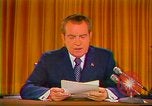
President Nixon speaks about reduction in defense budget while addressing the nation from the White House in Washington DC.
Television broadcast of U.S. President Richard Nixon's speech from the White House in Washington DC, United States on withdrawal of the remaining U.S. troops from Vietnam on 29th March 1973 during the Vietnam War. President Nixon speaks about progress that the U.S. has made towards peace and the end of the Vietnam War. He says that the United States should not reduce its defense budget. He speaks about negotiations with the Soviet Union regarding elimination of nuclear arms. He says that cutting down defense budget before the negotiations would increase the danger of war and there should be mutual reduction in defense. President Nixon says that the U.S. should maintain its strength.
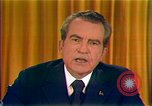
U.S. President Nixon speaks urging action from the Congress to fight inflation in the United States.
Speech by U.S. President Richard Nixon from the Oval Office of the White House in Washington DC, United States about inflation in the country. President Nixon speaks about battle against inflation. He states that the Congress can only hold down cost of living by holding down cost of the government. He says he would continue to veto spending bills which the country cannot afford. President Nixon urges the Congress to reduce tariffs and increase the supply of scarce goods. The President says the Congress should give him authority to move ahead with the Alaska Pipeline for oil to meet the shortage of oil and gas during energy crisis. He urges high production for farm industries. President Nixon speaks about peace in Vietnam and that all American prisoners have returned back. He talks about his summit meeting with General Secretary of the Communist Party of the Soviet Union Leonid Brezhnev which would take place a week later in Washington. President Nixon talks about achieving full prosperity without war and inflation. (Vietnam War period).
Republican nominee Richard Nixon express his views about the presidential race before U.S. Presidential Election of 1968.
Self-portrait of Richard Nixon aired during his 1968 presidential run against Hubert Humphrey and George Wallace in the United States. An interviewer asks Richard Nixon what did he think when he made a decision to run for the President of the United States in 1968. A picture showing Richard Nixon and his wife Pat Nixon. The interviewer asks if he felt any strain on the family. Nixon says he thought of his family first. A picture showing his wife Pat Nixon and daughters Julie Nixon and Tricia Nixon. Nixon calls this presidency more of a challenge in terms of America being involved in the Vietnam War and in the Cold War with the Soviet Union. A photograph shows Richard Nixon with his wife Pat Nixon, daughters Julie and Tricia and Julie's husband David Eisenhower at a beach. He says that present time is different from World Wars I and II because now America is a great power and there should be a best possible leader to lead the nation. Nixon states that America needs a kind of leadership that would obtain peace and avoid war and surrender. A picture of Mr. and Mrs. Richard Nixon.

Korean film depicts German Chancellor Adolf Hitler's plan of world conquest and shows montage of German military action scenes from World War II
After lenthy period of slates in Korean, the first images appear at TC: 01:52, as camera pans down over ruins at the exterior front of the German Reich Chancellery building in Berlin, Germany. A plaque in German identifies it as the Kanzlei des Führers der NSDAP (Chancellery of the Führer of the Nazi Party). Camera moves through various rooms of the building showing wreckage. In one room a world globe, a table and some broken furniture are shown. Scene changes to an animated map of Europe centered on Germany that depicts the dramatic expansion of German conquest in beginning of World War 2. It then shows further expansion with German invasion of the Soviet Union. From then on It adds a line directed to India (labeled in Russian) and another pointed into North America.The map then sends more lines covering the Continent of Africa and the South and Central America. These represent a plan for world conquest. View of a German three engine twin tail seaplane being launched by a catapult. Closeups of the plane in flight. Scene changes to German paratroopers jumping from a Junkers 52, three engine transport plane. Aerial view from above of the paratroopers leaping from the aircraft and from below as they descend with their chutes billowing out above them. Ground view of them landing on sand in North Africa. German troops on motor cycles, half track personnel carriers ( Sd.Kfz. 250 ) and Panzer III tanks. German Field Marshal Erwin Rommel standing with his staff, directing elements of his Afrika Korps forces in North Africa. Smiling German troops riding in an open Sd.Kfz. 251 (Sonderkraftfahrzeug 251) half-track personnel carrier. A huge explosion and dense black smoke is seen. Then, a German Heinkel HE 111 bomber is seen maneuvering overhead. Brief glimpse from an aircraft strafing an armored vehicle on the ground. Suddenly a submarine's periscope is seen just above the water and a transport ship (or freighter) is seen as through the periscope. Next, inside a German submarine, the Captain lowers his periscope and scene shifts to bow of submarine surfacing and the ship is seen burning and exploding. A torpedo is launched from a surfaced submarine and it strikes a ship creating a huge explosion and fireball.
CRITICALPAST.COM: About Us | Contact Us | FAQs - How to Order | License Agreement | My Account | My Lightboxes | Shopping Cart | Advanced Search | Featured Collections | Website Terms & Conditions | Privacy Policy ©2026 CriticalPast LLC.
License Agreement |
Terms & Conditions |
Privacy Policy
©2026 CriticalPast LLC.