


 Francais
 Deutsch
 Italiano

Refine Your Search
Stalingrad Russia Soviet Union 1943 stock footage and images
- Showing 1327 to 1332 of 4682 results more
 Hide
Color Sound
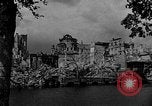
People in the U.S. listen as President Truman speaks during the United States flag raising ceremony in Berlin at end of World War 2
Filmed shortly before the Potsdam Conference in Berlin, Germany. A view of the devastated city of Berlin shortly after the end of World War 2 in Europe. Aerial views of bomb damaged Berlin and point of view shots from a moving car passing destruction, rubble, and skeletons of buildings from bomb damage. U.S. President Harry Truman surveying the damage from an open car, and view of his car approaching the Brandenburg Gate and driving on the Unter den Linden. Three flag towers each decorated at the base with an image of Truman, Stalin, and Churchill. U.S. President Harry S. Truman is riding through Berlin with General Secretary of the Communist Party of the Soviet Union Joseph Stalin and Soviet Foreign Minister Vyacheslav Mikhailovich Molotov. Flashback shows German Fuhrer Adolf Hitler parading in Berlin. People crowd on either side of a street to cheer. Close up back and side profile view of Hitler as he stands in a moving car waving to the crowd. Hitler speaking at a Nazi Rally, forcefully and animated, about Germany wiping out inferior races, and decrying America's society of mixed people, saying that it has a ridiculous notion of equality and freedom that cannot stand up against Germany. The German people in the hall applaud. Truman speaks into a microphone in Germany after the war. U.S. delegates stand in the background. A radio tower. A U.S. military serviceman operating controls for the radio broadcast. People in the U.S. listen to President Truman speaking from a Berlin Radio Station. A hand on a typewriter. People of the United States in groups listening to radio: Men gathered at a city store listening to the radio speech; a woman typist listening to the radio beside her typewriter; men in a rural general store gathered around a radio near a wood stove; farmers listening to a radio; office workers gathered around a radio; a family in a living room listens to the radio; group of U.S. Army soldiers gathered to listen to the radio . Truman speaking on the grounds of the United States Group Control Council Headquarters in Berlin. He is in a courtyard that had been the home of the German Air Defense for Berlin. An honor guard from Company 'E' of the 41st Infantry is present, along with Secretary Stimpson, Assistant Secretary McCloy, and Generals Eisenhower, Patton, Clay, and Bradley. Soldiers stand in formation in the background. He speaks about peace in the world during the ceremony raising the United States flag over the U.S. controlled area of Berlin. His words included the statement, "Let's not forget that we are fighting for peace and for the welfare of mankind. We're not fighting for conquest."

Harry S. Truman, Joseph Stalin, Winston Churchill sit around a conference table and the Potsdam Conference begins, Berlin.
The Potsdam Conference in Berlin, Germany. The delegates in a conference hall. A German officer after defeat signs a document. The officers shake hands with Generals. The ruins in Berlin. A damaged building. People stand on the ruins and debris . Men use shovels and fill the dirt in buckets. A close up of a German woman. A woman shows her anger. The delegates enter a hall for the Potsdam conference. Stalin meets a delegate. U.S. President Harry S. Truman, General Secretary of the Communist Party of the Soviet Union Joseph Stalin and UK Prime Minister Winston Churchill stand together. Other stand in the background. The delegates meet each other. The conference begins. All delegates including Truman, Stalin and Churchill sit around a conference table.

UN Security Council elects President for May, 1948, at Lake Success, Long island, New York
UN delegates are seen gathering for a meeting of the Security Council at the temporary United Nations headquarters in Lake success, Long Island, New York. One of the first to be seated is Andrei Gromyko of the Soviet Union. Another delegate stops to converse with him. Camera pans across delegates settling into their respective places at large curved table. Their nations are identified by placards at each place. Attention is focused on French Delegate Alexandre Parodi, who has apparently just been elected President of the Council for the month of May, 1948. At TC: 00:54, He is seen standing with Secretary General Trygve Lie. And at TC:01:19 he gently uses a gavel. At TC:01:28, another delegate holds the gavel with him as they laugh. After a while, the delegates settle down and begin to conduct business.
U.S. President Dwight Eisenhower answers queries of press men during his 130th press conference in Washington DC.
U.S. President Dwight Eisenhower's 130th press conference in Washington DC, United States. Newsmen from different nations arrive for President Eisenhower's 130th press conference. Men seated in a hall inside a building. President Eisenhower arrives with officials. The President speaks during the conference. Press and media representatives take notes. Chalmers M. Roberts, a pressman, asks the President that with the summit issues in the impasse between the U.S. and the Soviet Union, does the President see any initiative to break it or would the arms race go on indefinitely. President Eisenhower says that they should seek some common ground where there is a beginning made towards agreement in which they can work better co-operatively. The men gathered in the hall take down notes. View of the President speaking. Photographers taking pictures. The President unfolds a document and says that it is the list of subjects that the United States has proposed unilaterally with respect to the Allies. He cites the Baruch Plan - '46, the preparation of inspection and control measures, the Open Skies proposal, the peaceful use of outer space, the transfer of nuclear weapon stocks to peaceful use such as for power, freedom of travel and the limitation of the UN Veto. The President further says that he does not think he is being negative just by being firm and believing in what is right for the welfare of the United States.
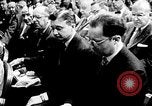
U.S. President Dwight Eisenhower answers a query on the spirit of Camp David during a press conference in Washington DC.
U.S. President Dwight Eisenhower's 175th press conference in Washington DC, United States. One of the pressmen asks the President that in the discussions about a date for an East-West summit conference with General Secretary of the Communist Party of the Soviet Union Mr. Nikita Khrushchev the point arises to preserve the momentum at the end. The Russians talk about the need to preserve the spirit of Camp David. He asks the President what he would like to maintain -- the spirit of Camp David or the momentum. The President says that he has heard of the expression the spirit of Camp David but he does not know what it means. He says that whenever he and Mr. Khrushchev spoke, they spoke in principle and in generality more. There was an agreement when they spoke about problems which the ministers will very likely take up. The President says he thinks that the spirit of Camp David must mean that they can talk together without being mutually abusive. About momentum, he says that that was a word used in discussions on development of foreign relations and agreements. If momentum is kept up it helps not to be rushing into things without being fully prepared.

Andrei Gromyko speaks at a UN Security Council session in Lake Success, New York during the Cold War.
A United Nations Security Council session held in Lake Success, New York during the Cold War. Chinese Representative speaks. Soviet Union's representative on the United Nations Security Council Andrei Gromyko speaks. U.S. Ambassador to the United Nations Warren Austin and other delegates seated. The delegates who accept the proposal of Argentina are asked to raise hands.
CRITICALPAST.COM: About Us | Contact Us | FAQs - How to Order | License Agreement | My Account | My Lightboxes | Shopping Cart | Advanced Search | Featured Collections | Website Terms & Conditions | Privacy Policy ©2026 CriticalPast LLC.
License Agreement |
Terms & Conditions |
Privacy Policy
©2026 CriticalPast LLC.