


 Francais
 Deutsch
 Italiano

Refine Your Search
Stalingrad Russia Soviet Union 1943 stock footage and images
- Showing 1357 to 1362 of 4682 results more
 Hide
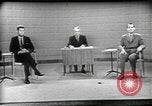
Senator John F. Kennedy and Vice President Richard Nixon face off in their first Presidential debate, in Chicago Illinois.
The first Kennedy-Nixon Presidential Debate in Chicago, Illinois. Moderator Howard K. Smith introduces the candidates-- Republican candidate U.S. Vice President Richard M. Nixon and Democratic candidate Senator John F. Kennedy. He talks about the opening and the closing statements to be given by the candidates. He talks about the questions which the panel of correspondents would ask the candidates. Senator Kennedy begins his statement. Kennedy talks about the direction of freedom for the Americans. He discusses domestic issues and the kind of society people live in. He talks about the strengths and the progress rate of the Americans. He urges people to make their country more powerful in every field. He feels disappointed about the unused steel-mill capacity, low rate of economic growth and poor educational system. He says he's not satisfied when he sees men like Jimmy Hoffa in charge of the largest union in the United States, and still free. He insists on overall infrastructural development and improvement of hydro power production where he says the Soviet Union has a lead. He states that every American should enjoy his full constitutional rights and they should meet their responsibilities. He says African American and Puerto Rican babies have much lower chances in education, work ,and advancement in the United States, and that this needs to change. He states that the government should provide effective programs and social security system for its citizens.
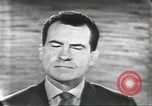
Nixon and Kennedy comment on the Cold War and Communist prestige during a presidential election debate in Washington DC.
The second Kennedy-Nixon Presidential Debate in Washington DC, United States. Edward P. Morgan of ABC News asks Republican candidate U.S. Vice President Richard M. Nixon to comment on whether the United States was doing well in the Cold War. Nixon states that they were not doing as well as they should have in the Cold War because of the presence of the Communists on the international scene. He says that the Communist prestige in the world is lower than the American prestige. He comments on cost cuttings on programs like mutual security and defense by the Democratic Congresses. Democratic candidate Senator John F Kennedy disagrees with Nixon's statement that the Congress has not provided funds for national defense. He also disagrees on the question of U.S. position in the United Nations. He mentions that various reports of Congressional committees indicate that the relative strength of the U.S. compared to that of the Soviet Union and the Chinese Communists together has deteriorated in the past years. Alvin Spivak of United Press International asks Kennedy how the losing prestige can be regained, and programs accomplished without damaging economy. Kennedy talks about the breaking off of the sugar quota with Cuba, passing of an authorization, and the development of the Inter-American Bank. He states that the U.S. has looked at the needs of Latin America. He states that instead of concentrating aid on surplus military equipment in Laos, the aid should have been concentrated in long-term loans. He concludes that Americans should identify themselves not only with the anti-Communist fight but also with the fight against poverty and hunger. Nixon presents his views and states that along with the necessity for economic assistance, the need for technical assistance should also be developed. Americans should not only think in terms of fighting Communism but also in terms of the interests of these countries. He concludes and mentions American ideals of independence, right of freedom and right of progress.
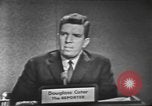
Kennedy and Nixon comment on nuclear disarmament before summit conference during a presidential election debate in the U.S.
The third Kennedy-Nixon Presidential Debate in the United States. Douglass Cater from Reporter magazine asks Democratic candidate Senator John F Kennedy about what sort of prolonged period does he envisage before there could be a summit conference and if he thinks that there could be any new initiatives on the grounds of nuclear disarmament during that period. Kennedy answers and talks about the need of strengthening of U.S. conventional forces and increasing missile production. On the question of nuclear weapon disarmament he states that the new administration should renew negotiations with the Soviet Union. He disagrees with the present administration's efforts regarding nuclear controls and general disarmament. He states that if he would get a chance he would make efforts to provide for control of nuclear weapons testing and begin general disarmament levels. Republican candidate U.S. Vice President Richard M Nixon mentions about his speech on this subject. He disagrees with Kennedy's statement that the administration is not making any effort because this is the highest level of operations in the whole State Department which is under the President himself. Roscoe Drummond from New York Herald Tribune asks Vice President Nixon about defending Quemoy and Matsu islands. Nixon answers and states that the U.S. should not deal with dictators and should not indicate which particular area it would defend. He gives the examples of the Korean War and World War II where the U.S. made a mistake. He says that Kennedy should change his position in this regard and not encourage the Chinese Communist and Soviet aggressors to react. Kennedy says that the treaty with the Republic of China excludes Quemoy and Matsu from the treaty area. He states that the treaty only includes defending of Formosa (Taiwan) and the Pescadores. He concludes that the U.S. should meet its commitments and raise war if the Chinese Communists attack the Pescadores and Formosa.
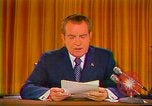
President Nixon speaks about reduction in defense budget while addressing the nation from the White House in Washington DC.
Television broadcast of U.S. President Richard Nixon's speech from the White House in Washington DC, United States on withdrawal of the remaining U.S. troops from Vietnam on 29th March 1973 during the Vietnam War. President Nixon speaks about progress that the U.S. has made towards peace and the end of the Vietnam War. He says that the United States should not reduce its defense budget. He speaks about negotiations with the Soviet Union regarding elimination of nuclear arms. He says that cutting down defense budget before the negotiations would increase the danger of war and there should be mutual reduction in defense. President Nixon says that the U.S. should maintain its strength.
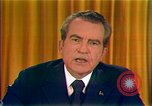
U.S. President Nixon speaks urging action from the Congress to fight inflation in the United States.
Speech by U.S. President Richard Nixon from the Oval Office of the White House in Washington DC, United States about inflation in the country. President Nixon speaks about battle against inflation. He states that the Congress can only hold down cost of living by holding down cost of the government. He says he would continue to veto spending bills which the country cannot afford. President Nixon urges the Congress to reduce tariffs and increase the supply of scarce goods. The President says the Congress should give him authority to move ahead with the Alaska Pipeline for oil to meet the shortage of oil and gas during energy crisis. He urges high production for farm industries. President Nixon speaks about peace in Vietnam and that all American prisoners have returned back. He talks about his summit meeting with General Secretary of the Communist Party of the Soviet Union Leonid Brezhnev which would take place a week later in Washington. President Nixon talks about achieving full prosperity without war and inflation. (Vietnam War period).
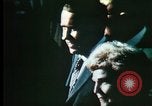
Republican nominee Richard Nixon express his views about the presidential race before U.S. Presidential Election of 1968.
Self-portrait of Richard Nixon aired during his 1968 presidential run against Hubert Humphrey and George Wallace in the United States. An interviewer asks Richard Nixon what did he think when he made a decision to run for the President of the United States in 1968. A picture showing Richard Nixon and his wife Pat Nixon. The interviewer asks if he felt any strain on the family. Nixon says he thought of his family first. A picture showing his wife Pat Nixon and daughters Julie Nixon and Tricia Nixon. Nixon calls this presidency more of a challenge in terms of America being involved in the Vietnam War and in the Cold War with the Soviet Union. A photograph shows Richard Nixon with his wife Pat Nixon, daughters Julie and Tricia and Julie's husband David Eisenhower at a beach. He says that present time is different from World Wars I and II because now America is a great power and there should be a best possible leader to lead the nation. Nixon states that America needs a kind of leadership that would obtain peace and avoid war and surrender. A picture of Mr. and Mrs. Richard Nixon.