


 Francais
 Deutsch
 Italiano
Refine Your Search
Stalingrad Russia Soviet Union 1943 stock footage and images
- Showing 187 to 192 of 4682 results more
more Hide
HideColor Sound
Images pertaining to advance of communism during 20th century, especially in East Germany
Statue of Karl Marx on his grave stone in Highgate Cemetery, London. A picture of Karl Marx. Scenes in Russia around the time of the Russian Revolution circa 1917 and creation of the Soviet Union. Soviet soldiers walking slowly in loose formation. Bolsheviks standing with a large banner. Images spanning many years thereafter: Damaged shops on a street. "One way" street signs in several languages. Large gathering of people carrying signs reading: "Frieden" (Peace, in German). A sign reading: "HALT, Landesgrenze" marking a German provincial boundary. A sign in German, designating the customs border at Furth im Wald, Bavaria ("Zollgrenz-Bezirk, Furth i.Wald"). East German border guards setting obstacles and sentry paths at barbed wire barriers (constituting the Berlin Wall, early on). Picture of Günter Litfin, a twenty-four-year-old tailor, who swam across the Spree Canal to West Germany on 24 August 1961. View of him being fatally shot from across the border, by East German guards, as he is being pulled into West Germany (the first such fatality at the East West German border). Animated map of the world with label references to Berlin,1961; Havana, 1959; Budapest, 1956; Coyoacan, 1940; and Kronstadt, 1921.
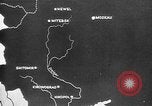
German infantry troops advance along Russian Front.
A map of Russia. German infantry troops advance along Eastern Front in Soviet Union during World War 2. They are wearing winter coats (likely late 1941). Troops walk on roads. Horse driven carriages, locomotive, trucks and cars in view. German engineers blast factories and other installations to clear a way for advancing troops. Several soldiers carry bicycles. Tanks on unpaved roads. German tanks cross water. Men observe with binoculars. Firing and explosion as Gerrman forces attack Soviet positions.
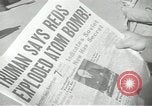
Men standing on a street in the United States read newspapers about the Russians exploding an atomic bomb.
Men reading various newspapers (mostly from New York) in the United States. Views of several newspaper headlines such as 'Truman says Russia set of Atomic blast' after President Truman revealed to the American public that the Soviet Union had successfully detonated an atomic bomb in a weapons test. Traffic on a road. Man in 1940's suit and hat standing on a street reading a newspaper. (World War II period).
Young communist men and women singing aboard a steamer underway in the Volga River during May Day celebrations.
A documentary based on activities in Stalingrad after World War II attack. The first May Day celebrations since war shows young Soviet communist men and women singing aboard a steamer underway in the Volga River.
U.S. shuttle-bombing of German positions and military installations under Operation Frantic during World War II.
Film title slate indicates "Operation Titanic" but it, in fact, depicts "Operation Frantic" with U.S. shuttle bombing operations over Germany from bases in Great Britain, Italy and Russia during World War II. United States Army Air Force B-17 Flying Fortresses in flight. Aerial view of bombers in flight with several aircraft flying in formation leaving behind contrails. View inside bomber aircraft with bombardier preparing to drop bombs. View of bomb bay door opening and closeup of hand near bomb drop switch. Bombs awawy view as bombs are dropped from American aircraft. German defenses are bombed along the invasion coast of France (just prior to D-Day) on June 2, 1944. Aerial views of B-24 and B-17 bombers also in flight bombing German military installations in German-occupied northwestern Europe. Aerial view of a target area. Smoke rising up from bombardment. Two different U.S. Army Air Force B-17 Liberator aircraft are seen falling from the sky toward crashes after being hit by German enemy fire. One of them has smoke trailing from it, and the other is in a free fall. Railroad and marshaling yards are also bombed over Debrecen, Hungary on June 2, 1944, with aircraft continuing on (shuttle bombing) rather than returning to base. United States Army Air Forces B-24 Liberator flying in formation on June 21, 1944. Aerial view as they bomb the Focke-Wulf Fw 190 engine aircraft factory near Basdorf, Germany. German factories are bombed. B-17 aircraft on the same date are seeing in formation and bomb railway stations, freight yards, and factory targets, along with the Nazi German Ministry of War, Ministry of Propaganda, and Gestapo headquarters in Berlin, Germany. Heavy flak bursts seen in the air near the aircraft. Dogfight scenes as several German airplanes are shot down. Machine gunners aboard U.S. bomber aircraft firing at German fighter aircraft and shooting down 43 of them, according to narrator. Aerial view of ball turret rotating below bomber and firing guns at German fighter aircraft. The B-17s and B-24s bombing the targets. Synthetic oil plants and refineries are bombed at Ruhland Germany, east of Leipzig. Planning for the operation was done on December 7, 1943. A document about the operation is typed. Animated map shows Nazi positions and method of shuttle-bombing, allowing American aircraft to bomb from Soviet bases, and allies broadly to bomb German targets from bases in the United Kingdom, Italy, and Soviet Ukraine.
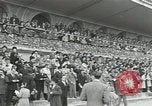
Scenes from German occupied Paris France; French collaborator Ferdinand De Brinon gives a speech to German officers (WW2)
Scenes shot in 1942 and 1943 from inside German occupied Paris, France during World War II. German officers and civilians at the Longchamps racetrack in Paris, France. Horses run on a dirt track. German troops at the Eternal Light for the Tomb of the Unknown Warrior at the Arc de Triomphe. A German Panther tank captured by the FFI (French Forces of the Interior) in 1944. French collaborator Ferdinand De Brinon speaks into a microphone. German officers listen carefully. Collaborators Marcel Deat, and Laval's son in law, Comte Rene de Chambrun also seen. French Regimental flag held by French collaborator militia. A crowd outside Notre Dame Cathedral. French Marshal Philippe Petain arrives in a car. French collaborationist troops stand at attention. Ceremony for the Legion against the Soviet Russia shows assemblage and German Swastikas on a wall.
CRITICALPAST.COM: About Us | Contact Us | FAQs - How to Order | License Agreement | My Account | My Lightboxes | Shopping Cart | Advanced Search | Featured Collections | Website Terms & Conditions | Privacy Policy ©2026 CriticalPast LLC.
License Agreement |
Terms & Conditions |
Privacy Policy
©2026 CriticalPast LLC.