


 Francais
 Deutsch
 Italiano
Refine Your Search
Stalingrad Russia Soviet Union 1943 stock footage and images
- Showing 1987 to 1992 of 5654 results more
more Hide
Hide
Montage of scenes from Russian offensive toward Warsaw, Poland, on Eastern Front in World War II
Soviet forces East of the Vistula River, attack Praga district, on eastern outskirts of Warsaw, Poland on their way to the city of Warsaw, during World War 2. View of Soviet Colonel-General Vasily Kazakov and his staff studying charts of the area. Nighttime view of Soviet artillery and rocket fire. Fires blazing and knocked out German tanks. Formation of Soviet Ilyushin Il-2 Shturmovik aircraft in flight. Bombs exploding on the ground. Anti-aircraft guns firing. A nearby explosion raising a huge amount of earth into the air. IS-2 / JS-2 (Josef Stalin) heavy tanks moving across smoke-filled terrain amidst explosions from German shells. Soviets operating captured German Panther tanks. Soviet infantry moving past barbed wire and attacking on the ground. Soviet Marshal Konstantin Rokossovsky (wearing large Marshal's star) and accompanied by a Lieutenant-general (two-star) is seen conversing with Colonel-General Vasily Kazakov at the local Soviet headquarters. Closeup of Marshal Rokossovsky, smoking a cigar in a holder. View of distance smoke rising from town. Scene shifts to Soviet armor and machine gunners engaged in urban building-to-building battles. Armor and infantry elements of the First Polish Army (Berling's) operating with the Soviets, are seen entering the Praga district of Warsaw, as liberated citizens cheer them.
Otto Von Bismarck, Prince of Wales, Tsar Nicholas II and Kaiser William II at the turn of the 20th century.
Earliest motion pictures captured at the turn of the 20th century in Europe. Berlin 1895: Otto Von Bismarck, Chancellor of Germany, addresses Germans about the need for 'blood and iron'. Large crowd gathered at a Berlin square to hear him. Next scene is in England, United Kingdom, in 1903: The young boy future Prince of Wales and future King Edward VIII plays with his brother Albert (the future King George VI) and his sister, Mary (Princess Royal and Countess of Harewood) on the grounds of Windsor Castle. The two boys hold toy guns and march. Next images are in Moscow, Russia, in 1907: Nicholas II, Tsar of Russia, at a gathering with military officials and other dignitaries. A large crowd outside the palace. Germany, 1910: Kaiser Wilhelm II along with other military officials at an orphanage. Children put up a show for the German Emperor. Orphan children posing with the Kaiser.
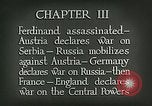
Assassination of Archduke Ferdinand becomes the prelude to World War I. Portion of funeral procession of Archduke Ferdinand.
Newspaper headline declares Archduke Franz Ferdinand of Austria and his wife Countess Sophie's assassination by a Bosnian youth in Sarajevo. The Archduke's bullet ridden uniform. The caskets carrying the bodies of the Archduke and his wife are taken to Vienna. The caskets wrapped in the Austrian flag at the port. Officers and soldiers salute in their honor. Priests lead the funeral procession followed by the caskets brought in horse carriages. Various New York newspaper headlines depicting beginning of World War I: Austria declares war on Serbia, Russia mobilizes against Austria, Germany declares war on Russia, France and England declare war on the Central Powers. Berlin: A large crowd gathered on the streets of Berlin. Mobilized German troops and band march on the streets. Crowd greets the German soldiers.
Training film for U.S. troops with the Army of occupation in Germany after world War II
Opens with bell tolling Victory against Germany in World War II. Next, a slate reads: "Victory Leads to Peace," and a farmer is seen with cattle pulling a plow. But narrator says "the problem now is future peace," and a map of Germany is shown overlaid with "Your Job in Germany." A cartoon of a soldier is superimposed on the map, along with one of a World War 1 American soldier and a figure of possible future soldier with similar mission. Camera focuses on parts of German aircraft in a jumbled heap. Closeups of weary defeated German soldiers at end ot World War II. Glimpse of Adolf Hitler speaking and haranguing an audience from a podium in an animated and forceful way. Swastika flags displayed from houses in a quaint German town. Joseph Goebbels, Nazi Reich Minister of Propaganda, at a microphone. Glimpse of a German concentration camp. But as they appear, each of the Nazi elements promptly disappears, showing the scenes without such Nazi symbols and persons. Skeleton remains of bombed buildings. Flower displays. Bucolic German rural countryside and quaint old villages in peaceful settings. Camera focuses on a book titled "German History." Chapter I, titled "Blood and Iron," shows Image of Otto von Bismarck. German troops march in a parade. Narrator states that "under Bismarck, the German empire was built." (He formed the German Empire in 1871, unifying Germany with himself as Imperial Chancellor, while retaining control of Prussia at the same time.) The film shows mounted German lancers as it alludes to Bismarck's campaigns against Denmark in 1867; Austria in 1866; and France, in 1870. Germany's leaders celebrating its status, in 1871, as the mightiest power in Europe. Troops marching and girls dancing nearby. Farmers plowing field with a horse and cow. Classic peaceful rural alpine scenes with local people in agricultural pursuits. A group of local German musicians playing folk music as village people dance outdoors. Back to the book, Kaiser Wilhelm II is shown on Chapter 2, entitled: "Deutschland über Alles." Gathering of German soldiers in Pickelhaube (spiked helmets). A German Big Bertha howitzer firing. German troops marching against Serbia; Russia; and France (with view of war damaged French cathedral). German invasion of Belgium in 1940 (with view of clock tower resting in rubble). German troops seen in Italy, walking past battle-damaged buildings. German Zeppelin dropping bombs on British targets and view of bombed out London neighborhood. Next scene shows a capsized ship with survivors running across its hull. Film slate labels the scene as United States, as if it is a U.S. ship attacked by Germany. (Actually, it is the Austro-Hungarian Battleship, SMS Szent Istvan, torpedoed, by Italian torpedo boats, during World War I.) Next, American soldiers in trench are seen going "over the top" and into "no man's land" on the western front of World War 1. Glimpse through a window of Kaiser Wilhelm II, after defeat of Germany, in 1918. View of Germans in a Beer Garden. Picturesque view of German town. A German orchestra performing. American soldiers marching out of Germany, with flags waving. Back to the history book,as chapter III is revealed, entitled "Today Germany, tomorrow, the world," and featuring Adolf Hitler. German troops invading Austria (where a civilian lies dead on the ground). German troops entering Czechoslovakia (where local people in tears render the Nazi salute). They march into Poland (where a girl weeps over someone, not seen, on the ground). They march into France (where a wounded, bandaged child cries in a bed). Next, is a scene from England, where a British child victim of bombing lies dead in the remains of a shelter. German troops invading Norway, Holland, Denmark, Belgium, Luxembourg and Russia (where a woman tries to rouse a dead woman). They invade Yugoslavia (where women sit near coffins of children) and Greece (where a woman rescues a naked child). A U.S. merchant ship explodes after being torpedoed by a German submarine (unseen). Scenes of destruction with people plucking dead victims from rubble of buildings. American troops invading Normandy, France on D-day, June 6, 1944. Several American soldiers fall to German gunfire on the beach. Wounded American soldiers being transported in jeeps on the battlefield and being placed on landing craft for evacuation. Americans walking past huge piles of destroyed aircraft parts. A landing craft filled with wounded American soldiers. American wounded and dead on a battlefield. Sailors abandoning a burning American ship by jumping into the sea. A sailor picked up in a life boat. A wounded American soldier being dragged from the beachhead at Normandy. Various wounds being treated by U.S. Medical Corps personnel. More scenes of American wounded being moved on stretchers. Scene shifts abruptly to German people folk dancing. Film concludes with question marks about the future.

Russian women volleyball team wins over United States at world women volleyball championship in Paris, France.
World women volleyball championship in Paris, France. Teams of United States and Russia compete for the finals. Russia wins the championship. Men walks with flags and a flag of United States. U.S. team walks. Male players stand. Match between United States and Russian teams. Spectators watch the game. Russian team wins.
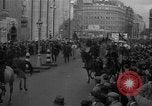
Peace Campaign in London, England. Mounted Police control crowd at Czechoslovakian Legation, Grosvenor Place
International Peace Campaign in London, England. Policemen ride horses on the street. Buildings in the background. Demonstrators move from Trafalgar Square and march to the Czechoslovakia Legation Building (8 Grosvenor Place, London SW1X 7SH, UK) at Grosvenor Place. Parade is led by men carrying flags of America, Britain, Czechoslovakia, and Russia. A banner carried by marchers reads 'Stand by Czechoslovakia, No plebiscite'. Buses, cars, and cyclists pass by. The crowd swells until it fills the entire street and sidewalks, so there is no room for vehicles. Mounted police control the crowd at the Czechoslovakian Legation and facilitate traffic on Grosvenor Place. Four men hold flags of America, Czechoslovakia, Britain, and Russia, in front of the Legation. Double decker buses traverse the area. One marcher carries French Tricolor flag. Several men march with drums.
CRITICALPAST.COM: About Us | Contact Us | FAQs - How to Order | License Agreement | My Account | My Lightboxes | Shopping Cart | Advanced Search | Featured Collections | Website Terms & Conditions | Privacy Policy ©2026 CriticalPast LLC.
License Agreement |
Terms & Conditions |
Privacy Policy
©2026 CriticalPast LLC.