


 Francais
 Deutsch
 Italiano
Refine Your Search
Stalingrad Russia Soviet Union 1943 stock footage and images
- Showing 2371 to 2376 of 5654 results more
more Hide
Hide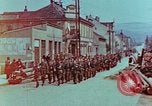
Fully armed Axis troops treck through Pilsen, Czechoslovakia , on their way to surrender to U.S. Forces in World War II
A contingent of Armed Axis troops, led by an officer, marches West through Pilsen, Czechoslovakia, intending to surrender to U.S. and UK forces of the Western Allies during final days of World War 2. A long line of German soldiers follows, some in horse-drawn wagons, and similar conveyances. Among the troops are some from Russia in German uniforms. Some of the surrendering German troops appear to be young boy soldiers.

The American Military Government officials interview displaced persons in a camp in Europe during World War II.
Activities of the American Military Government (AMG) officials in Europe during World War II. Displaced persons and refugees on the streets with their belongings. They haul bags, luggage, carts, and trolleys loaded with belongings. Jeeps move on the streets. The refugees, including women, children and men walk past damaged buildings. They gather in a field and sit and chat. The American Military Government officials interview men. Officers at a desk in an office. An officer talks over a telephone. He gives instructions to a woman officer to prepare for newly arriving refugees. Military personnel help children to get down from trucks at DP Camp. The displaced persons point at pictures placed on boards for various languages. They walk up the stairs of a camp office. Three soldiers interview a Belgian woman and her child. The displaced persons shown include refugees from Belgium, Netherlands, France, Russia. They are assigned to quarters in camps.
European Heads of State review their respective forces mobilizing for World War I. Glimpses of trench warfare.
German Kaiser Wilhelm II walks among German troops assembled for inspection in Berlin, Germany at outbreak of World War 1. The Kaiser and senior commanders review the troops on parade. The last contingent in the parade comprises civilian officials in top hats. French Prime Minister, Alexandre Ribot, is saluted by a military honor guard as he exits a building. He doffs his hat and turns in deference, as Raymond Poincaré, President of France exits behind him. They both enter a waiting car, followed by the French Minister of War, Jean Brun., who joins them. As they are being made comfortable in the car, French General Ferdinand Foch, exits the building (wearing a great coat) and is escorted by another General. In Russia, Emperor, Tsar nicholas ll, leads military commanders as they review a contingent of Russian guards in formation on the platform of a train station in Moscow. Camera pans across crowds filling the Palace Square, St. Petersburg, upon the declaration of war on 20, July, 1914. Base of the Alexander Column visible in center of crowd. Russian troops file into well established trenches. Huge explosions raise tons of earth amongst the trenches. Troops flee for safety. Many take cover in large shell craters. Several fall to machine gun fire, near barbed wire. A book is opened to a page entitled: "Military Program Proletarian Revolution" (in Russian). German troops are seen from above and behind sheltered in a trench with a desolate battlefield in front of them. Closeup of the troops. Next, Russian troops who died are seen in a water-filled trench. One is holding an M1891/Mosin–Nagant firle. Closeup of another soldier, covered in mud leaning against sandbags. Bodies of two soldiers at a pond of water in their trench. One is immersed, with face up, in the pond and the other is reaching down into it. What appear to be the bodies of soldiers entangled in barbed wire at edge of trench..
Historical references of chemical warfare in the U.S. show an ancient Greek war and the use of a smoke screen.
A film in the U.S. based on historical references of chemical warfare. U.S. soldiers march on a road near a battlefield during World War I. American soldiers setup and fire a World War 1 mortar. Smoke rises from explosions on the battlefield. Series of drawings follows: A drawing depicts an ancient Greek war in which poison gas was used. A drawing depicts usage of 'smoke screen' as a weapon in 1701 by King Charles XII of Sweden which effectively shrouded his forces moving across the Duna River against Russia. A drawing depicts laboratory tests being made by a person in the ancient times.
President Dwight D Eisenhower renews his open sky plans in the U.S. and offers to give American photo planes to the UN.
U.S. President Dwight D. Eisenhower renews his open sky plans in the United States. The President meets dignitaries from the United Nations. He shows them photographs taken from 13 miles height. He offers to give American photo planes to the UN if his plan is adopted. He addresses the nation and calls on Russia to resume business like talks. A cameraman records the event.
Pearl Harbor attack in Hawaii leading U.S. into WW2; assorted other World War 2 battle scenes
A prelude to the entry of United States in World War II, from the "Why We Fight" series. U.S. Army band marching along with the troops. The bombing of Pearl Harbor by Japanese during World War II. Night view of air raids in London and anti-aircraft fire amid British building silhouettes. British buildings collapsing and burning during blitz in Battle of Britain. Cavalry and tank battles in Russia against Nazi German forces. Montage of quick shots of German Panzer tank and German Luftwaffe aircraft operations in Western Europe. German troops marching through Paris at Arc de Triomphe. German heavy rail guns firing. Dead bodies of Japanese bombing victims lying on the street in China. German navy ships underway at sea. German army forces advancing in invasion of Czechoslovakia. Very low flying German trimotor bomber aircraft passing overhead over treeline. German invasion of Poland. German heavy artillery guns and railway guns firing. Fighter aircraft plunging toward ground and crashing. German paratroopers being dropped over Holland, Netherlands in invasion of Netherlands. Aerial views of German aircraft passing by Parthenon and ancient Greek monuments in Greece. More heavy rail gun shots. Germans invading Belgium, Albania, Yugoslavia.
CRITICALPAST.COM: About Us | Contact Us | FAQs - How to Order | License Agreement | My Account | My Lightboxes | Shopping Cart | Advanced Search | Featured Collections | Website Terms & Conditions | Privacy Policy ©2026 CriticalPast LLC.
License Agreement |
Terms & Conditions |
Privacy Policy
©2026 CriticalPast LLC.