


 Francais
 Deutsch
 Italiano
Refine Your Search
Stalingrad Russia Soviet Union 1943 stock footage and images
- Showing 2437 to 2442 of 5654 results more
more Hide
Hide
Views of street scenes and Songhua River in Harbin, Manchukuo
Flag of the Soviet-administered Chinese Eastern Railway, flying over the Harbin train station in Manckukuo. (It contains Manchukuo canton and small hammer, sickle, and star on the field.) Many cars waiting outside the station building. Overview of the city. Saint. Sofia Cathedral of Harbin seen clearly. Shoppers and pedestrians walking on crowded sidewalk under many electric power wires strung overhead. Japanese flag displayed at corner shop. Various ethnic peoples seen on sidewalks. Kitayskaya Street (China Street) lined with buildings and stores. Patrons seated on veranda of a restaurant overlooking the Songhua River. Boats on the river and bridge in far background. Closeup showing that some are houseboats in the river. Western persons in bathing attire on a sandy beach at the river. (No other ethnic groups are represented.) Sun sparkling on the water. Two Western men row a boat with a woman in the back seat. A couple of small day-sailor boats are seen under sail. View of railroad bridge over the Songhua River. A sidewheeler boat flying the Japanese Rising Sun Naval Ensign flag.
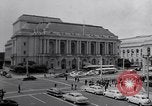
Primer Mr Shigeru Yoshida addresses and signs peace treaty with representatives of other countries in San Francisco, CA
San Francisco Peace Treaty conference with Japan, in San Francisco, California. Beginning shows the War Memorial Opera House and Van Ness Avenue. U.S. President Harry S Truman steps to a podium, at the Opera House, to address delegates at the conference. With him on the stage are Dr. Warren Kelchner, Temporary Chairperson of the Japanese Peace Treaty Conference, Governor Earl Warren of California, and Secretary of State Dean Acheson. Next, Dean Acheson is seen seated at the center of a table with Dr. Kelchner, at his right, as Soviet representative Andrei A. Gromyko steps to the microphone and speaks. (Narrator says he raises complaint about rules of procedure.) Dean Acheson removes his translating headset in frustration. Next, a representative of Poland comes to the microphone, and calls for delays. View of delegates in the audience. New Zealand representative, Sir Carl August Berendsen, takes the stand to renounce delaying tactics. Audience members applaud. Carlos P. Rómulo, of the Philippines, speaks in support of the treaty. John foster Dulles, of the United States, steps to the podium to speak for the treaty. Next, Japanese Premier, Shigeru Yoshida, referring to notes in a roll of paper, endorses the treaty. Audience applauds. Secretary of State Acheson is seen signing the treaty for the United States, followed by representatives of: Australia; Cambodia; Great Britain; Ceylon; France; Indonesia; Philippines; and Pakistan. Next, the Japanese delegation comes forward, and Prime Minster Shingera Yoshida, signs the historic document. Closeups of ordinary Japanese from all walks of life. Japanese people commuting to work.
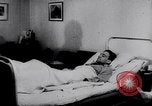
German pilot, Hans-Ulrich Rudel, in hospital recovering from wounds, receives Germany's highest award and is promoted, during World War II
Germany's most famous pilot of Stuka dive bombers (Junkers Ju 87) Hans-Ulrich Rudel, seen in hospital, after being wounded in the thigh, during World War 2. His doctor visits and asks how he is doing. He replies "ausgezeichnet" (excellent). His wife comes to the bedside and speaks with him briefly. Rudel's hospital chart is seen, with his rank shown as Oberst (Colonel).This is notable, when downed in November, he had been a Lieutenant Colonel with Schlachtgeschwader 2 "Immelmann" (Battle Squadron 2 "Immelmann.") Another German officer sits at his bedside and inquires about his experience. Colonel Rüdel explains how he was downed by flak while attacking Soviets tanks on the Eastern Front. He speaks about his comrade fliers. Next, the award of "Knight's Cross with Golden Oak Leaves, Swords and Diamonds"is shown. (This award was created by act of the Reichstag, solely for Rudel, on December 29, 1944. He was also promoted to Colonel, the same day.) The film concludes with additional comments by Colonel Rudel.
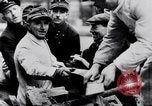
Ordinary German citizens build barricades and dig trenches for defense of Berlin in final months of World War II
People build barricades and dig trenches for defense of Berlin in Germany, during World War 2. Men build barricades for defense of Berlin against advancing Soviet forces. Women carries goods on wheel carts to help in building barricades. Man smokes cigar. They build tank traps. They dig a trench in the field.

Chinese military and civilians celebrate the 10th anniversary of the Founding of the People's Republic of China in Beijing
Top communist leaders of the People’s Republic of China wave towards people from a balcony in Peiping (Beijing), China. A large crowd gathers to celebrate the 10th anniversary festival of the People’s Republic of China at Tiananmen Square. Soviet leader Nikita Khrushchev heads the roster of top communist leaders. Khrushchev stands side by side with Mao Zedong on the reviewing stand. The Communist Chinese stage a monumental celebration with a huge and colorful parade viewed by a large crowd. Flags on building. Decorated floats on the street. Acrobats and people perform. People hold balloons in hand. They cheer as balloons are released.
U.S. Army soldiers guard German SS-Totenkopfverbände (SS-TV) prisoners of war being held near a village.
United States Army soldiers guarding a group of German SS prisoners of war who are being held near a village. Cameraman slate indicates location of "Wittring" (presumably Wittring France, just outside the German border, in the Moselle region), but U.S. government record accompanying the film indicates "Wittring, (?) Germany" (sic). A wheel cart is seen on the street. The German prisoners of war have SS markings on their right lapel and also the SS skull insignia on the cap, identifying them most likely as part of the SS-Totenkopfverbände or SS-TV; also called Death's Head units. (Theories on these captured soldiers include: 1) SS-TV units were primarily in charge of administering the Nazi Concentration Camps in World War II. Hinzert Concentration Camp was possibly the closest camp to Wittring. Perhaps these soldiers came from it or another camp; 2) They may have been part of the 3rd SS Panzer Division. Reportedly, whole platoons and elements of the 3rd SS Panzer division were not following orders and were giving up prior to the Budapest and Vienna battles to avoid Soviet captivity, as early as Jan 1945). Prisoners rub their hands to warm them in the cold. Camera shows a close-up view of one of the prisoners, as an American soldier attaches a Prisoner of War identification tag over around the neck of the prisoner.
CRITICALPAST.COM: About Us | Contact Us | FAQs - How to Order | License Agreement | My Account | My Lightboxes | Shopping Cart | Advanced Search | Featured Collections | Website Terms & Conditions | Privacy Policy ©2026 CriticalPast LLC.
License Agreement |
Terms & Conditions |
Privacy Policy
©2026 CriticalPast LLC.