


 Francais
 Deutsch
 Italiano
Refine Your Search
Stalingrad Russia Soviet Union 1943 stock footage and images
- Showing 2647 to 2652 of 5654 results more
more Hide
Hide
Effects of the atomic bombing of Hiroshima, Japan, in World War II, and early international efforts to control atomic weapons
Film showing city of Hiroshima, Japan, before and after the August 6, 1945 dropping of the atomic bomb over the city in World War 2. Sequence opens on what the narrator says is August 5, 1945, the day before the event (but the footage is likely from before that date). Camera pans over the city of Hiroshima before the atomic bomb destroyed the city. Japanese air raid lookouts are seen on watch for allied bombers. View of atomic bomb detonation as seen from aircraft high overhead (this is actually a view of the Nagasaki blast, not the Hiroshima blast despite narrator's comments). Next, the complete destruction of the city of Hiroshima is seen from camera at low altitude showing the four and one half square miles of the city flattened and burned. A Japanese hospital still functioning, with red cross flag on it. Hospital workers retrieving wounded victims of the bombing. Ambulatory victims clustered in doorways and halls. Shadow image of a large industrial valve wheel burned onto wall behind it. Similar image of a ladder burned onto a wall. The decorative pattern on a woman's dress burned onto skin of her back. Japanese physicians treating victims of thermal and radiation burns. Views of various victims, including some children, and their respective injuries. Scene shifts forward one year, to August 6, 1946. Children are lined up outside a school building, and then seen inside their classroom. Disfiguration and wounds on children resulting from injuries are still evident on the children at their desks. Sequence shifts again, this time to an early United Nations meeting with delegates grappling with the issue of controlling nuclear power and atomic weapons. Closeup view of American delegates, including James F. Byrnes (Secretary of State)and James B. Conant, President of Harvard University in the assembly. Closeups of representatives from South Asian nations. Closeup of USSR delegation, headed by Foreign Minister, Vyacheslav Molotov. Signs identifying delegates from Colombia, Egypt, Iraq, Bolivia, China. Final sequence shows several U.S. atomic scientists in their respective laboratories, including Enrico Fermi and Vannevar Bush. United States representative to the UN, Warren Austin, speaking about the so-called Baruch Plan, for international control of atomic weapons. (Principal author, Bernard Baruch, is standing behind speaker's left shoulder.) USSR delegation, headed by permanent representative, Andrei Gromyko, who is seen presenting the Soviet plan. View of explosion and mushroom cloud during U.S. Operation Crossroads atomic bomb test in the Pacific.
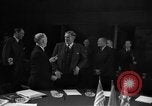
James F Byrnes, Anthony Eden and Vyacheslav Molotov gathered for Potsdam Conference in Potsdam, Germany during World War II.
Representatives of Allied nations gathered for Potsdam Conference at Schloss Cecilienhof Palace (Im Neuen Garten, 14469 Potsdam, Germany) in Potsdam, Germany during World War II. Interiors of the conference room. United States Secretary of States James Francis Byrnes speaks with Minister of War, Anthony Eden of Great Britain. He shakes hands with other representatives. Byrnes takes his seat at conference table. Soviet People's Commissar for Foreign Affairs Vyacheslav Mikhailovich Molotov enters and shake hands with Byrnes and staff. Representatives take their seats around the conference table. Document files kept on the table in front of them.
The Czech revolt to liberate city from German occupation and Czech President Benes returns after 7 years of exile in Prague.
Czechoslovakians fight for freedom in Prague uprising near the end of World War II. The Czechoslovakians revolt to liberate the city of Prague from German occupation. Civilians burn Nazi German flags. Police capture German ammunition. Armed civilians throw hand grenades and fire guns on streets at German forces. Explosions arise during the battle. Dead bodies of rebel civilians on streets. Czech police and citizens inspect the surrendered Germans. Civilians and defenders happily greet Soviet Army tanks as they enter the city following retreat of Germans. Men and women collaborators are marched through city streets toward incarceration in concentration camps. President of Czechoslovakia Edvard Benes disembarks a train. The President returns to Prague after 7 years of exile. An officer salutes the President. A large crowd of civilians gathered to greet the President. The President waves at the gathering from the balcony of a building.

Display of the model form of Venus probe space vehicle, Mariner 5 at the Jet Propulsion Laboratory in California.
Display of model form of NASA Mariner 5 in California. Scientists gather at the Jet Propulsion Laboratory. They receive and analyze data from the actual Mariner 5 Venus probe space vehicle which differs from Soviet findings. Display of the model form of Mariner 5. Narrator indicates that Mariner 5 evaluates radioactivity and the potential of man landing on Venus.
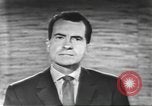
Kennedy and Nixon present their views about a summit conference during a presidential election debate in Washington DC.
The second Kennedy-Nixon Presidential Debate in Washington DC, United States. Alvin Spivak of United Press International asks Republican candidate U.S. Vice President Richard M Nixon about the possibility of occurrence of a summit conference after the presidential elections. Nixon states his willingness as the President to meet Soviet Premier Nikita Khrushchev or any other world leader if it would serve the cause of peace. He states that another summit conference will lead to negotiations at the diplomatic level and hamper peace. He concludes that he would hold another summit conference only after some preparation and assurance from Khrushchev that he wanted something meaningful from the conference. Democratic candidate Senator John F Kennedy states that before any summit conference the United States should build its military as well as economic strength. He talks about U.S. commitment to Berlin. He concludes and says that he agrees with Nixon statement in not meeting Mr. Khrushchev unless there were some agreements at the secondary level- foreign ministers and ambassadors - which would indicate that the meeting would have some hope of success, or a useful exchange of ideas.
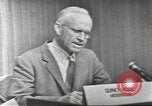
Vice President Nixon talks about Communist influence in the Western Hemisphere prior to presidential elections in the U.S.
The fourth presidential election debate held between Democratic nominee Senator John F. Kennedy and Republican nominee U.S. Vice President Richard Nixon in New York, United States on 21st October 1960. ABC news correspondent Quincy Howe speaks during the fourth Kennedy-Nixon presidential debate. He speaks that the candidates would answer and comment upon questions put by these four correspondents: Frank Singiser of Mutual News, John Edwards of ABC News, Walter Cronkite of CBS News and John Chancellor of NBC News. Frank Singiser puts the first question to Vice President Nixon. He asks Nixon the way he would handle Fidel Castro's regime and prevent establishment of Communist governments in the Western Hemisphere and why his policy is better for peace and security of the United States in the Western Hemisphere. Nixon answers that Senator Kennedy's policies and recommendations for the handling of Castro regime are dangerously irresponsible recommendations that he's made during the course of this campaign. Nixon speaks that what Senator Kennedy recommends is that the U.S. government should give help to exiles and to those within Cuba who oppose Castro regime, provided they are anti-Batista. Nixon says the United States have five treaties with Latin America, including the one setting up the Organization of American States in Bogota in 1948, in which the U.S. has agreed not to intervene in the internal affairs of any other American country. He further says that if the U.S. follows recommendations of Senator Kennedy then the country would probably be condemned in the United Nations and it would result in an open invitation to Soviet Premier Nikita Khrushchev to come into Latin America and to engage the U.S. in a civil war. He speaks about quarantining Cuban Prime Minister Fidel Castro by cutting off trade and diplomatic relations with Cuba.
CRITICALPAST.COM: About Us | Contact Us | FAQs - How to Order | License Agreement | My Account | My Lightboxes | Shopping Cart | Advanced Search | Featured Collections | Website Terms & Conditions | Privacy Policy ©2026 CriticalPast LLC.
License Agreement |
Terms & Conditions |
Privacy Policy
©2026 CriticalPast LLC.