


 Francais
 Deutsch
 Italiano
Refine Your Search
Stalingrad Russia Soviet Union 1943 stock footage and images
- Showing 2689 to 2694 of 5654 results more
more Hide
Hide
Heinrich Himmler and other German officers visit a camp near Minsk, Belarus.
German leader Heinrich Himmler visits a camp near Minsk Belarus during German occupation of Belarus in World War 2. He is accompanied by other German officers. Several men stand on stairs of a building. German officers stand in a line. Heinrich Himmler meets and talks to them. Several men stand on a balcony. Heinrich Himmler waves to them. His car leaves the area. Heinrich Himmler stops the car and talk to people, including a young boy, working in fields. The car moves on a road. Buildings in the background. He arrives at Minsk Ghetto. Wire fencing on the boundaries of the camp. The prisoners sit on the other side of wiring. He tours the camp area. (World War II period).
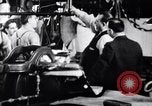
U.S. Labor strife - strikes and lockouts in the clothing industry in the 1920s
Post-World War 1 United States marked by labor-management strife and strikes, especially in the garment industry. Clothing workers are seen busy at their jobs in a factory in New York City. A man is seen symbolically closing and locking a steel door (narrative refers to a company "lockout.") Footage of police officers and crowd of laborers on New York City street. Police try to maintain order as crowds fill garment district streets in protest. Montage of persons awaiting a June 1921 decision by the Supreme Court of the State of New York, Kings County. Narrator announces that Justice James C. Van Siclen, has granted an injunction (against all picketing by the Amalgamated Clothing Workers of America). Narrator quotes Van Siclen's opening statement in the decision: "The court must stand at all times as the representative of capital, of the captains of industry..." View of Sidney Hillman, leader of the Amalgamated union (ACWA) sitting with other union members. View of a bustling New York City street lined with tenements and pushcarts in the lower east side of Manhattan. A man washing his face at a sink. A woman preparing a meal over a stove. Four children sharing a large bed. A gathering of idled clothing workers in a school room setting. Some in art classes. Dancers entertaining locked out workers. Young people presenting a puppet show. Narrator states that the lockout lasted 6 months, but the union prevailed. View of pleased union members.
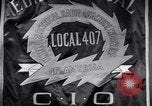
Pairs of American and British workers on exchange visits meet workers at American cities across the country
Logo of United Electrical, Radio, and Machine Workers Union Local 407 in New Jersey is shown. Narrator says it it one of the places a group of 4 English and 4 American Working men were to see on their exchange visit to America. View of their luggage The group is seen examining a map of the United States as they plan to make their visits in pairs to save time. They decide that each British worker would visit the hometown of an American counterpart. One pair leaves to visit Bethlehem, Pennsylvania. The pick up their luggage. Another pair are going to Detroit, Michigan. They pick up their luggage. The third pair is going to St. Louis, Illinois. They pick up their luggage. The final pair are going to Los Angeles, California. They pick up the last remaining pieces of luggage. One pair of workers is seen entering the Chrysler plant in Detroit. The American was welcomed home to America from his trip to England. View inside the plant of an African American woman working beside an older man, where they were making tank and marine engines. The visitors examine the gang drill presses containing multiple drills operated by a single operator. They stop to say hello to the American's daughter who also works at the plant, checking to assure parts met tolerances. It was noted that she was paid the same as any man doing the job. The pair of visitors are met at the American's home by some company union workers. They sit together on the step outside the house and get acquainted. An infant inside the house looks out the window at them. Scene shifts to Los Angeles where another English-American visiting pair is seated outdoors and the wife of the American brings out some bottles of beer for them to all share. Change of scene shows the pair visiting the offices of the Screen Actors Guild in Hollywood, where they meet celebrities Edward Arnold, George Murphy, Dick Powell, Alan Hale, Jane Wyman, Helen Hayes and Lena Horne. Edward Arnold, President of the Guild's Board, speaks with the pair, alone explaining how every actor in Hollywood belongs to the Guild which is affiliated with the America Federation of Labor (AFL). Arnold shows the pair his union card. Closeup of the card.
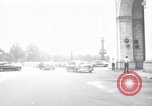
U.S. President Harry Truman in an award ceremony of USO (United Service Organizations)
President Truman's limousine arrives at the Union Station in Washington, DC, United States. U.S. President Harry Truman participates in an award ceremony of USO (United Service Organizations). A banner reads 'USO' . President Harry Truman presents awards an Army Sergeant and a Wave. The award recipients lead others in taking refreshments from a long table set up in the portico of the Union Station. A woman wearing armband reading 'USO' helps serve the guests. A sailor, a woman Marine, and a soldier, sit on a sofa and read magazines in the USO room of the Union Station. Three soldiers sit on a sofa and enjoy their refreshments.
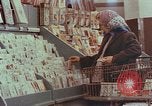
People select groceries and other items from supermarket shelves in the late 1950s, in Yonkers New York.
Interior of a suburban American supermarket or grocery store called the Grand Union Food-O-Mat, located in the Cross County Shopping Center in Yonkers, New York. A woman stands beside her cart or trolley and looks at greeting cards in a rack. View of a person's hand choosing a can of soup from shelves filled with soup cans including many by Campbell's Soups. Views of various products being lifted from the shelves by hands of shoppers, including Ivory Snow detergent, Cream of Wheat cereal, Minute Rice, Tapioca pudding, Bon Ami cleanser, Blue Cheer, Quaker Oats instant oatmeal, French's Instant Mashed Potatoes, Progresso canned tomatoes. Each time, a new item slides into place via gravity fed shelving which the Grand Union termed the Food-O-Mat. A young boy helps his mother choose plastic cups. A child wearing a winter coat walks to an end cap and lifts a giant box of Tide laundry detergent powder. Camera pans by plastic wrapped meats in the butcher section of the store that Grand Union called the Meateria.
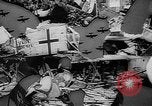
Scenes of Germany during period from 1919 to 1938 showing military resurgence and territorial expansion
Germany's military resurgence from the end of World War I through its reoccupation of the Rhineland in 1936 and union with Austria in 1938. German war materiel piled up in scrap yards and aircraft engines being destroyed in accordance with the Treaty of Versailles after World War 1. Smoke stacks of war plants being toppled, aircraft hangars being destroyed, and warships being scuttled. German postwar armored cars for training. A soldier flexes the rubber gun barrel on one of them. French forces, including Colonials, occupying Coblenz (Koblenz) in accordance with the Treaty of Versailles, after World War I. French soldiers on guard at the railroad station as a train pulls in. French colonial troops tending to their horses. A British soldier standing guard in front of a building displaying a placard with the Union Jack and word:"General Headquarters, British Army of the Rhine, No.1 Building." French troops stationed in front of their headquarters and patrolling fences across railroad tracks at their occupational boundary. A large film slate announcing that the Rheinland is again free, followed by scenes of German troops re-occupying the Rhineland in 1936. Local citizens cheer the troops, who parade through a city and along the banks of the Rhein River. German sentries posted at The "Deutsche Eck" in Koblenz beside the monument of Kaiser Wilhelm I. Sign demarking boundary of Austria. Border guards opening the gates and German troops entering as crowds cheer. Adolf Hitler speaking before a huge crowd,immediately following the Anschluss (union of Germany with Austria) on 12 March 1938.
CRITICALPAST.COM: About Us | Contact Us | FAQs - How to Order | License Agreement | My Account | My Lightboxes | Shopping Cart | Advanced Search | Featured Collections | Website Terms & Conditions | Privacy Policy ©2026 CriticalPast LLC.
License Agreement |
Terms & Conditions |
Privacy Policy
©2026 CriticalPast LLC.