


 Francais
 Deutsch
 Italiano
Refine Your Search
Stalingrad Russia Soviet Union 1943 stock footage and images
- Showing 2761 to 2766 of 5654 results more
more Hide
Hide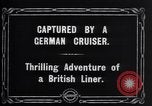
British steamship 'Galician' is stopped at sea by German cruiser off the Canary Islands, in World War I
Slate reads: "The Union Castle Steamship, 'Galician' from Capetown to Southhampton, was on August 15th, when off Teneriffe, signalled to stop by the German Cruiser, 'Kaiser Wilhelm Der Grosse.' Next slate reads: "The 'Kaiser Wilhelm der Grosse,' had been transformed from a liner, whilst at sea, six heavy guns and 24 machine guns being mounted." A brief view from the "Galician" of the German four-stacker auxiliary cruiser, "Kaiser Wilhelm Der Grosse." The next slate reads: "Bearing down on the 'Galician' at a speed of 24 knots, the cruiser signalled to the liner to 'Heave To.' The marconi operator sent out the 'S.O.S.' distress signal and the cruiser ordered 'Cease communication or we will sink you." Two officers photographed on deck of the "Galician." View of the Cruiser near the "Galician." Boat carrying German boarding party arrives at the ship and they climb the ladder to board. A German sailor seen aloft at the "Galician's" mast, disabling her marconi wireless antenna. A torn white ensign (missing a canton) flies from the mast. Captain and officers of the "Galician" pose for photographer (marconi operator). Slate lists British military personnel aboard, who were taken as prisoners of war. One of them is photographed. The German boarding party leaves the ship taking their prisoners with them. The German Cruiser seen departing. Civilian passengers and crew aboard the "Galician," pose celebrating their relative good fortune.
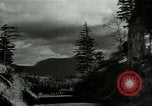
American landscape views 1930s; contributions of U.S. soldiers in the history and development of the USA.
The involvement of the American soldier in the history and growth of the United States from early 1900s until roughly 1938 before World War 2. Views of western United States countryside and mountain areas, including Mount Hood in Oregon, as seen from a slow moving car or other vehicle on a roadway. Wide, expansive landscape views in the U.S. Two Confederate and one Union uniformed veteran soldiers of the American Civil War walk together in the Arlington National Cemetery, in Virginia. U.S. Army soldiers marching at a an Army base, likely early 1930s, and wearing World War 1 era helmets. U.S. Army soldiers marching in a parade in Washington DC with U.S. Capitol in the background. Views of cities and towns in which U.S. Army posts were established, in the United States. Wide view of downtown Colorado Springs, Colorado, with Antlers Hotel in the distance and Pikes Peak in the far distance. Next shot is an unidentified downtown main street in the U.S. 1930s, followed by a scene of an industrial plant with a large water tower and snow covered low mountains in the distance. Next scene is the San Francisco skyline in the 1930s with the Bay Bridge in the far distance. Army troops and cavalry creating trails and paths, and eventually railroads, in wilderness areas of the United States. A railroad locomotive approaching beside the camera position at high speed, and then passing by pulling train cars. View of the Presidio Army Base and the Golden Gate Bridge, California. Subtle references to U.S. Army accomplishments, including curbing Mississippi River floods (Corps of Engineers) and conquering Yellow Fever (Army Doctor Walter Reed). Point of view (POV) shot from moving railroad train in a Colorado canyon; a side wheeler River boat on the Mississippi River; a sugar cane field in Cuba. View of locks in the Panama Canal. Statue of World War I soldiers.

Protestant Theologian Dr. Paul Tillich, in New York City, addresses a anti-Nazi gathering at Madison Square Garden.
A huge crowd gathered in Madison Square Garden. An unseen speaker (likely Theologian Reinhold Niebuhr) criticizes the efforts of Prime Minister Chamberlain, of Britain, to appease Hitler. Featured Speaker, Dr. Paul Tillich, of Union Theological Seminary, addresses the crowd. He talks about the forced emigration of German Jews because of their religious and political beliefs. Cameramen record the event. An orchestra is seated on stage behind the speaker as if ready to perform. Professor Tillich discusses the attack on Jewish people in Germany and equates it to attacks on Christians. The crowd applauds.
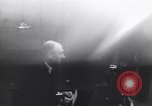
Dr Harry F. Ward, chairman of the American League Against War and Fascism, calls for a boycott on German international commerce
A mass gathering of concerned Americans in Madison Square Garden, New York City, following news of the Kristallnacht attacks on Jews in Germany a few weeks prior. Dr. Harry F. Ward of Union Theological Seminary, and chairman of the American League Against War and Fascism, addresses a huge crowd. He speaks about the emigration of the German Jewish citizens. He states that efforts should be made for the resettlement of the German Jews and the cost should be born by the Nazi German Government. The Government should make some arrangements in this regard. He proposes a boycott of all German International commerce. The crowd applauds.
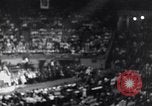
Ninth National Convention of the Communist Party, New York City. Earl Browder and theme"Against hunger fascism war"
Ninth National Convention of the Communist Party USA in New York City, June 24 -38, 1936. The theme as seen in outsize banners included a huge likeness of Earl Browder displaying the words: "Against Hunger Fascism War" and a banner around the hall reading in part: "forward to Unity..." The activities seen are like any major political party convention, including having placards identifying delegates from all the States of the Union, such as Georgia, Virginia,Iowa,West Virginia, Kentucky, Maryland, District of Columbia,Oregon, etc. Lights sweep over the darkened arena highlighting the signs of the various states. Several scenes show massed flags of the Communist Party displaying the hammer and Sickle on a solid field.
New Yorkers in Manhattan march against Germany and Nazis
20,000 New York residents dressed in traditional Czechoslovakian clothing march in streets of Manhattan in an Anti Nazi Parade against invasion of Czechoslovakia by Hitler and Nazi Germany, early in World War 2. Men,women and children of all ages hold hands and Allied flags are seen. Banners saying "Jesus not Hitler", "Keep America open for refugees", "Strong union...democracy" and many others can be seen. An overhead view of the parade gathered at Columbus Circle.
CRITICALPAST.COM: About Us | Contact Us | FAQs - How to Order | License Agreement | My Account | My Lightboxes | Shopping Cart | Advanced Search | Featured Collections | Website Terms & Conditions | Privacy Policy ©2026 CriticalPast LLC.
License Agreement |
Terms & Conditions |
Privacy Policy
©2026 CriticalPast LLC.