


 Francais
 Deutsch
 Italiano

Refine Your Search
Stalingrad Russia Soviet Union 1943 stock footage and images
- Showing 2923 to 2928 of 4682 results more
 Hide
Color Sound
United States Army troops communicate with field telephones in the front (WW2)
'Your Job in the Signal Corps' discusses the importance of communication lines in the army during World War II. A sign on the door of the office of a Major General. U.S. Major General H. G. Ingles, Chief Signal Officer speaks about the U.S. Army Signal Corps and their role in all the three divisions of army. Major General Ingles speaks from his office. A soldier on top of a moving tank. Tanks in a field. Mechanized units in a field during a war. The troops communicate from the field. U.S. Army Air Force aircraft in flight and view of pilot and copilot in cockpit. Bomb bay door opens. Soldier on aircraft operates bomb sight device. Bombs fall from bombers and hit the ground. Artillery is fired. A U.S. soldier reads a map and talks over a field phone. Gun crew fires artillery. Railway gun firing. U.S. Navy guns firing from ship. A boat lands on a beach head. Troops walk in a jungle. A soldier blows a whistle. Allied soldiers fire a bazooka on a moving German armored vehicle. Soldier sends a morse code transmission using a telegraph machine. A soldier calls with a telephone. Another soldier uses the radio for communication. Carrier Pigeons and rockets are also used to stay in touch. A hand fires a signal rocket. A messenger hand delivers a message. Officers making calls from their desks, field telephones and telephones on trees.
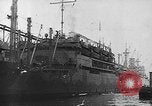
Infantry troops using field telephones; soldiers and civilian telephone operators connecting calls (WW2)
Communication equipment available to the United States Signal Corps in World War II. A ship at a port waits for freight to be brought aboard. Crates containing signal equipment from the United States Signal Corps at a dock. The freight is lowered. Bomber aircraft in flight. Infantry troops communicate from trenches and gun emplacements through telephone. An infantry soldier calls with field telephone. A soldier on the phone at an observation post. Soldiers and civilian telephone operators connecting calls on their switchboards. Men typing on typewriters. View of the U.S. Capitol in Washington DC. Animation shows communication to all parts of the world from the headquarters. Weathervanes and balloons of the Signal Corps. A man marks a weather report on a map at a station. Soldiers work with a landmine detector. A fighter plane takes off from an aircraft carrier. Soldiers moving artillery in a field.
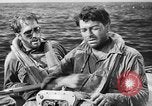
Different communication equipment used by units of the United States Army Signal Corps.
Communication means and equipment maintained and used by the U.S. Army Signal Corps during World War 2. Soldiers in a life boat use a hand cranked radio and an aircraft comes to rescue them. They wave at the aircraft. View of machines used for processing and printing V-Mail letters that are typed by machines and then delivered to soldiers. View of a soldier opening a small V-mail envelope and reading the note inside. Men and women work at various jobs in America in support of war production and war materiel. Men and women war production workers assembling various pieces of electronic equipment and radio devices. Men and women in large, busy clerical and administrative offices supporting typing and communications for the U.S. Army and military. Engineers work in a laboratory. A man loads a tube into a pneumatic message delivery system. Close up views of woman's hands on typewriter typing telegrams, letters, and messages. Women file clerks sort files. Technicians work on a telegraph machine. U.S. Army soldiers on a pole stringing communication wires. A soldier ties a wire on a tree. (World War II period).

Marshal Konstantin Rokossovskiy's Soviet forces cross river via wooden log bridge in Belorussia in World War II.
From a Russian film titled Srazhenie Za Gomel about the Battle of Gomel in World War 2. Position of Gomel on a map. Animated arrow shows movement of Soviet Marshal Konstantin Rokossovskiy's forces. Soldiers advance in a river. They use a small wooden raft to cross the river. Bomb explodes in a field. Russian soldiers fire machine gun. Soldiers cross river on a bridge. Soldiers run in hilly area. Artillery fired. Soldiers row boat. Artillery fired on the shore. Soviet T-34 medium tank crosses wooden bridge.
U.S. B-24 aircraft bomb targets in Japanese occupied Hanoi and Haipong, Indochina, during World War 2
U.S. Army Air Force B-24s bombing targets in Japanese-held areas of Indochina, during the Second World War. View of U.S. Army Air Force B-24 from waist gun position of another B-24. View from B-24 (below 10,000 feet) over an airfield. Waist gunner poses, without oxygen mask, at his machine gun (not firing). View from 17,500 feet as B-24s bomb a supply depot in Hanoi. Clouds of smoke rise from numerous bomb explosions. B-24s on mission to bomb Haiphong, Indochina. Aerial view of B-24 named "80 Days," with two dice (a Five and a Three) pictured under its name. Bombs falling from B-24s as they bomb smelting and foundry plants from 17,000 feet over port city of Haiphong. Smoke rising from targets.

U.S. supply and ammunition base in Munda, New Georgia Island in World War II.
Wreckage and debris in Munda, New Georgia Island, during World War 2. Workers clear field at Munda Point. Air Force construction team clear area using power shovel and road graders. Supply and ammunition base of the island. TBF planes taxi on runway. C-47 crew unload bomb carriers. Loaded bomb carriers move out towards flight line. Control Tower operators look at a P-39. It taxis and takes off. B-25 (Mitchell Bomber) makes forced belly landing.
CRITICALPAST.COM: About Us | Contact Us | FAQs - How to Order | License Agreement | My Account | My Lightboxes | Shopping Cart | Advanced Search | Featured Collections | Website Terms & Conditions | Privacy Policy ©2026 CriticalPast LLC.
License Agreement |
Terms & Conditions |
Privacy Policy
©2026 CriticalPast LLC.